What didn't I receive that I'm still looking for?
6 min read
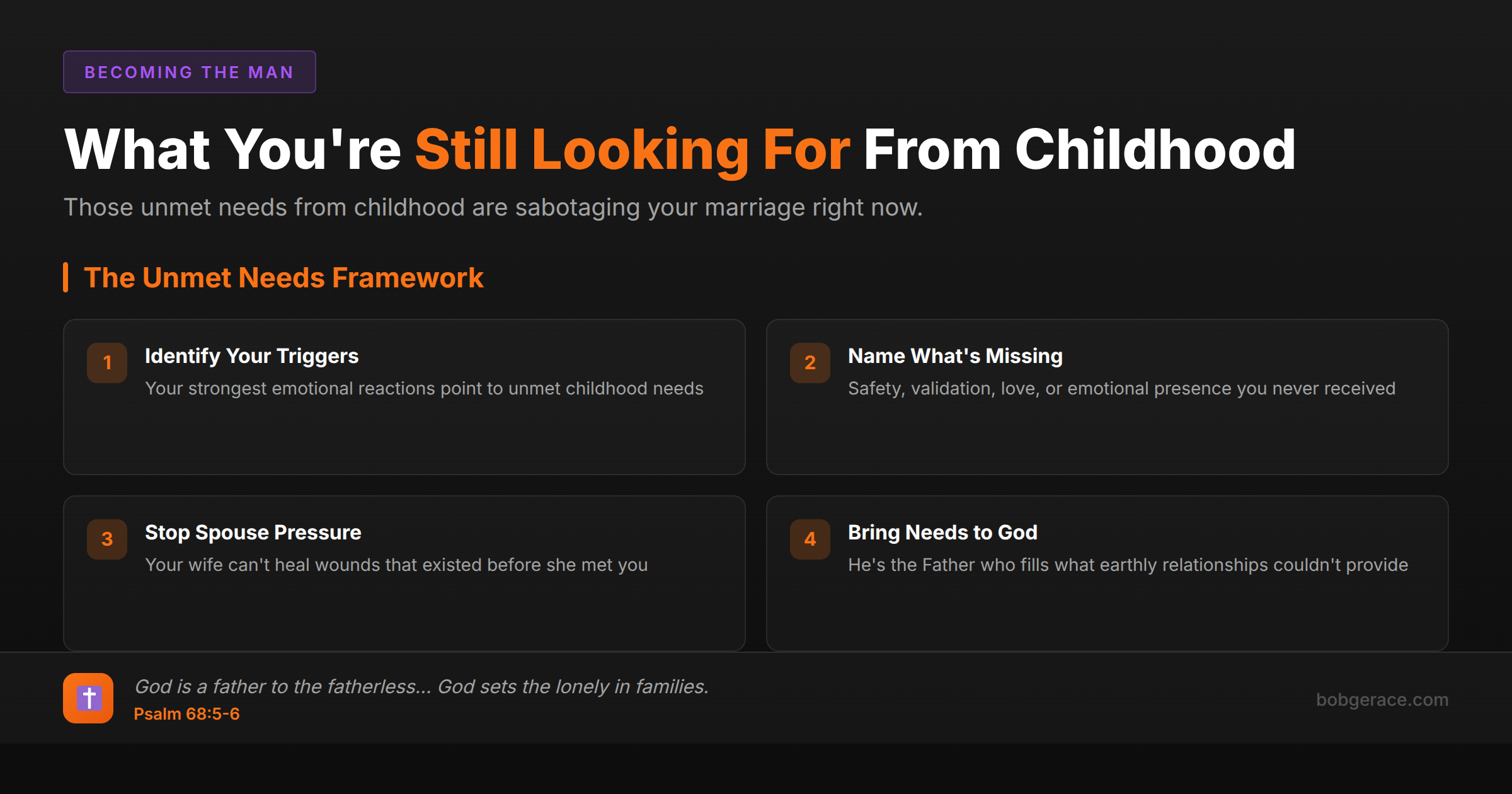
You're likely looking for the foundational needs every child deserves: unconditional love, safety, validation, and consistent emotional attunement. These core needs - when unmet in childhood - create deep longings that follow us into marriage. You might be seeking the security you never felt, the praise you rarely heard, or the emotional presence that was missing from key relationships. This isn't about blame or dwelling on the past. It's about understanding why certain triggers hit so hard and why you might feel desperate for your spouse's approval or devastated by their criticism. When we identify what we didn't receive, we can stop expecting our spouse to fill those childhood voids and start healing those wounds properly.
The Full Picture
Every child has fundamental emotional needs: to feel safe, loved unconditionally, seen and understood, valued for who they are, and equipped with healthy boundaries. When these needs aren't met consistently, we develop what I call "hungry spots" - areas of deep longing that never quite get satisfied.
The most common unmet needs include:
Emotional Safety - Growing up walking on eggshells around an unpredictable parent creates a desperate need for reassurance and stability. You might find yourself constantly scanning your spouse's mood, trying to prevent conflict at all costs.
Unconditional Love - If love felt conditional on performance, you're likely still performing, trying to earn your spouse's affection through people-pleasing, perfectionism, or overachieving.
Being Truly Seen - Children who were dismissed, minimized, or had their emotions invalidated often become adults who feel invisible in their marriage, desperately seeking acknowledgment and understanding.
Healthy Boundaries - Without proper modeling, you might struggle with either rigid walls or no boundaries at all, leading to either emotional distance or overwhelming enmeshment with your spouse.
Consistent Presence - Emotionally absent parents create adults who either become clingy and demanding or completely self-reliant, unable to truly let their spouse in.
The key insight? Your marriage isn't meant to be a rehabilitation center for your childhood. When we bring these unhealed needs into our relationship, we put impossible pressure on our spouse and create unhealthy dynamics that damage intimacy.
What's Really Happening
From an attachment perspective, we're dealing with what researchers call "internal working models" - unconscious blueprints formed in early relationships that shape how we approach intimacy as adults. These models operate below conscious awareness, driving behaviors and expectations in marriage.
When core needs weren't met consistently, the nervous system develops protective strategies. An anxiously attached individual might become hypervigilant to signs of rejection, while someone with avoidant attachment might shut down emotionally to prevent further hurt. These aren't character flaws - they're adaptive responses to early environments.
The neurobiological reality is that unmet attachment needs create actual changes in brain development, particularly in areas responsible for emotional regulation and interpersonal connection. This is why simply "trying harder" doesn't work - we're dealing with deeply embedded patterns.
However, the brain's neuroplasticity means these patterns can be rewired through corrective emotional experiences. This happens through secure relationships, including marriage, but only when we're conscious of our needs and working actively to heal rather than simply expecting our spouse to fill the void.
Recognizing what you didn't receive isn't about becoming a victim of your past - it's about developing the self-awareness necessary to break generational patterns and create the secure relationship you never experienced as a child.
What Scripture Says
God understands our deepest longings because He designed us for relationship - first with Him, then with others. The unmet needs from childhood point to spiritual truths about what our hearts truly crave.
Psalm 68:5-6 tells us that *"God is a father to the fatherless, a defender of widows, is God in his holy dwelling. God sets the lonely in families."* Even when earthly relationships fail us, God positions Himself as the ultimate source of what we needed but didn't receive.
Isaiah 49:15-16 reveals God's heart: *"Can a mother forget the baby at her breast and have no compassion on the child she has borne? Though she may forget, I will not forget you! See, I have engraved you on the palms of my hands."* The unconditional love and constant presence we craved is found perfectly in our relationship with God.
2 Corinthians 1:3-4 shows us the redemptive purpose in our pain: *"Praise be to the God and Father of our Lord Jesus Christ, the Father of compassion and the God of all comfort, who comforts us in all our troubles, so that we can comfort those in any trouble with the comfort we ourselves receive from God."*
Ephesians 3:17-19 describes what our hearts are ultimately seeking: *"That Christ may dwell in your hearts through faith. And I pray that you, being rooted and established in love, may have power... to know this love that surpasses knowledge - that you may be filled to the measure of all the fullness of God."*
The beautiful truth is that God can heal what was broken and provide what was missing, enabling us to love others from overflow rather than emptiness.
What To Do Right Now
-
1
Make a list of your strongest emotional reactions in marriage - what triggers hurt, anger, or desperation? These reactions often point to unmet needs.
-
2
Identify patterns from childhood: What did you crave but rarely receive? Safety, attention, validation, consistent love, or emotional presence?
-
3
Stop expecting your spouse to heal your childhood wounds. Have an honest conversation about how your unmet needs might be creating pressure in your marriage.
-
4
Begin bringing these needs to God in prayer, asking Him to be the ultimate source of what you're seeking rather than demanding it from your spouse.
-
5
Practice self-soothing techniques when triggered, recognizing that your adult self can provide comfort to the wounded child within.
-
6
Consider professional counseling to work through deep attachment wounds that may require more intensive healing than you can manage alone.
Related Questions
- What attachment style did I develop in childhood?
- What attachment injuries did I experience?
- What did I learn about love from my parents?
- What unmet needs from childhood am I still seeking?
- How do childhood attachment wounds show up in marriage?
- What is 'internal working model' and how do I change mine?
- What is anxious attachment and am I doing it right now?
- Why do I feel like I'm going to die if she leaves?
- What does 'protest behavior' look like and am I doing it?
- What attachment needs was the affair meeting?
Also find Bob on
Subscribe for weekly videos on Christian marriage.
Your Marriage Isn't Your Childhood
But untangling the two takes a coach who knows your actual story—not just the theory. Bring this to someone who can see what's specific about your triggers and your marriage.
Talk to Bob →