What does a comprehensive mental health assessment look like?
6 min read
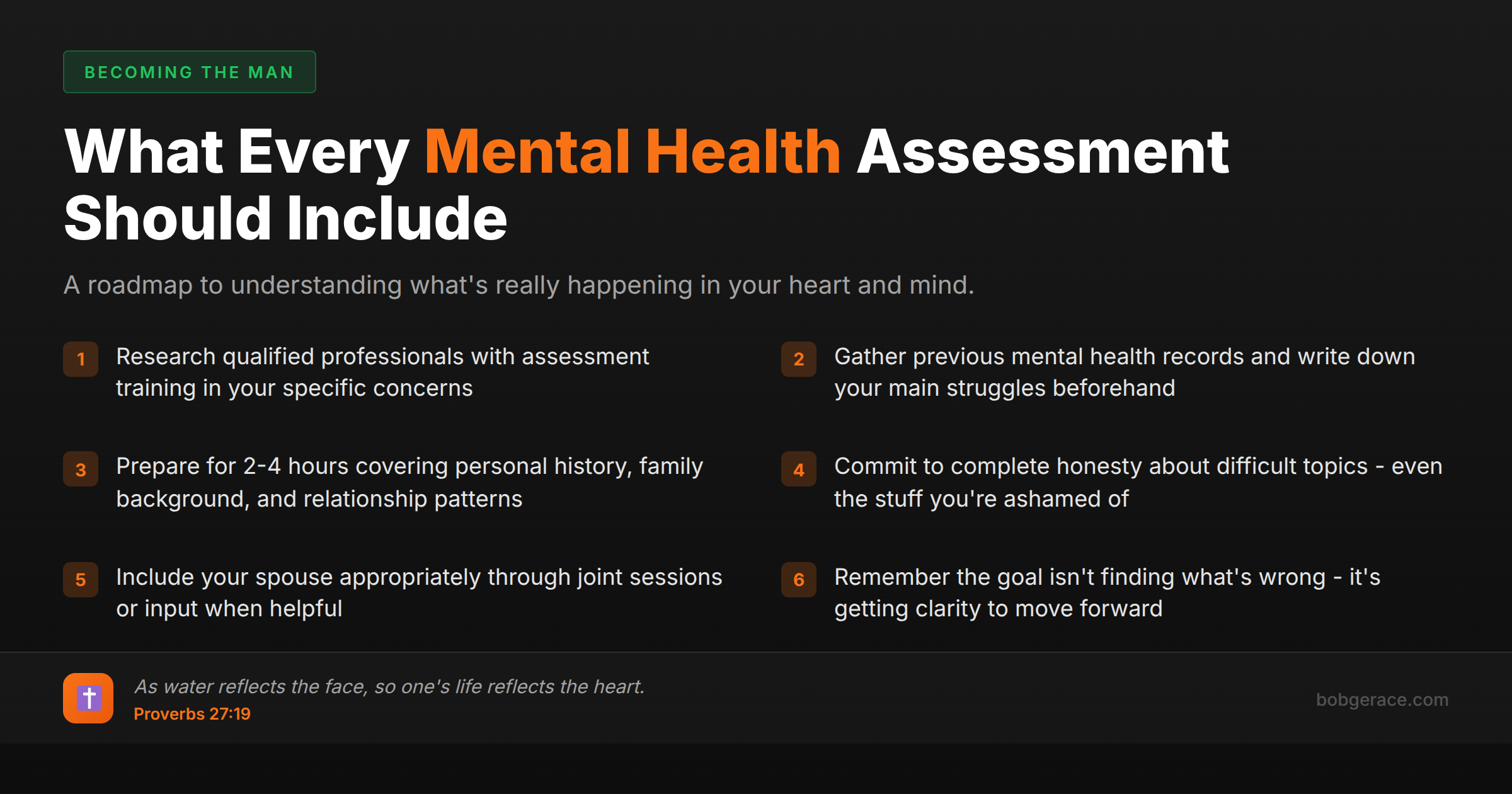
A comprehensive mental health assessment is a thorough evaluation that examines your psychological, emotional, and behavioral patterns to identify any underlying issues that might be affecting your marriage and relationships. It typically includes structured interviews, standardized questionnaires, and sometimes psychological testing to get a complete picture of your mental health. The process usually takes 2-4 hours and covers your personal history, family background, relationship patterns, current symptoms, and any previous mental health treatment. The goal isn't to find something wrong with you—it's to understand the full context of your struggles so you can get the right help and move forward with clarity and purpose.
The Full Picture
Think of a comprehensive mental health assessment like getting a complete physical for your emotional and psychological health. Just as a doctor runs various tests to understand what's happening in your body, a mental health professional uses specific tools and techniques to understand what's happening in your mind and heart.
The assessment typically includes several components:
Clinical Interview - This is usually the longest part, where the therapist asks detailed questions about your current concerns, symptoms, and how they're affecting your daily life and relationships. They'll want to know when problems started, what makes them better or worse, and how they impact your marriage.
Personal and Family History - Understanding your background helps identify patterns and potential contributing factors. This includes your childhood experiences, family mental health history, significant life events, trauma, and relationship patterns.
Standardized Questionnaires - These are research-backed tools that measure specific symptoms like depression, anxiety, ADHD, or relationship satisfaction. They provide objective data to complement the interview.
Mental Status Exam - The clinician observes your appearance, mood, thought processes, and cognitive functioning during your interaction.
Risk Assessment - This evaluates any immediate safety concerns and your overall level of functioning.
The entire process is collaborative. You're not being judged or diagnosed based on a few questions. Instead, you're working with a professional to understand the complete picture of your mental health and how it relates to your relationship struggles.
What's Really Happening
Many people come to assessment feeling anxious about being 'labeled' or having something fundamentally wrong with them discovered. In reality, comprehensive assessment is often the first step toward relief and clarity. When someone says they 'keep blowing it' in their marriage, there are usually identifiable patterns and contributing factors we can address.
During assessment, I'm looking for several key things: Are there underlying mood disorders like depression or anxiety that are affecting emotional regulation? Is there unresolved trauma creating triggers in the relationship? Are there attention or learning differences that impact communication? Is substance use a factor? Are there personality patterns that create relationship conflict?
I also pay attention to strengths and protective factors. What coping strategies have worked in the past? What motivates this person? How do they connect with their faith? What support systems exist?
The assessment process itself can be therapeutic. Many clients feel heard and understood for the first time when someone takes this comprehensive approach to their struggles. It validates that their problems are real and complex, not just a matter of trying harder or having more willpower.
Remember, the goal isn't to pathologize normal human struggles, but to identify treatable conditions that might be creating unnecessary barriers in your marriage. Sometimes just understanding why certain things are hard for you can dramatically shift how you and your spouse approach problems together.
What Scripture Says
Scripture affirms both the importance of seeking wisdom and understanding ourselves deeply. Proverbs 27:19 tells us, *'As water reflects the face, so one's life reflects the heart.'* A comprehensive assessment is essentially holding up a mirror to understand what's really happening in our hearts and minds.
Proverbs 18:13 warns us, *'To answer before listening—that is folly and shame.'* Good assessment requires deep listening—both from the clinician and from us about our own experiences. We can't address problems we don't fully understand.
Psalm 139:23-24 shows David's heart for self-examination: *'Search me, God, and know my heart; test me and know my anxious thoughts. See if there is any offensive way in me, and lead me in the way everlasting.'* This is essentially what happens in assessment—inviting God and trusted professionals to help us see ourselves clearly.
Proverbs 15:22 reminds us that *'Plans fail for lack of counsel, but with many advisers they succeed.'* Professional assessment provides the kind of wise counsel that can help our marriages succeed.
Romans 12:2 calls us to be *'transformed by the renewing of your mind.'* Sometimes this renewal requires understanding how our minds actually work and what might be hindering healthy thinking patterns.
God created us as complex beings with minds, bodies, and spirits that all interact. Seeking professional assessment isn't a lack of faith—it's stewarding the mind and heart God gave us by understanding them fully so we can love Him and others more effectively.
What To Do Right Now
-
1
Research qualified professionals - Look for licensed therapists with specific training in assessment and your areas of concern
-
2
Gather relevant information - Collect any previous mental health records, medications, and write down your main concerns before the appointment
-
3
Prepare mentally and spiritually - Pray for wisdom and commit to honesty during the process, even about difficult topics
-
4
Include your spouse appropriately - Discuss whether joint sessions or spouse input would be helpful (with proper boundaries)
-
5
Plan for follow-up - Understand that assessment leads to treatment recommendations, so be prepared to act on what you learn
-
6
Trust the process - Remember that understanding your struggles more deeply is the first step toward real change and healing
Related Questions
- What assessments would help me understand myself?
- What are markers that I need more than coaching?
- What is 'complex trauma' and do I have it?
- What role might ADHD/depression/anxiety play?
- What's the difference between therapy and coaching for me?
- Do I need therapy, coaching, or both?
- What is 'betrayal trauma' and do I have it?
- Is this PTSD?
- What therapies help with this kind of trauma?
- What is EMDR and could it help?
Also find Bob on
Subscribe for weekly videos on Christian marriage.
Bring Your Assessment Results to a Coach
Understanding what's happening inside you is step one. Applying it to your specific marriage—the fights, the patterns, the history between you two—is where a human coach makes the difference.
Talk to Bob →