What assessments would help me understand myself?
6 min read
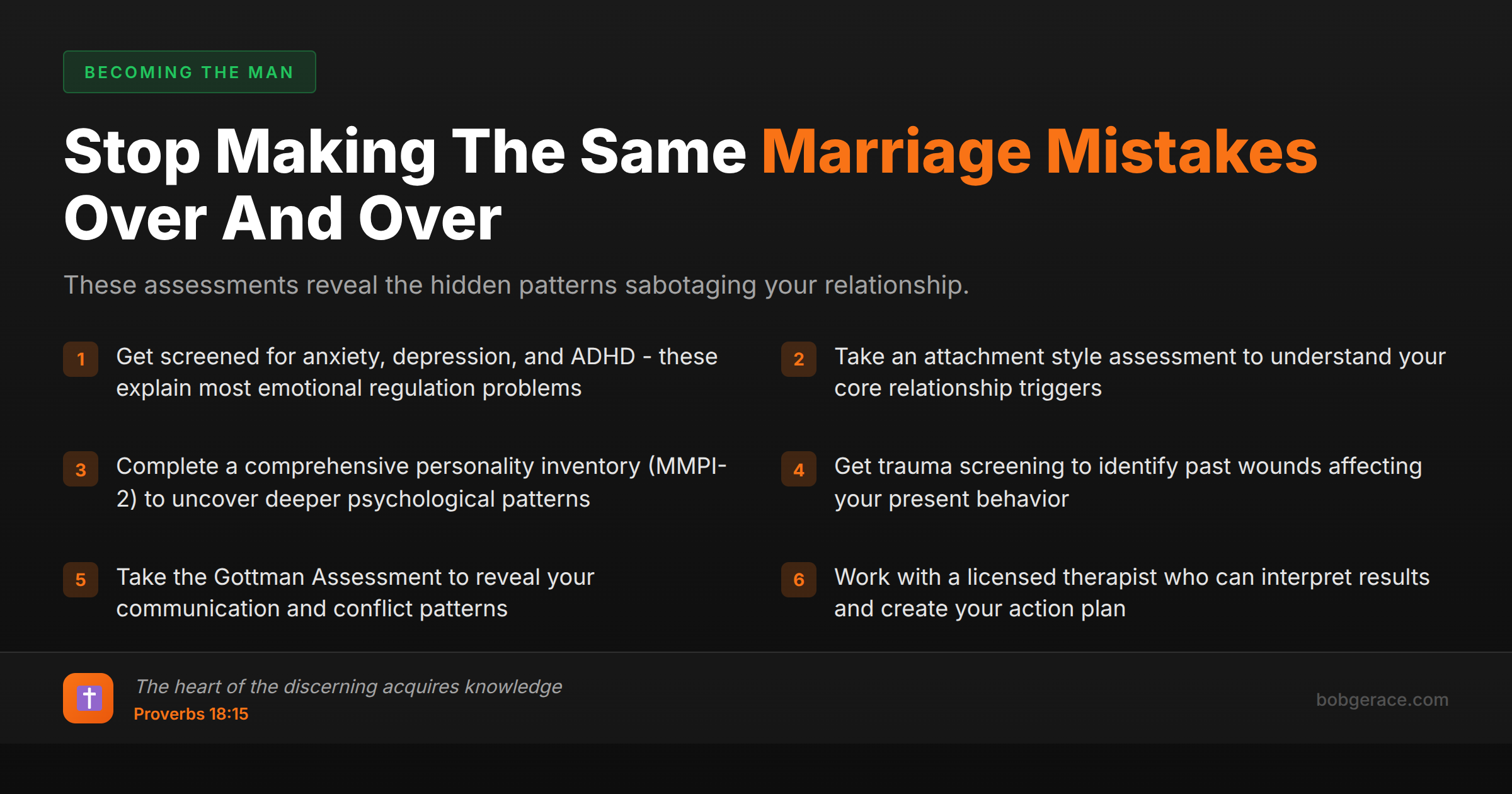
When you keep making the same mistakes in your marriage, professional assessments can be game-changers for understanding your patterns. The most helpful evaluations include attachment style assessments (revealing how you connect), the MMPI-2 or similar personality inventories (uncovering deeper psychological patterns), and trauma screenings that identify past wounds affecting your present behavior. I also recommend relationship-specific tools like the Gottman Assessment or Prepare/Enrich inventory, which highlight your communication styles and conflict patterns. Don't overlook practical assessments for ADHD, anxiety, or depression - these often-missed conditions can explain why you struggle with emotional regulation or follow-through in your marriage. The key is working with a qualified therapist who can administer these properly and help you understand what the results mean for your relationship.
The Full Picture
Self-awareness is the foundation of lasting change, but it's hard to see your own blind spots. That's where professional assessments become invaluable - they're like having a GPS for your inner world, showing you exactly where you are and mapping the route to where you want to be.
Attachment and Relationship Patterns Start with attachment style assessments like the Adult Attachment Interview (AAI) or Experiences in Close Relationships-Revised (ECR-R). These reveal how your early relationships shaped your current marriage patterns. If you're anxiously attached, you might pursue your spouse when they need space. If you're avoidant, you might shut down during conflict. Understanding your attachment style explains so much about why you "blow it" repeatedly.
Personality and Mental Health Comprehensive personality assessments like the MMPI-2 or PAI can uncover underlying mental health conditions affecting your marriage. Many people discover they have undiagnosed ADHD, anxiety disorders, or depression that explain their emotional reactivity or inability to follow through on commitments. The Myers-Briggs or Enneagram, while less clinical, can also provide helpful insights into your motivational patterns.
Trauma and Past Wounds Trauma screenings like the ACE (Adverse Childhood Experiences) questionnaire or PTSD assessments often reveal hidden wounds driving destructive behaviors. Childhood trauma, even "minor" incidents, can create triggers that explode in your marriage without warning.
Relationship-Specific Tools The Gottman Assessment analyzes your specific relationship dynamics, while tools like Prepare/Enrich focus on communication styles, conflict resolution, and shared values. These show you exactly where your relationship strengths and vulnerabilities lie.
What's Really Happening
From a clinical perspective, people who "keep blowing it" in marriage often have undiagnosed or undertreated psychological factors creating repetitive destructive patterns. Assessment isn't about labeling or pathologizing - it's about understanding the neurobiological and psychological mechanisms driving your behavior.
Attachment trauma is frequently at the root. When your early caregiving relationships were inconsistent, chaotic, or harmful, your nervous system develops hypervigilant or shutdown responses that activate during marital stress. You're not choosing to blow it - your brain is automatically triggering survival responses that worked in childhood but destroy adult intimacy.
Executive functioning deficits, often from undiagnosed ADHD or anxiety disorders, can also explain why you have good intentions but poor follow-through. Your prefrontal cortex - responsible for planning, impulse control, and emotional regulation - may be compromised, making it neurologically difficult to maintain consistent positive behaviors.
Personality disorders, particularly those in Cluster B (borderline, narcissistic, histrionic, antisocial), can create chronic relationship instability. However, even sub-clinical personality traits can significantly impact marriage dynamics. Understanding these patterns through proper assessment allows for targeted therapeutic interventions.
The key is comprehensive evaluation by qualified professionals who understand both individual psychology and relationship dynamics. Self-administered online tests have limited value - you need clinical interpretation to understand how your individual psychological makeup specifically impacts your marriage and what interventions will be most effective for your unique situation.
What Scripture Says
Scripture consistently calls us to self-examination and wisdom, making assessment a deeply biblical practice. Proverbs 27:5-6 reminds us that "Better is open rebuke than hidden love. Wounds from a friend can be trusted, but an enemy multiplies kisses." Professional assessment provides that trusted "wound" - honest feedback that reveals areas needing growth.
Proverbs 18:15 tells us "The heart of the discerning acquires knowledge, for the ears of the wise seek it out." Seeking professional assessment demonstrates the wisdom and discernment God calls us to pursue. It's not weakness - it's biblical stewardship of your marriage and emotional health.
Jesus himself practiced deep self-awareness and regularly withdrew for self-reflection. Luke 5:16 shows us "But Jesus often withdrew to lonely places and prayed." Assessment is a structured form of this self-examination, helping you understand your patterns, triggers, and growth areas through a professional lens.
Psalm 139:23-24 should be every spouse's prayer: "Search me, God, and know my heart; test me and know my anxious thoughts. See if there is any offensive way in me, and lead me in the way everlasting." Professional assessment is one way God answers this prayer, revealing blind spots and patterns you can't see on your own.
Proverbs 15:22 reminds us that "Plans fail for lack of counsel, but with many advisers they succeed." Professional assessors provide the expert counsel needed to understand complex psychological and relational dynamics. Finally, James 1:5 promises that "If any of you lacks wisdom, you should ask God, who gives generously to all without finding fault." God often provides this wisdom through trained professionals who can help you understand yourself more deeply.
What To Do Right Now
-
1
Find a licensed therapist or psychologist experienced in both individual and couples therapy who can administer comprehensive assessments
-
2
Start with basic screenings for anxiety, depression, ADHD, and trauma - these often-missed conditions explain many marriage problems
-
3
Complete an attachment style assessment to understand your core relationship patterns and triggers
-
4
Take a comprehensive personality inventory (MMPI-2, PAI, or similar) to identify underlying psychological factors affecting your marriage
-
5
If possible, complete a couples assessment like the Gottman or Prepare/Enrich with your spouse to understand your specific relationship dynamics
-
6
Schedule a feedback session with your assessor to create an action plan based on your results - assessment without application is worthless
Related Questions
- What is 'family of origin' work?
- What attachment style did I develop in childhood?
- What are markers that I need more than coaching?
- Do I have a personality disorder?
- What role might ADHD/depression/anxiety play?
- What's the difference between therapy and coaching for me?
- What is 'betrayal trauma' and do I have it?
- What is 'alexithymia' and do I have it?
- What is limerence?
- What does a comprehensive mental health assessment look like?
Also find Bob on
Subscribe for weekly videos on Christian marriage.
Get a Coach Who Knows Your Story
Assessments show patterns. A coach helps you apply them to your actual marriage—the fights you're having, the wounds that keep reopening, the specific ways you shut down or blow up.
Talk to Bob →