What does discernment require?
6 min read
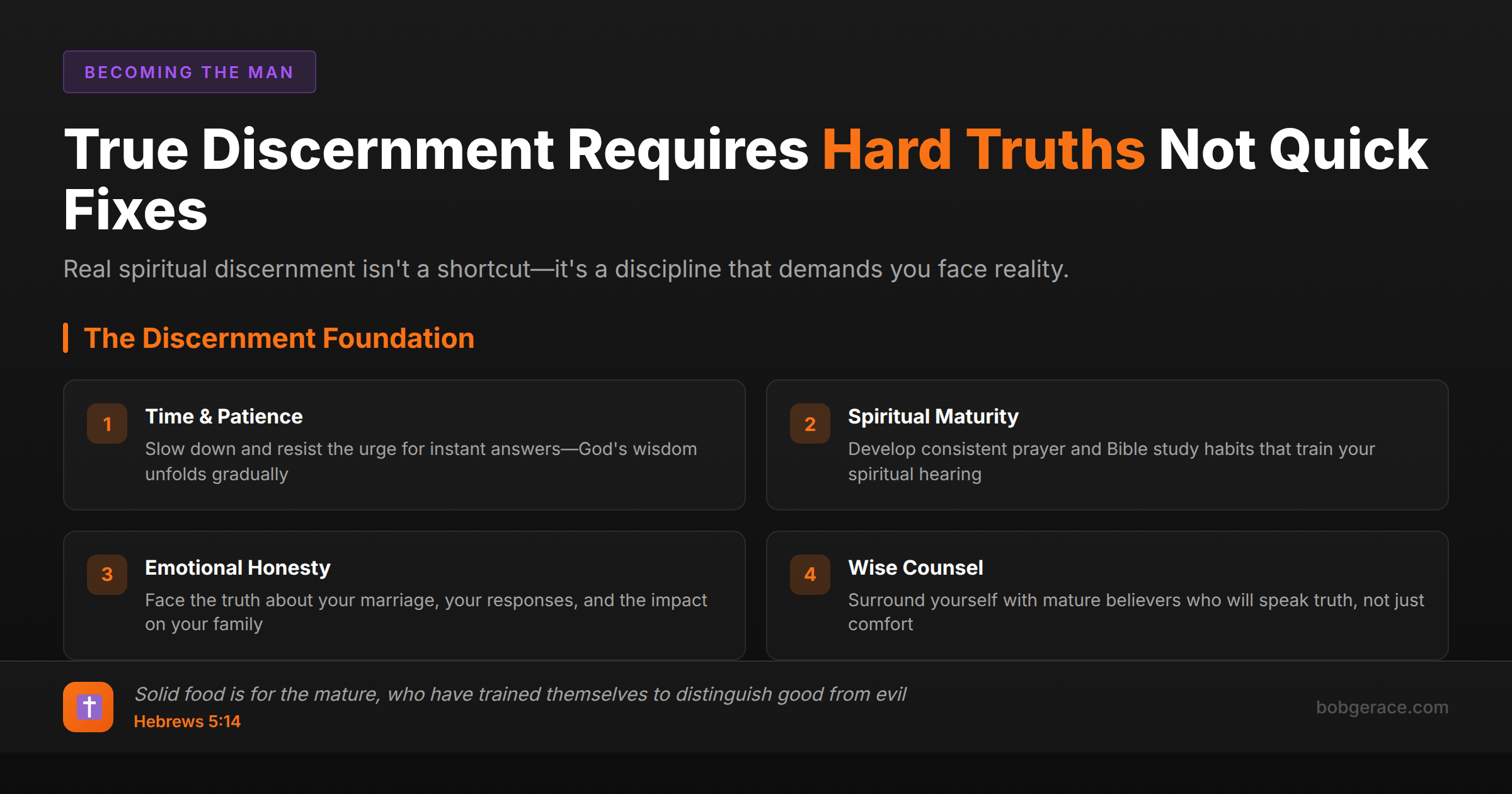
Discernment requires time, spiritual maturity, and a willingness to hear hard truths. It's not a quick decision-making tool, but a deep spiritual practice that demands you slow down and listen—to God, to wise counsel, and to the Holy Spirit's prompting in your heart. True discernment also requires emotional honesty about your situation. You can't discern clearly while in denial about your marriage's realities. It demands that you face the truth about your husband's behavior, your own responses, and the impact on your children and future. This process isn't comfortable, but it's necessary for making decisions that align with God's heart and protect what He values most.
The Full Picture
Discernment is not intuition or wishful thinking—it's a disciplined spiritual practice that requires specific conditions to flourish. Many wives confuse discernment with their natural desire to hope for the best or avoid difficult decisions. Real discernment cuts through these emotional clouds to reveal God's perspective.
First, discernment requires space and silence. You cannot hear God's voice clearly while managing constant crisis, walking on eggshells, or drowning in emotional chaos. This is why creating physical and emotional distance from toxic patterns is often the first step in developing discernment. Some wives need to literally remove themselves from their daily environment to gain clarity.
Second, it requires spiritual input beyond your own understanding. Discernment grows through regular Bible study, prayer, fasting, and seeking counsel from mature believers who aren't afraid to tell you hard truths. It's not about finding people who agree with what you want to hear—it's about surrounding yourself with godly wisdom that challenges your assumptions.
Third, discernment demands that you examine your own heart and motives honestly. Are you seeking God's will, or confirmation of your fears? Are you looking for permission to leave, or courage to stay? Are you trying to control outcomes, or surrender to God's timing? The process of discernment often reveals as much about our own spiritual condition as it does about our circumstances.
Finally, discernment requires patience with God's timing. Some wives want instant clarity about complex situations that have developed over years. God's wisdom often unfolds gradually as you prove faithful in small steps of obedience.
What's Really Happening
From a clinical perspective, discernment requires what we call 'metacognitive awareness'—the ability to think about your thinking. Women in difficult marriages often develop survival mechanisms that actually interfere with clear decision-making: hypervigilance, emotional numbing, or cognitive distortions that minimize serious problems.
True discernment requires neurological calm. When your nervous system is constantly activated by stress, fear, or trauma responses, the prefrontal cortex—responsible for executive decision-making—literally goes offline. This is why many women report feeling confused or unable to think clearly while living in chaotic marriages. You cannot discern well from a place of chronic stress.
Discernment also requires what I call 'emotional differentiation'—the ability to separate your feelings from facts, your fears from God's truth, and your desires from His will. Many women struggle with this because they've been taught to prioritize others' needs over their own inner wisdom, or they've been gaslit into questioning their own perceptions.
Additionally, research shows that discernment improves when we have what psychologists call 'cognitive flexibility'—the ability to consider multiple perspectives and outcomes without becoming overwhelmed. This skill develops through practices like journaling, therapy, spiritual direction, and honest conversation with trusted friends. The goal isn't to eliminate uncertainty, but to become comfortable making faithful decisions despite incomplete information.
What Scripture Says
Scripture consistently links discernment with spiritual maturity and disciplined seeking after God's heart. Proverbs 27:14 reminds us that *"But solid food is for the mature, who by constant use have trained themselves to distinguish good from evil."* This training takes time and practice.
James 1:5-6 provides the foundational promise for discernment: *"If any of you lacks wisdom, you should ask God, who gives generously to all without finding fault, and it will be given to you. But when you ask, you must believe and not doubt, because the one who doubts is like a wave of the sea, blown and tossed by the wind."* Notice that receiving wisdom requires both asking and believing—active faith, not passive hoping.
Proverbs 15:22 emphasizes the communal aspect of discernment: *"Plans fail for lack of counsel, but with many advisers they succeed."* God rarely gives wisdom in isolation. He confirms His direction through multiple sources: His Word, prayer, circumstances, and godly counsel.
1 Kings 19:11-12 shows us that God's voice often comes not in dramatic signs, but in *"a gentle whisper."* This is why discernment requires quietness and patience. You must create space to hear what God is saying beyond the noise of crisis and emotion.
Philippians 1:9-10 reveals God's heart for our discernment: *"And this is my prayer: that your love may abound more and more in knowledge and depth of insight, so that you may be able to discern what is best."* God wants you to discern what is truly best—not just what's easiest or most comfortable, but what aligns with His perfect will for your life and family.
What To Do Right Now
-
1
Create daily space for prayer and Bible reading away from distractions—even 15 minutes of consistent quiet time will begin developing your spiritual hearing
-
2
Start a discernment journal where you record prayers, Scripture verses that speak to your situation, and patterns you notice over time
-
3
Identify 2-3 mature Christian women who can speak truth into your life and aren't afraid to challenge your thinking—schedule regular conversations with them
-
4
Practice fasting one day per week specifically to seek God's wisdom about your marriage—use the hunger pangs as reminders to pray
-
5
Remove yourself physically from your normal environment for at least 24 hours to gain perspective—stay with family, go on a retreat, or simply spend a day in different surroundings
-
6
Ask God to reveal any ways you're avoiding truth or trying to control outcomes instead of surrendering to His will—confess what He shows you
Related Questions
- How do I discern God's will for my marriage?
- How do I distinguish my desires from God's direction?
- How do I hear God when I'm in crisis?
- What role does Scripture play in discernment?
- What role does wise counsel play?
- How do I separate fear from wisdom?
- How do I make this decision?
- What factors should I weigh?
- How do I separate hope from denial?
- What if godly people disagree on what I should do?
Also find Bob on
Subscribe for weekly videos on Christian marriage.
Discernment Is Harder in Your Own Marriage
A coach who knows your story can help you see what you can't see alone—and hear what God might be saying through the noise.
Talk to Bob →