What does healthy self-respect look like right now?
6 min read
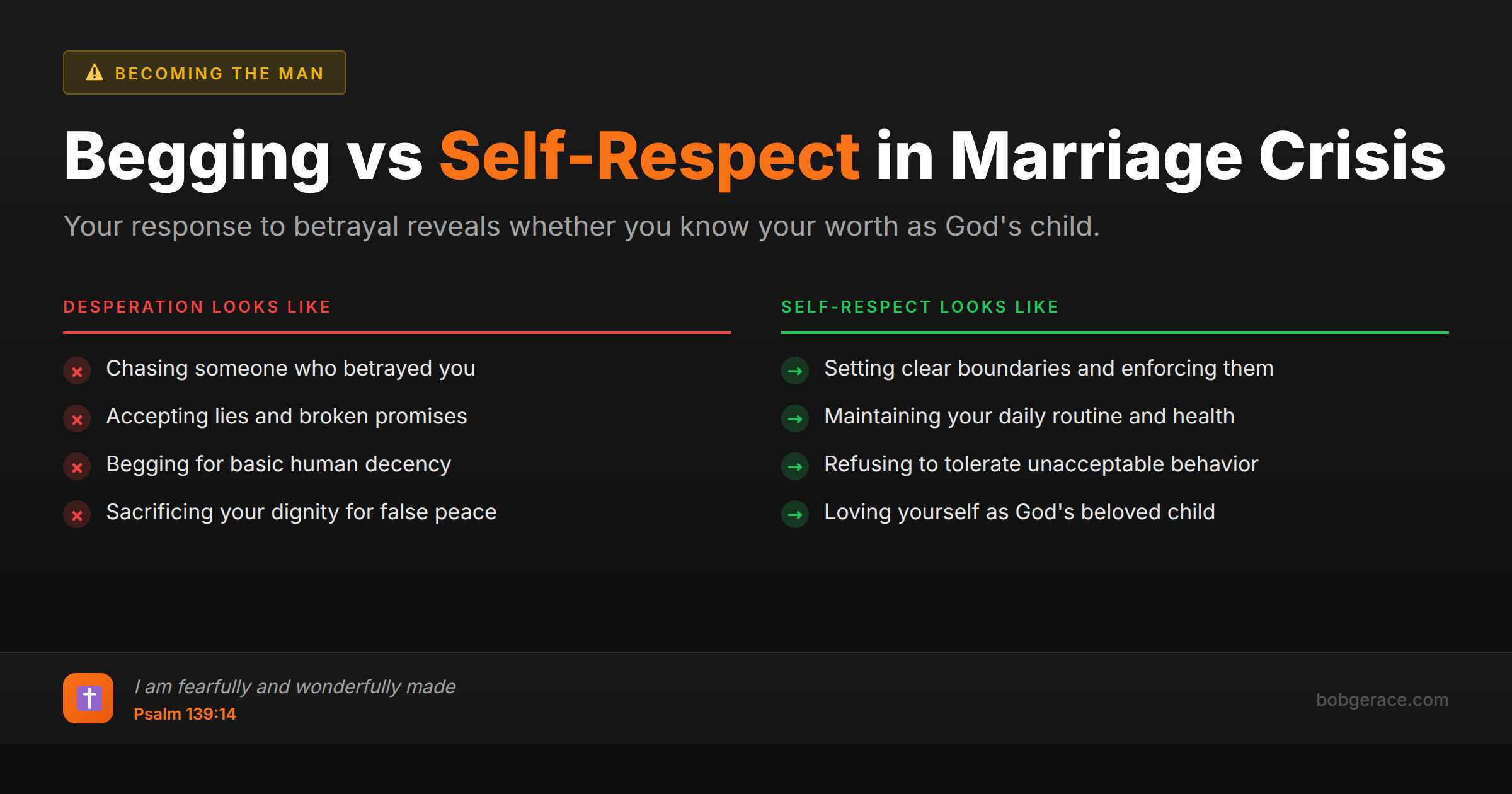
Healthy self-respect during a marriage crisis means maintaining your dignity while refusing to accept unacceptable behavior. It's not about pride or retaliation - it's about knowing your worth as God's beloved child and acting accordingly. Right now, this looks like setting clear boundaries about what you will and won't tolerate, taking care of your physical and emotional needs, and refusing to beg or chase someone who's betraying your marriage. You can love your spouse while still protecting yourself from further harm. Self-respect means recognizing that you deserve honesty, faithfulness, and basic human decency - and that accepting less doesn't help anyone, including your spouse.
The Full Picture
When your spouse is involved with another person, your sense of self can feel completely shattered. You might find yourself doing things you never thought you would - checking phones obsessively, pleading for attention, or accepting treatment you'd never tolerate from anyone else. This isn't weakness; it's a trauma response to having your world turned upside down.
But here's what many people miss: losing your self-respect during this crisis actually makes reconciliation less likely, not more. When you consistently accept disrespectful treatment, you're inadvertently teaching your spouse that their behavior has no real consequences. You're also modeling for your children (if you have them) what marriage looks like.
Healthy self-respect isn't about being cold or punitive. It's about maintaining your dignity while still leaving room for genuine repentance and restoration. It means you can grieve, you can hurt, you can even fight for your marriage - but you do it from a position of strength, not desperation.
This balance is crucial because respect is the foundation of any healthy relationship. If you don't respect yourself, it becomes nearly impossible for your spouse to respect you either. And without mutual respect, even if the affair ends, you'll likely find yourself in a marriage that feels hollow and unsatisfying.
The goal isn't to become hardened or defensive. It's to become someone who knows their worth and acts accordingly - someone who can extend grace from a position of strength rather than fear.
What's Really Happening
From a clinical perspective, what we're seeing is a complex interplay between attachment trauma and self-preservation instincts. When infidelity occurs, it triggers our deepest attachment wounds - the fear of abandonment that lives in all of us at some level.
The natural response is often what we call 'protest behaviors' - pursuing, pleading, monitoring, and accepting increasingly poor treatment in hopes of preventing abandonment. But these behaviors, while understandable, often push the unfaithful spouse further away and reinforce their justifications for the affair.
Healthy self-respect during this time requires what we call 'secure attachment behaviors.' This means maintaining connection where possible while also protecting your own emotional safety. You're essentially communicating: 'I value our relationship, but I value myself enough not to accept abuse.'
Neurologically, when we act with self-respect - setting boundaries, maintaining our routines, refusing to engage in degrading behaviors - we're actually helping our brain move out of survival mode. This allows for clearer thinking and better decision-making, which you desperately need right now.
It's also worth noting that self-respect often triggers respect from others, including your spouse. When you demonstrate that you won't accept poor treatment, you're more likely to receive better treatment. This isn't manipulation - it's healthy relationship dynamics at work.
What Scripture Says
Scripture is clear about our inherent worth and dignity, which forms the foundation for healthy self-respect. Psalm 139:14 reminds us, *'I praise you because I am fearfully and wonderfully made; your works are wonderful, I know that full well.'* This isn't about pride - it's about recognizing the truth of who God created you to be.
1 Corinthians 6:19-20 tells us, *'Do you not know that your bodies are temples of the Holy Spirit, who is in you, whom you have received from God? You are not your own; you were bought at a price. Therefore honor God with your bodies.'* This includes refusing to allow others to dishonor what God has called sacred.
Jesus himself modeled healthy boundaries and self-respect. In Matthew 10:14, He instructed His disciples: *'If anyone will not welcome you or listen to your words, leave that home or town and shake the dust off your feet.'* Even in ministry, there were limits to what treatment He would accept.
Ephesians 5:29 reminds us that *'no one ever hated their own body, but they feed and care for their body, just as Christ does the church.'* Self-care and self-respect aren't selfish - they're biblical. You're called to steward the life God has given you well.
The balance comes in Matthew 5:39 where Jesus talks about turning the other cheek - but notice He doesn't say to keep offering your face for repeated slapping. Grace has boundaries, and love doesn't mean accepting ongoing abuse.
What To Do Right Now
-
1
Stop begging or chasing - If your spouse is choosing another person, give them the space to feel the full weight of that choice without you pursuing them.
-
2
Maintain your daily routine - Continue showering, eating well, exercising, and taking care of your responsibilities. This preserves your dignity and mental health.
-
3
Set clear boundaries - Decide what behavior you will and won't accept, then communicate these boundaries calmly and enforce them consistently.
-
4
Don't accept breadcrumbs - Refuse to be grateful for minimal attention or effort. You deserve full commitment, not leftover scraps of attention.
-
5
Seek support from others - Connect with trusted friends, family, or a counselor who can remind you of your worth when you forget.
-
6
Focus on what you can control - Pour your energy into your own growth, healing, and well-being rather than trying to control your spouse's choices.
Related Questions
- What boundaries should I set?
- What's the difference between boundary and ultimatum?
- How do I set boundaries without controlling?
- How do I be warm without being a doormat?
- How do I stay connected while enforcing boundaries?
- Should I give her space or fight for her?
- What does it mean to love without grasping?
- How do I honor her autonomy while fighting for us?
Also find Bob on
Subscribe for weekly videos on Christian marriage.
Your Marriage Needs Your Specific Story
Self-respect in crisis isn't a formula—it's calibrated to what's actually happening in your home. A coach who knows your situation can help you hold the line without losing yourself.
Talk to Bob →