What if I make the wrong choice?
6 min read
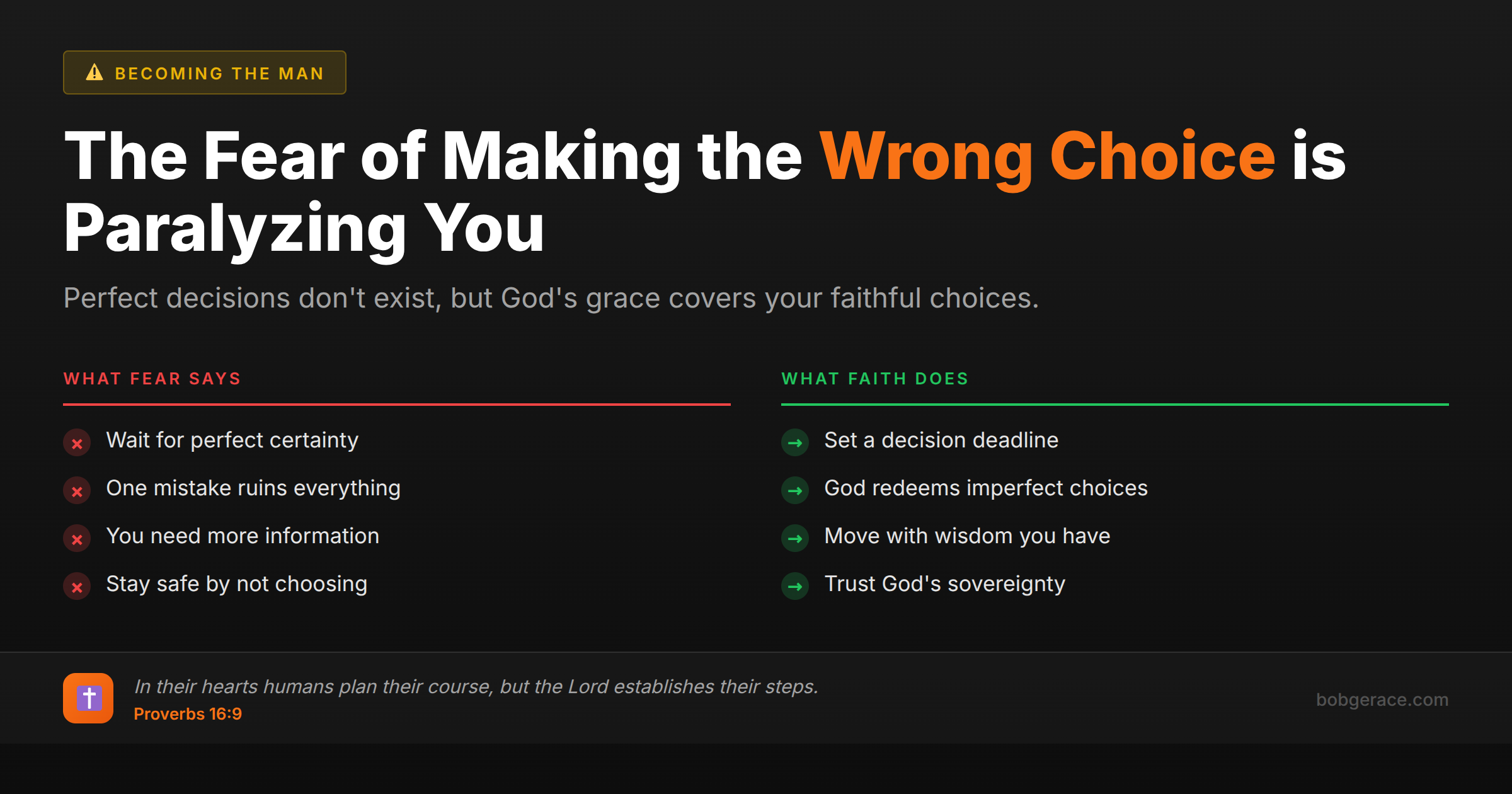
The fear of making the wrong choice can paralyze you, but here's the truth: God's grace is bigger than your mistakes. Perfect decisions don't exist, and waiting for certainty that never comes is itself a choice that keeps you stuck. What matters more than making the "perfect" choice is making a faithful choice with the information and wisdom you have right now. God can work through imperfect decisions made with sincere hearts seeking His will. The goal isn't to avoid all mistakes—it's to move forward in faith, trusting that God's sovereignty covers your human limitations and that He can redeem even your missteps for His purposes.
The Full Picture
The fear of making the wrong choice is one of the most paralyzing emotions you can experience, especially when it comes to major life decisions about your marriage, career, or family. But this fear often reveals a deeper issue: the belief that you must be perfect and that God's plan for your life is so fragile that one wrong turn will derail everything.
Here's what's really happening: You're operating under the myth of the "perfect path"—the idea that there's one exactly right choice and everything else leads to disaster. This perfectionist thinking creates analysis paralysis, where you research endlessly, seek advice from everyone, and still feel no closer to certainty.
The reality is that most significant decisions involve trade-offs and unknowns. You're not choosing between perfect and imperfect options—you're choosing between different imperfect paths, each with their own challenges and opportunities. The question isn't whether you'll make mistakes; it's whether you'll let fear of mistakes keep you from moving forward at all.
Consider this: staying stuck in indecision IS a choice. When you refuse to decide because you might be wrong, you're actually choosing the status quo, which may be slowly killing your spirit, your relationships, or your calling. Sometimes the "wrong" choice that moves you forward is infinitely better than the "safe" non-choice that keeps you trapped.
God's sovereignty means He can work through your imperfect decisions. He's not sitting in heaven wringing His hands when you make a less-than-optimal choice. He's already factored your human limitations into His eternal plan. Your job is to seek wisdom, pray for guidance, counsel with wise advisors, and then step forward in faith.
What's Really Happening
From a psychological perspective, the fear of making wrong choices often stems from what we call "decision anxiety" and perfectionist cognitive patterns. This creates a cycle where the fear of imperfection leads to avoidance, which increases anxiety and makes future decisions even more overwhelming.
What I see clinically is that people who struggle with decision-making often have underlying beliefs about control and catastrophic thinking. They believe they must control outcomes perfectly and that any wrong choice will lead to disaster. This is particularly common in individuals who experienced unpredictable environments growing up or who received conditional love based on performance.
The neurological reality is that our brains are wired to perceive uncertainty as threat. When facing major decisions, your amygdala (fear center) can hijack rational thinking, making every option seem dangerous. This is why you might feel physically anxious when trying to make important choices—your body is responding to perceived threat.
Healthy decision-making involves accepting uncertainty as part of life. Research shows that people who make satisfying life decisions don't necessarily make "better" choices—they make choices and then commit to making them work. They practice what psychologists call "post-decision commitment" rather than endless rumination about alternatives.
The therapeutic goal isn't to eliminate the possibility of wrong choices, but to build tolerance for uncertainty and confidence in your ability to adapt and course-correct. Most decisions are reversible or adjustable. Very few life choices are truly permanent, and even permanent choices can lead to growth and redemption you couldn't have imagined.
What Scripture Says
Scripture doesn't promise that you'll never make mistakes, but it does promise that God's sovereignty covers your imperfect decisions when your heart is seeking Him.
Proverbs 16:9 reminds us: *"In their hearts humans plan their course, but the Lord establishes their steps."* This verse beautifully balances human responsibility with divine sovereignty. You're called to plan and choose wisely, but God ultimately directs your path—even through your imperfect choices.
Romans 8:28 provides incredible comfort: *"And we know that in all things God works for the good of those who love him, who have been called according to his purpose."* Notice it says "all things"—including your mistakes, your less-than-perfect choices, and your human limitations. God specializes in bringing good from imperfect situations.
Proverbs 3:5-6 gives us the framework for decision-making: *"Trust in the Lord with all your heart and lean not on your own understanding; in all your ways submit to him, and he will make your paths straight."* The promise isn't that you'll choose perfectly, but that as you trust God, He will make your paths straight—even the crooked ones.
James 1:5 offers hope for those who feel they lack wisdom: *"If any of you lacks wisdom, you should ask God, who gives generously to all without finding fault, and it will be given to you."* God doesn't withhold wisdom because you've made poor choices before. He gives generously and without reproach.
Jeremiah 29:11 provides ultimate perspective: *"'For I know the plans I have for you,' declares the Lord, 'plans to prosper you and not to harm you, to give you hope and a future.'"* God's good plans for you aren't derailed by your imperfect human choices.
What To Do Right Now
-
1
Gather wisdom, then set a decision deadline - Seek counsel, pray, research, but give yourself a specific timeframe to decide. Information gathering without action is procrastination.
-
2
List what you know vs. what you fear - Write down facts versus anxious projections. Often fears are based on imagined worst-case scenarios, not actual data.
-
3
Consider the cost of not choosing - What happens if you stay stuck in indecision for another six months or year? Sometimes this clarifies that imperfect action beats perfect inaction.
-
4
Make the choice that aligns with your values and calling - Choose based on who God has called you to be, not just on avoiding potential problems.
-
5
Commit to making your choice work - Instead of second-guessing, invest your energy in making your decision successful. Most choices become "right" through commitment and effort.
-
6
Trust God's sovereignty over your limitations - Release the need for perfect control and trust that God can work through your human, imperfect, but faithful choices.
Related Questions
- How do I make this decision?
- What factors should I weigh?
- How do I separate fear from wisdom?
- How do I separate hope from denial?
- How do I live with uncertainty?
- What does discernment require?
- What if godly people disagree on what I should do?
- How do I hear God when I'm in crisis?
- Should I give her space or fight for her?
Also find Bob on
Subscribe for weekly videos on Christian marriage.
You Don't Have to Figure This Out Alone
A coach who knows your marriage can help you see what faithful looks like in your specific situation—not a formula, but clarity for the choice in front of you.
Talk to Bob →