What is 'amygdala hijack' and how do I interrupt it?
6 min read
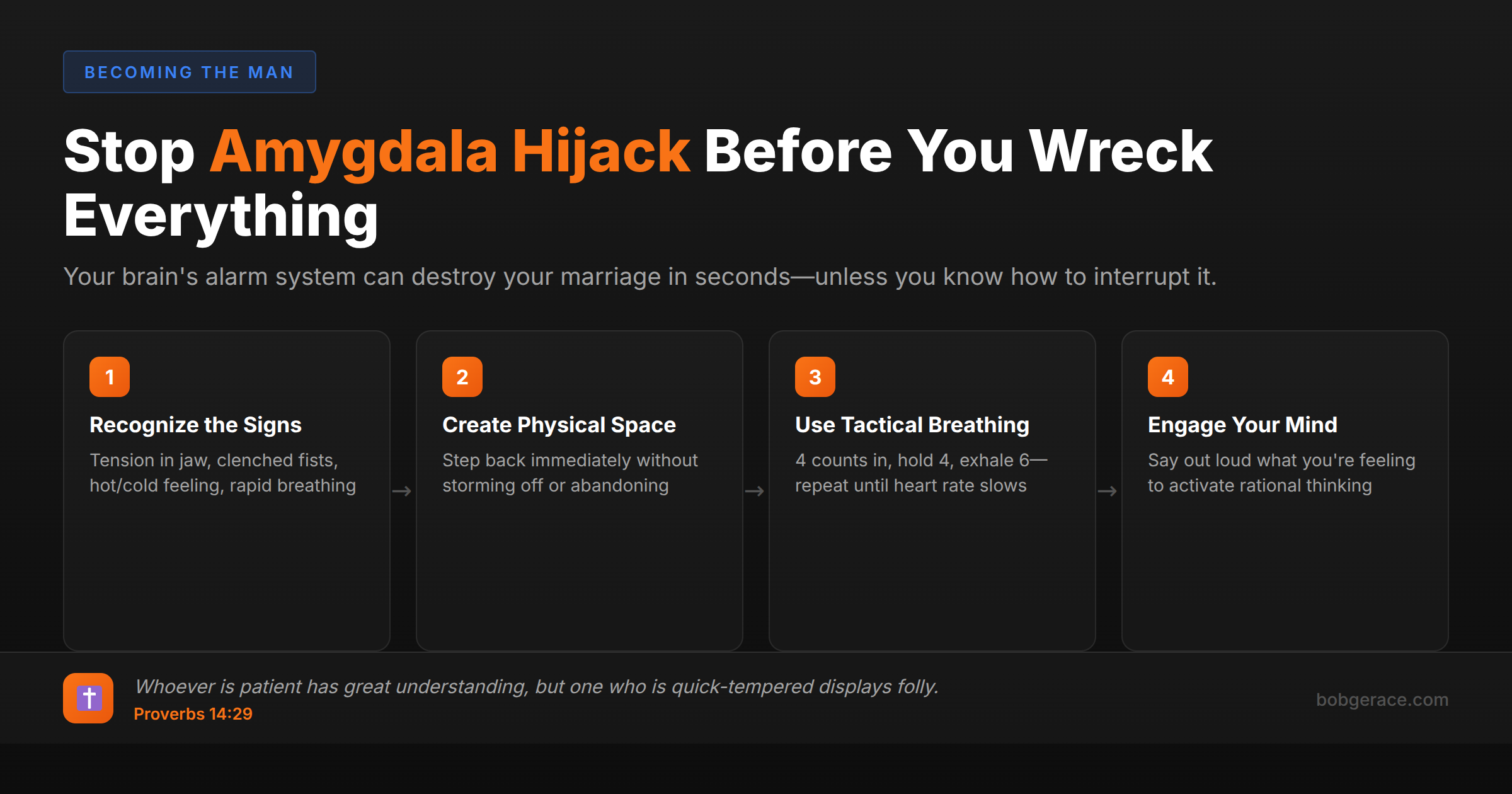
Amygdala hijack is when your brain's alarm system (the amygdala) takes control before your rational mind can respond, flooding your body with stress hormones and triggering fight-or-flight responses. This happens in milliseconds, often leaving you saying or doing things you later regret. To interrupt it, you need to create space between the trigger and your response. The moment you feel anger rising, immediately slow your breathing, take a step back physically, and engage your prefrontal cortex by naming what you're feeling. This neurological 'pause' gives your rational brain time to come back online and make better choices.
The Full Picture
Your amygdala is designed to keep you alive. When it perceives a threat – real or imagined – it hijacks your entire nervous system in about 200 milliseconds. That's faster than conscious thought.
Here's what happens during amygdala hijack:
The Physical Process: - Stress hormones flood your system - Heart rate spikes - Blood flow shifts away from your prefrontal cortex - Your body preps for physical action - Rational thinking goes offline
Why It Happens in Marriage: Your spouse's tone, facial expression, or words can trigger your amygdala just like a physical threat would. Your brain doesn't distinguish between a saber-toothed tiger and perceived rejection or criticism.
The Real Problem: Once hijacked, you're operating from a 200,000-year-old survival system that doesn't care about your marriage, your values, or your long-term happiness. It only cares about immediate survival.
The Good News: While you can't prevent the initial hijack, you can learn to interrupt it quickly. The key is recognizing the early warning signs and having a plan ready.
Common Triggers in Marriage: - Feeling dismissed or ignored - Perceived criticism or judgment - Threats to your autonomy - Financial stress conversations - Discussions about past hurts
Understanding this process removes shame and gives you back control.
What's Really Happening
From a neurological perspective, amygdala hijack represents a complete override of your executive functioning. The amygdala, roughly the size of two almonds, has direct connections to every major system in your body and can initiate responses before information even reaches your conscious awareness.
What makes this particularly challenging in marriages is that emotional intimacy actually increases amygdala sensitivity. The closer we are to someone, the more our nervous system monitors them for signs of threat or safety. This evolutionary mechanism helped our ancestors survive, but in modern relationships, it can create unnecessary conflict.
The interruption process involves activating your parasympathetic nervous system and re-engaging your prefrontal cortex. Deep breathing is effective because it stimulates the vagus nerve, which signals safety to your brain. Physical movement helps metabolize stress hormones. Naming emotions activates language centers in your prefrontal cortex, essentially talking your amygdala down from high alert.
Research shows it takes 20-90 minutes for stress hormones to fully clear your system after activation. This is why the 'cooling off' period isn't just good advice – it's neurological necessity. Trying to resolve conflict while your amygdala is still activated often makes things worse.
The goal isn't to eliminate emotional responses but to create enough space for choice in how you respond.
What Scripture Says
God understands how He designed us, including our neurological responses to threat and stress. Scripture consistently calls us to pause, reflect, and respond wisely rather than react impulsively.
Proverbs 14:29 teaches us, *"Whoever is patient has great understanding, but one who is quick-tempered displays folly."* This isn't just moral instruction – it's recognition that quick reactions often come from our most primitive brain systems.
James 1:19-20 provides the perfect framework: *"My dear brothers and sisters, take note of this: Everyone should be quick to listen, slow to speak and slow to become angry, because human anger does not produce the righteousness that God desires."* The progression – listen first, speak carefully, manage anger – mirrors exactly what neuroscience tells us about interrupting amygdala hijack.
Proverbs 16:32 reminds us that *"Better a patient person than a warrior, one with self-control than one who takes a city."* Self-control isn't weakness – it's strength. It's choosing to engage your God-given capacity for wisdom over your automatic reactions.
Ephesians 4:26-27 acknowledges that anger happens: *"In your anger do not sin: Do not let the sun go down while you are still angry, and do not give the devil a foothold."* Notice it doesn't say don't get angry – it says don't sin in your anger and don't let it linger.
God gave you both your amygdala and your prefrontal cortex. Using the tools to manage both honors His design for your life and marriage.
What To Do Right Now
-
1
Learn your early warning signs: tension in jaw, shoulders, or chest; changes in breathing; feeling hot or cold; clenched fists
-
2
Practice the 5-4-3-2-1 technique: Name 5 things you see, 4 you can touch, 3 you hear, 2 you smell, 1 you taste
-
3
Use tactical breathing: Inhale for 4 counts, hold for 4, exhale for 6, repeat until your heart rate slows
-
4
Create physical space immediately: Step back, sit down, or move to another room without storming off
-
5
Engage your prefrontal cortex: Say out loud 'I'm feeling angry because...' or count backwards from 100 by 7s
-
6
Return to the conversation only after you can speak calmly and think clearly, even if that takes 30 minutes
Related Questions
- What's happening in my brain when I rage?
- What is the 'rage circuit' and how do I rewire it?
- What does chronic anger do to my nervous system?
- What is 'window of tolerance' and how do I widen mine?
- How do I stay in prefrontal cortex during conflict?
- How do I widen the gap between stimulus and response?
- What's happening to my nervous system right now?
- What is 'hypervigilance' and why am I doing it?
- How do I regulate when my body is in fight-or-flight?
- What does 'window of tolerance' mean and why am I outside it?
Also find Bob on
Subscribe for weekly videos on Christian marriage.
Ready to apply this in your marriage?
Knowing the neuroscience is one thing. Doing it when your wife says the thing that sets you off is another. A coach helps you map this to your actual triggers and patterns.
Talk to Bob →