What is redemption of my story?
6 min read
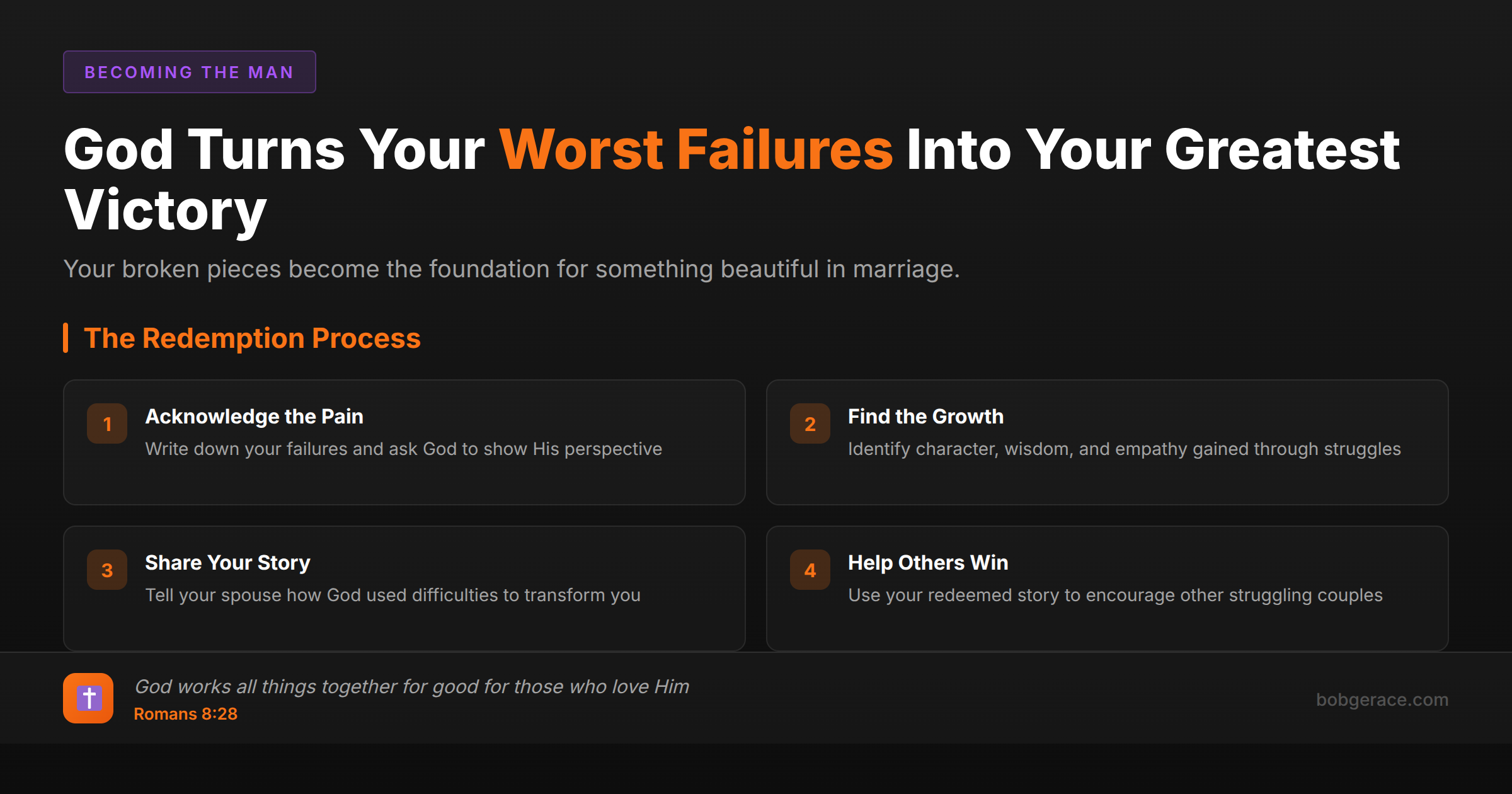
Redemption of your story means God takes your failures, mistakes, and broken pieces and weaves them into something beautiful and purposeful. It's not about erasing your past or pretending your failures didn't happen. Instead, redemption transforms your story from one of defeat into one of victory, from shame into testimony, from brokenness into wholeness. In marriage, this means your worst moments don't define you or doom your relationship. God specializes in taking the very things that seem to disqualify us and using them as the foundation for something greater. Your redeemed story becomes a source of strength, wisdom, and hope - not just for you, but for others walking similar paths.
The Full Picture
Your story isn't over, even when it feels like you've written the worst possible chapter. Redemption is God's specialty - taking what looks like a complete disaster and turning it into something that serves His purposes and your good.
Think about it this way: every great story has conflict, failure, and moments where everything seems lost. The hero faces seemingly insurmountable odds, makes terrible mistakes, and appears defeated. But that's not where the story ends. The best stories are about comeback, restoration, and triumph over adversity.
Your marriage story is no different. The fights, the betrayals, the seasons of distance, the harsh words, the broken promises - these aren't the end of your story. They're the raw material God uses to create something remarkable. Redemption doesn't mean your failures disappear; it means they get repurposed.
When God redeems your story, several things happen. First, your perspective changes. What once brought shame now brings humility and empathy. Second, your capacity for grace expands. You understand forgiveness differently because you've needed it desperately. Third, your testimony becomes powerful. Others see that if God can redeem your mess, He can redeem theirs too.
Redemption also means your future isn't limited by your past. The marriage that seemed doomed can become a beacon of hope. The spouse who seemed beyond forgiveness can become your greatest champion. The relationship that felt irreparably broken can become stronger than it ever was before the crisis.
What's Really Happening
From a therapeutic perspective, redemption involves a fundamental shift in narrative identity. When clients ask about redemption of their story, they're often struggling with what we call 'narrative coherence' - the ability to see their life as a meaningful, connected whole rather than a series of disconnected failures.
This process involves several psychological mechanisms. Post-traumatic growth occurs when individuals don't just recover from difficult experiences but actually develop beyond their previous level of functioning. Research shows that couples who work through significant marital crises often report stronger relationships afterward than they had before the crisis occurred.
Meaning-making is crucial here. The brain naturally seeks to create coherent narratives from our experiences. When we can't make sense of our failures and pain, we often develop shame-based narratives that become self-perpetuating. Redemptive thinking helps reconstruct these narratives in ways that promote healing and growth.
Neuroplasticity research demonstrates that our brains can literally rewire themselves based on new experiences and perspectives. When couples engage in redemptive practices - forgiveness, empathy, shared meaning-making - they're actually creating new neural pathways that support healthier relationship patterns.
The concept of 'redemptive sequences' in narrative therapy shows how people can reframe their stories by identifying moments of agency, resistance, and growth within their struggles. This isn't positive thinking or denial - it's recognizing the fuller truth of their experience, including their capacity for resilience and transformation.
What Scripture Says
Scripture is filled with stories of redemption, showing us that God's pattern is to take broken things and make them beautiful. Romans 8:28 promises that 'God works all things together for good for those who love Him and are called according to His purpose.' This doesn't mean everything that happens is good, but that God can work good through everything that happens.
Joel 2:25 declares God's heart for restoration: 'I will restore to you the years that the locust has eaten.' Your marriage may feel devoured by conflict, betrayal, or neglect, but God specializes in restoration that goes beyond simply getting back to where you were before.
The ultimate picture of redemption is found in Ephesians 2:10: 'We are God's workmanship, created in Christ Jesus for good works, which God prepared beforehand, that we should walk in them.' The word 'workmanship' is 'poiema' in Greek - it means masterpiece or work of art. God is actively crafting something beautiful from your story.
2 Corinthians 5:17 reminds us that 'if anyone is in Christ, he is a new creation. The old has passed away; behold, the new has come.' This newness doesn't erase your history but redefines its meaning and power in your life.
Perhaps most powerfully, Isaiah 61:3 promises that God gives 'beauty for ashes, the oil of joy for mourning, the garment of praise for the spirit of heaviness.' Your marital ashes - the burned-out dreams, the destroyed trust, the dead affection - these become the very foundation for unprecedented beauty.
Romans 5:20 declares that 'where sin abounded, grace abounded much more.' Your failures don't limit God's grace; they showcase it.
What To Do Right Now
-
1
Write down your marriage story, including the failures and pain, then ask God to show you His perspective on these events
-
2
Identify specific ways your struggles have developed character, empathy, or wisdom in you that wasn't there before
-
3
Share your redemptive story with your spouse, focusing on how God has used difficulties to grow you
-
4
Look for opportunities to encourage other couples using insights gained from your own journey through difficulties
-
5
Practice gratitude for the ways God has already begun redeeming parts of your story, however small
-
6
Commit to viewing current struggles as potential raw material for future testimony rather than final verdicts on your marriage
Related Questions
Ready to Start Writing Your Redemption Story?
Don't let past failures define your marriage's future. Get the guidance and support you need to see God's redemptive work unfold.
Get Help Now →