What would it take to be curious instead of defensive?
6 min read
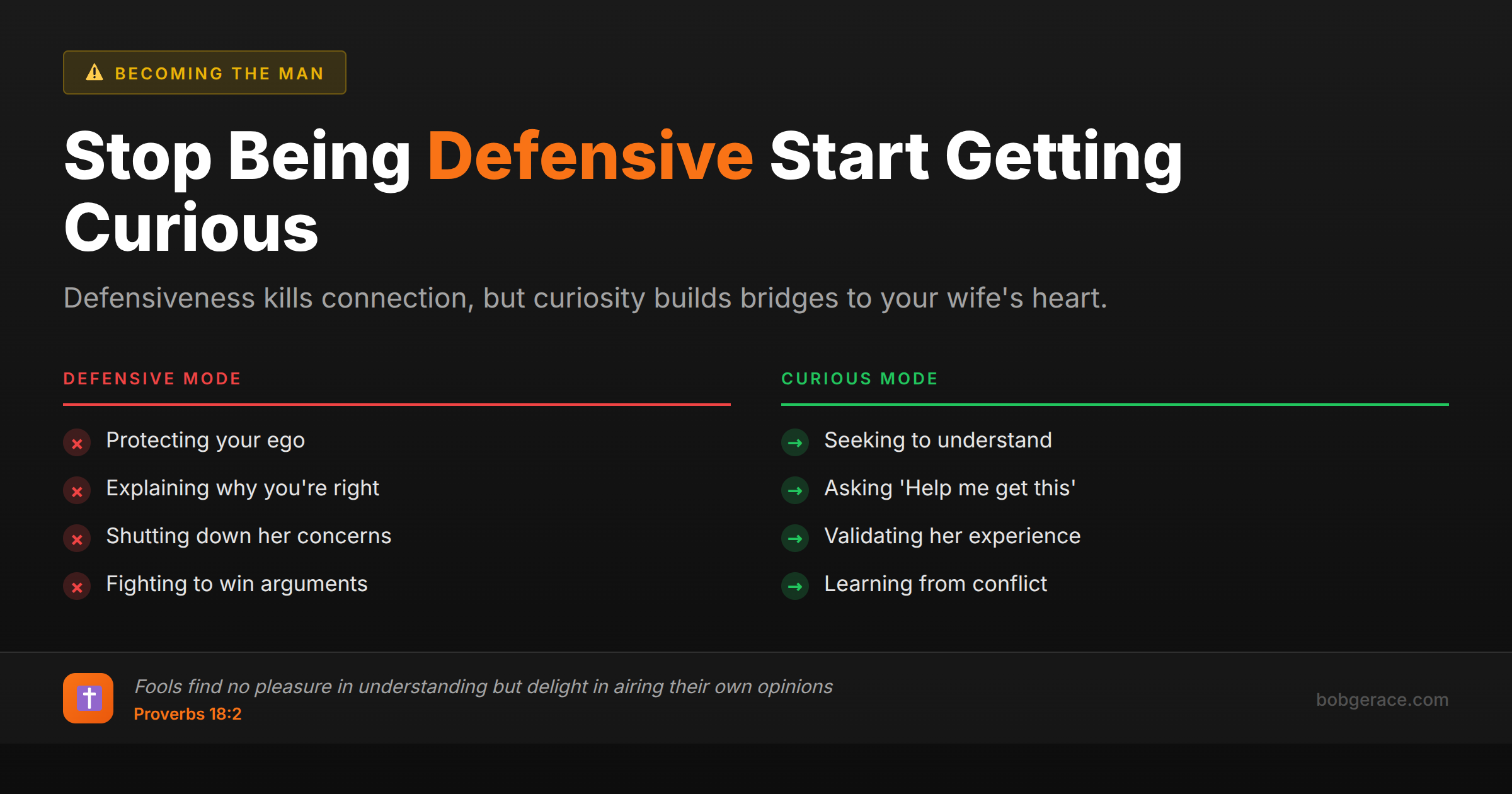
Moving from defensiveness to curiosity requires three fundamental shifts: safety, self-awareness, and intentional practice. First, you need to recognize that defensiveness is your nervous system's attempt to protect you from perceived threat - usually shame or rejection. Second, you must create enough internal safety to pause before reacting. This means slowing down your responses and getting curious about what's happening inside you before focusing on your spouse. The key is understanding that curiosity and defensiveness cannot coexist. When you're defensive, you're in protection mode. When you're curious, you're in learning mode. The bridge between them is self-compassion and the willingness to be wrong or imperfect without it meaning you're worthless.
The Full Picture
Defensiveness is one of the most destructive patterns in marriage, and it's almost always rooted in shame. When your spouse brings up a concern, your brain interprets it as an attack on your worth, competence, or lovability. Your nervous system kicks into protection mode, and suddenly you're fighting for your emotional survival rather than working toward connection.
The shame-defensiveness cycle works like this: Your spouse expresses frustration → You feel criticized and worthless → Your brain activates threat response → You defend, counterattack, or shut down → Your spouse feels unheard and disconnected → They escalate or withdraw → You feel more threatened → The cycle intensifies.
Curiosity breaks this cycle because it operates from a completely different assumption. Instead of "I must protect myself from attack," curiosity asks "What can I learn here?" and "How can I understand my spouse's experience?" This shift requires you to believe that feedback about your behavior doesn't equal condemnation of your worth.
The transformation isn't just behavioral - it's neurological. When you practice curiosity consistently, you're literally rewiring your brain's default response to perceived criticism. You're training your nervous system to stay regulated when your spouse expresses dissatisfaction. This creates safety for both of you to be honest about your needs and struggles.
But here's what most people miss: you can't be genuinely curious about your spouse's experience until you're curious about your own internal reactions. The journey from defensiveness to curiosity starts with self-awareness, not spouse-awareness.
What's Really Happening
From an attachment perspective, defensiveness is almost always a trauma response rooted in early experiences of criticism, rejection, or emotional invalidation. Your brain learned that being "wrong" or imperfect meant losing love or safety. Now, decades later, when your spouse expresses frustration about the dishes or your tone, your nervous system responds as if your survival is at stake.
The neurobiological reality is that when shame gets triggered, your amygdala hijacks your prefrontal cortex - the part of your brain responsible for curiosity, empathy, and rational thinking. You literally cannot access curiosity when you're in a shame spiral. This is why simply deciding to "be more curious" doesn't work. You need to address the underlying shame and create neurological safety first.
Curiosity requires what we call "mentalization" - the ability to understand that your spouse's emotions and behaviors make sense from their perspective, even if you don't agree. This capacity develops when you feel secure in your own worth and in the relationship. When shame is driving the bus, mentalization goes offline.
The good news is that secure attachment can be developed in adulthood through what's called "earned security." This happens when you learn to regulate your own emotional states, develop self-compassion, and practice staying present with discomfort rather than immediately defending against it. Over time, your brain learns that feedback doesn't equal abandonment, and curiosity becomes your natural response to relational tension.
What Scripture Says
Scripture consistently calls us toward humility, wisdom-seeking, and love over self-protection. Proverbs 18:2 tells us, "Fools find no pleasure in understanding but delight in airing their own opinions." Defensiveness is essentially this - delighting in protecting our own perspective rather than seeking understanding.
James 1:19 instructs us to "be quick to listen, slow to speak and slow to become angry." This is the opposite of defensiveness, which is quick to speak, slow to listen, and quick to anger. God's design for relationships prioritizes understanding over being understood.
Proverbs 27:5-6 says, "Better is open rebuke than hidden love. Wounds from a friend can be trusted." This challenges our defensive assumption that criticism is always an attack. Sometimes the people who love us most will say things that initially feel wounding but are actually expressions of care and commitment.
1 Corinthians 13:5 reminds us that love "is not easily angered, it keeps no record of wrongs." Defensiveness keeps detailed records of every slight and responds with anger to protect those records. Love operates from a different posture entirely.
Philippians 2:3 calls us to "consider others better than yourselves" - not because they're perfect, but because love chooses curiosity about their experience over protection of our ego. When we're secure in Christ's love for us, we can afford to be wrong, to learn, and to grow.
Ultimately, curiosity is an act of faith - trusting that God's love for you isn't dependent on your performance, and that your spouse's feedback is an opportunity for growth rather than a threat to your worth.
What To Do Right Now
-
1
Practice the pause: When you feel defensive, take 3 deep breaths and ask yourself, 'What am I protecting right now?' Notice the fear or shame underneath the defensiveness.
-
2
Get curious about your triggers: Write down the specific words, tones, or situations that make you most defensive. What do they remind you of from your past?
-
3
Use the curiosity phrase: When your spouse brings up a concern, respond with: 'Help me understand what this is like for you.' Then listen without planning your rebuttal.
-
4
Practice self-compassion: Remind yourself that being imperfect doesn't make you unlovable. You can make mistakes and still be worthy of love and respect.
-
5
Create safety rituals: Develop specific practices (prayer, deep breathing, positive self-talk) that help you feel grounded when discussions get tense.
-
6
Ask for breaks: When you notice defensiveness rising, say 'I want to hear you, but I need a few minutes to get centered first.' Then return to the conversation.
Related Questions
Ready to Break the Defensiveness Cycle?
If defensiveness is damaging your marriage, you don't have to figure this out alone. Let's work together to build the emotional safety and security that makes curiosity possible.
Get Support →