Why does 'trying harder' often backfire?
6 min read
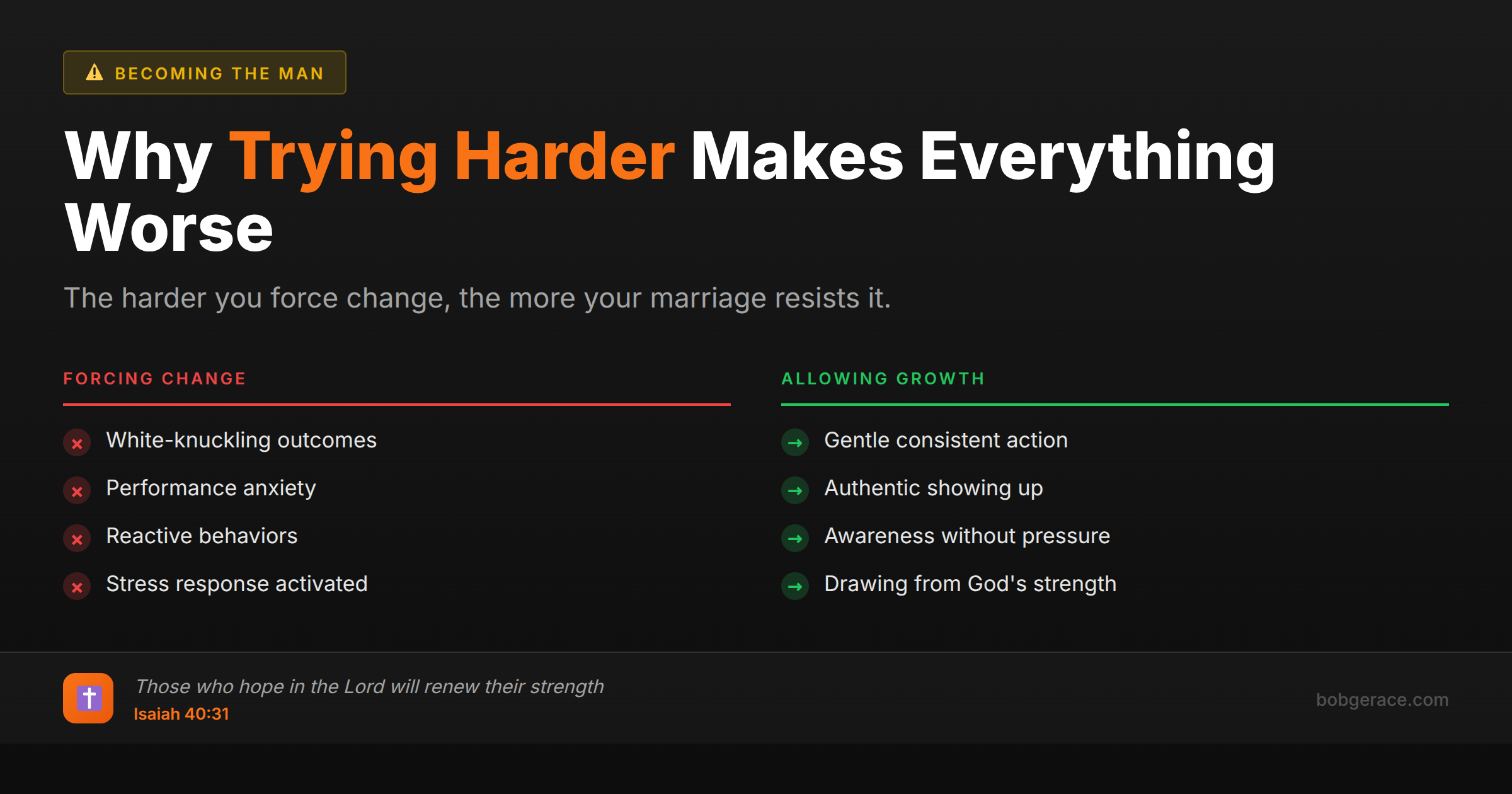
When you 'try harder' in your marriage, you typically increase pressure, create performance anxiety, and activate your stress response system. This makes you less flexible, more reactive, and ironically less capable of the very behaviors you're trying to force. It's like trying to fall asleep by forcing yourself to sleep - the harder you try, the more elusive it becomes. Real change happens through awareness, acceptance, and gentle consistent action, not through white-knuckling your way to improvement. When you release the death grip on outcomes and focus on showing up authentically, you create space for genuine transformation that feels natural rather than forced.
The Full Picture
Here's what most people don't understand about change: effort and force are not the same thing. When you 'try harder' in your marriage, you're usually applying force rather than intelligent effort.
Think about learning to ride a bike. The moment you grip the handlebars too tightly and try to force balance, you wobble and fall. Balance comes from relaxed attention and small, responsive adjustments - not from muscling your way through.
The same principle applies to marriage change. When you white-knuckle your way toward being a better spouse, several things go wrong:
First, you activate your nervous system's stress response. Your brain shifts into fight-or-flight mode, which makes you less creative, less empathetic, and more reactive. You become the opposite of what you're trying to be.
Second, you create what psychologists call 'performance anxiety.' The harder you try to be perfect, the more you focus on not messing up, which actually increases the likelihood you'll mess up. It's like telling someone 'don't think of a pink elephant' - suddenly that's all they can think about.
Third, forced change feels inauthentic to both you and your spouse. Your partner can sense when you're performing rather than genuinely changing. This creates distance instead of connection.
The alternative isn't trying less - it's trying differently. Real change comes from understanding, acceptance, and consistent small actions taken from a place of peace rather than panic. When you stop forcing outcomes and start focusing on process, transformation becomes natural rather than stressful.
What's Really Happening
From a neuroscience perspective, 'trying harder' activates your sympathetic nervous system, flooding your brain with stress hormones like cortisol and adrenaline. This literally shrinks your prefrontal cortex's capacity - the very brain region responsible for empathy, emotional regulation, and complex decision-making that healthy marriages require.
What we see clinically is that couples who 'white-knuckle' their way through marriage problems often create what we call 'change resistance.' The harder one spouse tries to force improvement, the more the other spouse unconsciously resists, creating a push-pull dynamic that makes things worse.
The paradox is that sustainable change requires what we call 'relaxed focus.' When you approach marriage improvement from a place of curious attention rather than desperate effort, you access your brain's natural neuroplasticity. Your nervous system stays regulated, allowing for genuine behavioral flexibility.
I often tell clients that change is like growing a garden. You can't force a seed to sprout faster by pulling on it - you create optimal conditions and allow natural processes to unfold. The same applies to marriage transformation. When you stop forcing and start creating conditions for growth through consistent, peaceful actions, change becomes inevitable rather than effortful.
This doesn't mean being passive. It means channeling your energy into sustainable practices rather than unsustainable force. The goal is to become someone who naturally behaves differently, not someone who's constantly fighting their own nature.
What Scripture Says
Scripture consistently teaches that lasting change comes through God's power, not human effort alone. Isaiah 40:31 reminds us: *'But those who hope in the Lord will renew their strength. They will soar on wings like eagles; they will run and not grow weary, they will walk and not be faint.'* This isn't about trying harder - it's about drawing from a different source of strength.
Matthew 11:28-30 reveals Jesus' approach to change: *'Come to me, all you who are weary and burdened, and I will give you rest. Take my yoke upon you and learn from me, for I am gentle and humble in heart, and you will find rest for your souls. For my yoke is easy and my burden is light.'* Notice that transformation through Christ is described as 'easy' and 'light' - not forced or strained.
The Apostle Paul understood this principle deeply. In 2 Corinthians 12:9-10, he writes: *'But he said to me, "My grace is sufficient for you, for my power is made perfect in weakness." Therefore I will boast all the more gladly about my weaknesses, so that Christ's power may rest on me. That is why, for Christ's sake, I delight in weaknesses, in insults, in hardships, in persecutions, in difficulties. For when I am weak, then I am strong.'*
Galatians 5:22-23 describes the fruit of the Spirit: *'But the fruit of the Spirit is love, joy, peace, forbearance, kindness, goodness, faithfulness, gentleness and self-control.'* Notice these are called 'fruit' - they grow naturally from spiritual health, not from forced effort.
Philippians 2:13 provides the key: *'For it is God who works in you to will and to act in order to fulfill his good purpose.'* Real change happens when we align with God's work in us rather than trying to muscle our way to righteousness.
What To Do Right Now
-
1
Stop forcing and start noticing - For the next week, simply observe your marriage patterns without trying to change them. Awareness precedes transformation.
-
2
Release outcome attachment - Focus on showing up authentically today rather than controlling how your spouse responds or how quickly things improve.
-
3
Practice nervous system regulation - Use deep breathing, prayer, or brief walks when you feel the urge to 'try harder' or force change.
-
4
Choose one small, sustainable action - Pick one specific behavior you can do consistently without strain, like expressing daily gratitude.
-
5
Surrender daily to God's timing - Pray each morning, asking God to work in your marriage according to His timeline, not your urgency.
-
6
Celebrate small progress - Acknowledge any positive movement, however minor, rather than dismissing it because it's not dramatic enough.
Related Questions
- What is 'white-knuckling' vs. real transformation?
- I know what to do but can't do it
- Why can't I just change?
- What is 'implementation intention' and why does it help?
- What structures support sustainable change?
- What role does identity play in behavior change?
- What is 'white-knuckling' vs. internalized change?
- How long does real transformation take?
- What makes change sustainable vs. temporary?
- What if I change and she still leaves?
Also find Bob on
Subscribe for weekly videos on Christian marriage.
You Don't Have to Keep Guessing Alone
A coach who knows your marriage can help you see what's actually happening and what to do next—without the white-knuckling.
Talk to Bob →