She doesn't believe I understand what I did
6 min read
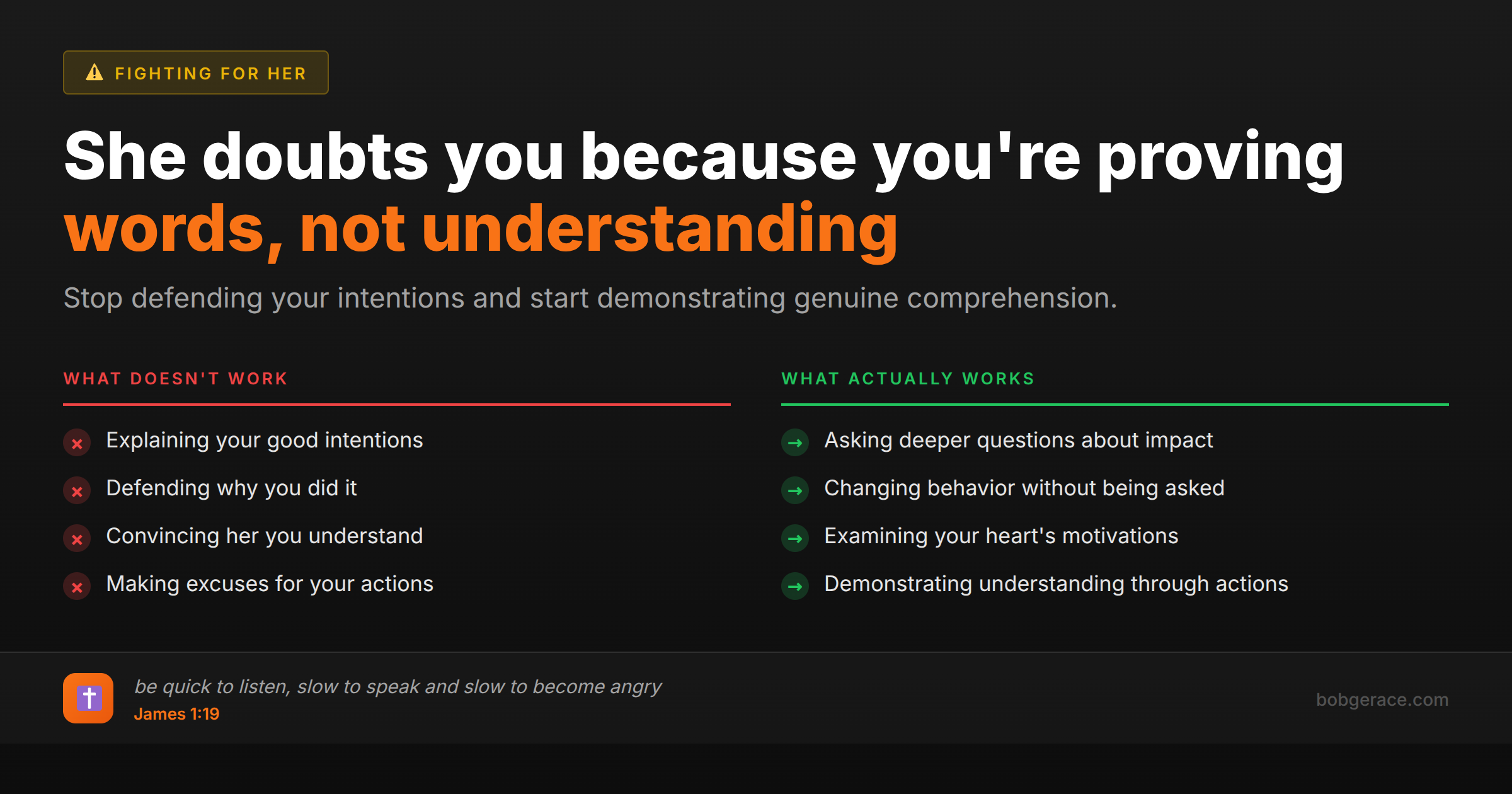
When your wife doesn't believe you understand what you did wrong, it's because your words and actions haven't aligned to demonstrate genuine comprehension. She's looking for evidence that you truly grasp not just what happened, but the impact it had on her emotionally, relationally, and spiritually. This isn't about defending yourself or explaining your intentions—it's about proving through consistent behavior that you 'get it.' Until she sees authentic understanding reflected in changed behavior over time, her skepticism will remain a protective barrier against further hurt.
The Full Picture
Here's what's really happening: your wife has moved beyond wanting apologies to needing proof of understanding. She's been hurt, and now she's protecting herself by maintaining doubt about your comprehension of the situation.
This skepticism didn't develop overnight. It likely built up through a pattern where you said you understood, but then repeated similar behaviors or failed to address the root issues. Maybe you apologized quickly without really listening, or you got defensive when she tried to explain how your actions affected her.
She's testing your understanding because understanding equals safety. If you truly comprehend what you did and why it hurt her, you're less likely to do it again. But if your understanding is surface-level or self-serving, she remains vulnerable to being hurt in the same way.
The challenge is that proving understanding requires time and consistency. You can't convince her with words alone—she needs to see evidence through your actions, your questions, your patience with her process, and your willingness to sit with the discomfort of her doubt without becoming defensive.
Right now, every interaction is being evaluated through the lens of 'Does he really get it?' Your responses to her emotions, your proactive changes in behavior, and your ability to articulate not just what you did but why it mattered—all of this contributes to her assessment.
The good news is that genuine understanding can be demonstrated and recognized over time. But it requires you to move past the frustration of not being believed and focus instead on becoming someone who truly deserves to be believed.
What's Really Happening
From a psychological perspective, your wife's skepticism represents a protective mechanism following relational injury. When trust is damaged, the injured party develops heightened sensitivity to authenticity versus performance.
What you're encountering is called cognitive-emotional incongruence detection. She's subconsciously scanning for mismatches between your stated understanding and your actual behavior. This isn't conscious distrust—it's her nervous system protecting her from re-injury.
The empathy gap is crucial here. Many partners believe they understand because they can intellectually grasp what happened, but true understanding requires emotional resonance—actually feeling the impact of your actions on her inner world. She can sense when your understanding is cognitive versus emotional.
Women often process relational injuries through emotional integration, meaning they need to feel heard and understood at a deep level before they can move toward forgiveness. Your wife isn't being difficult—she's unconsciously assessing whether it's safe to be vulnerable again.
The path forward involves demonstrating embodied understanding—showing through micro-behaviors, unprompted actions, and patient responses that you've internalized not just what you did, but who she is and how she experiences the world. This creates the safety needed for her protective skepticism to gradually relax.
What Scripture Says
Scripture calls us to understanding that goes beyond surface-level acknowledgment. Proverbs 20:5 tells us, *'The purposes of a person's heart are deep waters, but one who has insight draws them out.'* Your wife's heart contains deep waters of hurt that require patient, skillful drawing out—not quick assumptions about what she needs.
James 1:19 instructs us to *'be quick to listen, slow to speak and slow to become angry.'* When she expresses doubt about your understanding, this is your opportunity to listen more deeply rather than defend your comprehension. Her doubt is information, not attack.
The principle of true repentance appears in 2 Corinthians 7:10-11: *'Godly sorrow brings repentance that leads to salvation and leaves no regret, but worldly sorrow brings death. See what this godly sorrow has produced in you: what earnestness, what eagerness to clear yourselves, what indignation, what alarm, what longing, what concern, what readiness to see justice done.'* Notice the demonstrable changes that accompany genuine repentance.
Philippians 2:3-4 challenges us: *'Do nothing out of selfish ambition or vain conceit. Rather, in humility value others above yourselves, not looking to your own interests but each of you to the interests of the others.'* Focus on her need to feel understood rather than your need to be believed.
Proverbs 18:13 warns: *'To answer before listening—that is folly and shame.'* Perhaps she doesn't believe you understand because you've been answering before fully listening to the depths of her experience.
1 Peter 3:7 calls husbands to live with wives *'in an understanding way,'* which implies ongoing, deepening comprehension—not one-time acknowledgment of wrongdoing.
What To Do Right Now
-
1
Stop trying to convince her you understand and start asking questions that prove you want to understand better: 'What else did my actions communicate to you that I might not realize?'
-
2
Identify and address the root motivations behind your actions, not just the surface behaviors—show her you're examining your heart, not just your habits
-
3
Demonstrate understanding through unprompted changes in behavior that show you've internalized her perspective without being asked
-
4
When she expresses doubt, respond with curiosity rather than defensiveness: 'Help me understand what I'm still missing' instead of 'But I do understand'
-
5
Regularly check in with specific questions about her experience: 'How did it feel when...' and listen without correcting or qualifying her responses
-
6
Give her permission to doubt and space to process without pressuring her for acknowledgment of your growth—let your consistent actions speak over time
Related Questions
- She brings up things from years ago
- How do I address years of built-up hurt?
- What is 'accumulated resentment'?
- What does genuine repair look like for old wounds?
- Why didn't my past apologies work?
- What is 'felt understanding' and how do I give it?
- What does 'taking responsibility' actually look like?
- What's the difference between explaining and defending?
- How do I not lose my mind right now?
- What does real forgiveness look like?
Also find Bob on
Subscribe for weekly videos on Christian marriage.
Show Her You Get It
A coach who knows your marriage can help you close the gap between what you think you understand and what she needs to see from you.
Talk to Bob →