She has a list of everything I did wrong
6 min read
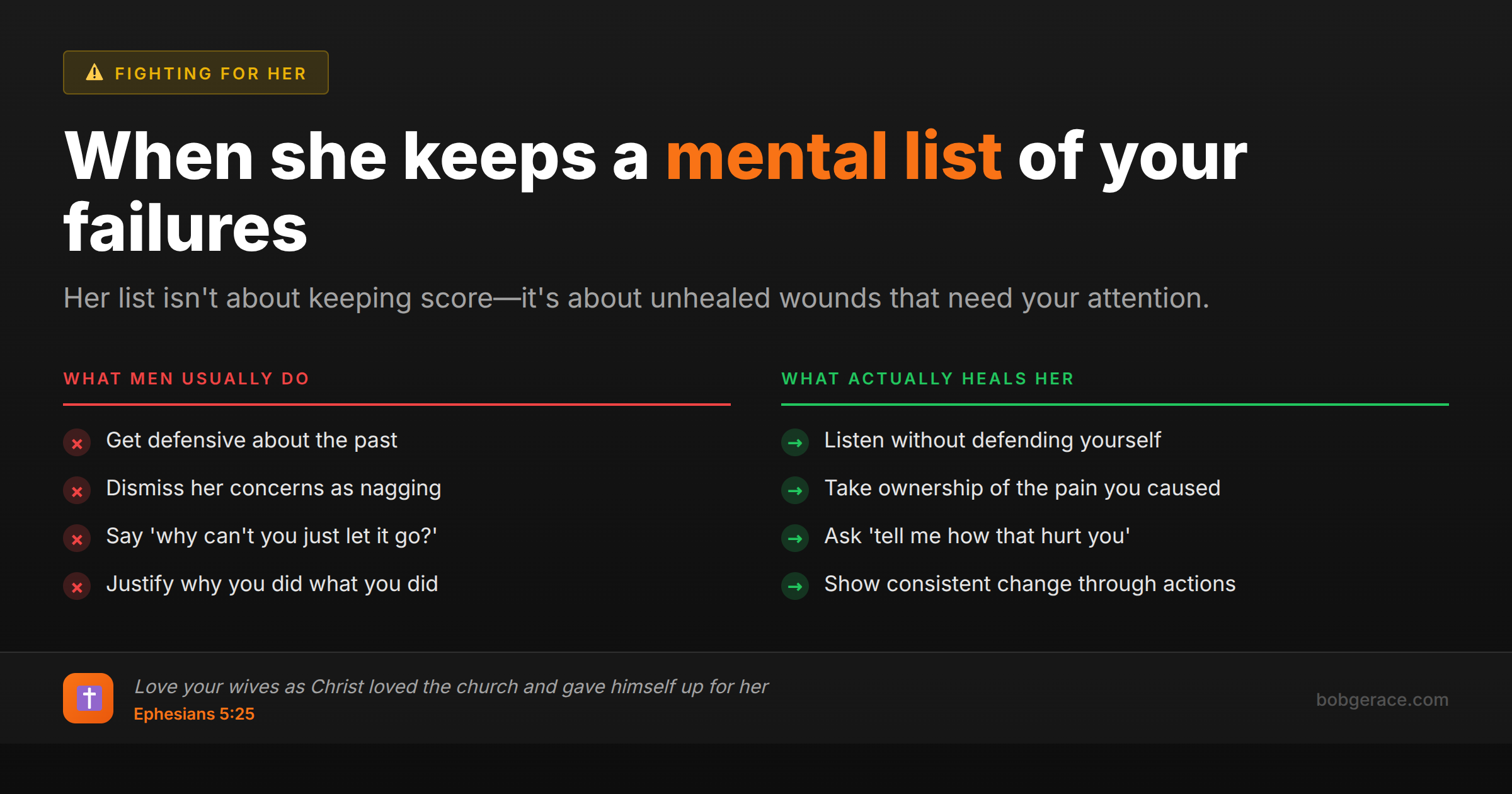
When your wife has a mental catalog of your mistakes, it's not because she enjoys keeping score—it's because those hurts haven't been properly addressed or healed. This list represents unresolved pain that has turned into resentment. She's holding onto these grievances because she doesn't feel heard, validated, or see genuine change from you. The solution isn't to dismiss her list or get defensive about the past. Instead, you need to understand that each item represents a moment where she felt hurt, disappointed, or let down. Your job is to take ownership of your part, validate her pain, and demonstrate through consistent action that you're committed to being the husband she needs going forward.
The Full Picture
Let me be straight with you—when your wife has a running tally of your failures, you're dealing with deep-seated resentment that didn't happen overnight. This isn't about her being vindictive or keeping score for fun. This is about unhealed wounds that have accumulated over time.
Every item on her mental list represents a moment where she felt hurt, dismissed, or let down. Maybe it was the time you forgot an important anniversary. Maybe it was when you chose work over family repeatedly. Maybe it was harsh words spoken in anger or promises broken. Each incident might have seemed small in the moment, but together they've created a compound effect of pain.
Here's what most men don't understand: women often internalize hurt differently than men. While you might move on quickly from an argument or mistake, she's processing the emotional impact more deeply. When these hurts aren't properly addressed—when there's no genuine acknowledgment, apology, or behavior change—they don't just disappear. They accumulate.
The list isn't really about the past—it's about the future. She's keeping track because she's trying to protect herself from being hurt again. It's her evidence that you haven't truly changed, that the patterns will repeat. From her perspective, if you can't even acknowledge what went wrong before, how can she trust that things will be different?
This dynamic creates a vicious cycle. The more defensive you get about her "list," the more evidence you're giving her that you don't understand the depth of pain you've caused. The more she brings up the past, the more frustrated you become, which often leads to more items being added to that list.
The good news? This list can become the roadmap for healing your marriage—if you approach it correctly.
What's Really Happening
From a psychological perspective, your wife's "list" represents what we call unresolved attachment injuries. These are moments when the fundamental safety and //blog.bobgerace.com/true-trust-in-god-when-marriage-failing/:trust in your relationship was damaged. Unlike minor disagreements that couples can easily move past, attachment injuries cut deeper because they threaten the emotional bond between partners.
When someone keeps a mental catalog of hurts, they're exhibiting what's known as negative sentiment override. This means her brain has shifted into a protective mode where she interprets neutral or even positive behaviors through the lens of past hurt. She's not doing this consciously or maliciously—it's an automatic psychological defense mechanism.
The trauma-informed perspective is crucial here. Repeated relational injuries, especially when they go unaddressed, can create symptoms similar to trauma responses. Her hypervigilance to your mistakes, her detailed memory of past hurts, and her inability to "let things go" are all protective responses her nervous system has developed.
Research shows that couples stuck in these patterns often have repair attempts that fail. A repair attempt is any gesture—verbal or nonverbal—meant to prevent negativity from escalating. When these attempts repeatedly fail, partners lose faith in the relationship's ability to heal.
The neuroscience is telling: chronic relationship stress actually changes brain structure, making it harder to access empathy and easier to remain in defensive, reactive states. Both partners become trapped in what we call "negative sentiment override," where even neutral interactions are interpreted negatively.
Healing requires what we term corrective emotional experiences—consistent, repeated interactions that gradually rebuild safety and trust. This isn't about forgetting the past; it's about creating new neural pathways that allow for connection and healing.
What Scripture Says
Scripture gives us clear guidance on how to handle hurt, resentment, and the process of healing in marriage. The Bible doesn't minimize the reality of pain, but it provides a path forward for both the one who has caused hurt and the one who has been wounded.
For you as the husband, Ephesians 5:25-28 calls you to "love your wives as Christ loved the church and gave himself up for her." This means taking ownership of your part in her pain without defensiveness. Just as Christ didn't minimize or excuse our sin, you shouldn't minimize her hurt. 1 Peter 3:7 instructs husbands to be "considerate as you live with your wives, and treat them with respect as the weaker partner and as heirs with you of the gracious gift of life, so that nothing will hinder your prayers."
Matthew 5:23-24 provides the clearest guidance: "If you are offering your gift at the altar and there remember that your brother or sister has something against you, leave your gift there in front of the altar. First go and be reconciled to them; then come and offer your gift." This means you must address each item on her list with genuine repentance.
For the process of healing, James 5:16 says "confess your sins to each other and pray for each other so that you may be healed." True confession isn't just admitting wrongdoing—it's taking full ownership and demonstrating genuine change.
Regarding resentment, Ephesians 4:31-32 calls both of you to "get rid of all bitterness, rage and anger, brawling and slander, along with every form of malice. Be kind and compassionate to one another, forgiving each other, just as in Christ God forgave you." However, biblical forgiveness doesn't mean pretending hurt didn't happen—it means choosing to release the right to punish while still expecting righteousness going forward.
Galatians 6:7 reminds us that "a man reaps what he sows." Her list is, in part, the harvest of seeds you've planted. But 2 Corinthians 5:17 promises that "if anyone is in Christ, the new creation has come: The old has gone, the new is here!" This means genuine transformation is possible.
What To Do Right Now
-
1
Stop defending and start listening. The next time she brings up something from the past, resist every urge to justify, minimize, or deflect. Instead say: "Tell me more about how that hurt you."
-
2
Take a fearless inventory. Write down every hurt you can remember causing her, even if it seems small to you. Don't wait for her to bring them up—proactively acknowledge where you've fallen short.
-
3
Make specific, detailed apologies. For each item, acknowledge what you did wrong, how it impacted her, and take full ownership without any "but" statements or excuses.
-
4
Ask what she needs to see differently. Instead of promising you'll change, ask her specifically what behaviors or attitudes need to shift. Then commit to those changes with a timeline.
-
5
Create new patterns immediately. Don't just apologize for past failures—start demonstrating different behavior today. Consistent action over time will gradually replace her negative expectations.
-
6
Suggest professional help if needed. If the resentment runs too deep for you both to work through alone, take the lead in finding a qualified Christian marriage counselor who can guide the healing process.
Related Questions
- She brings up things from years ago
- She can't seem to forgive the past
- She says I killed her love over time
- How do I address years of built-up hurt?
- Her resentment runs deeper than I knew
- What is 'accumulated resentment'?
- Why does she remember everything I forgot?
- What are 'attachment injuries' and how many did I cause?
- I said things I can't take back
- What does real forgiveness look like?
Also find Bob on
Subscribe for weekly videos on Christian marriage.
Get a Coach on This Today
That list didn't appear overnight, and generic advice won't address what's specific to your marriage. A coach who knows your story can help you turn her resentment into healing—before this 30 days decides the next 30 years.
Talk to Bob →