What does reconciliation require that apology doesn't?
6 min read
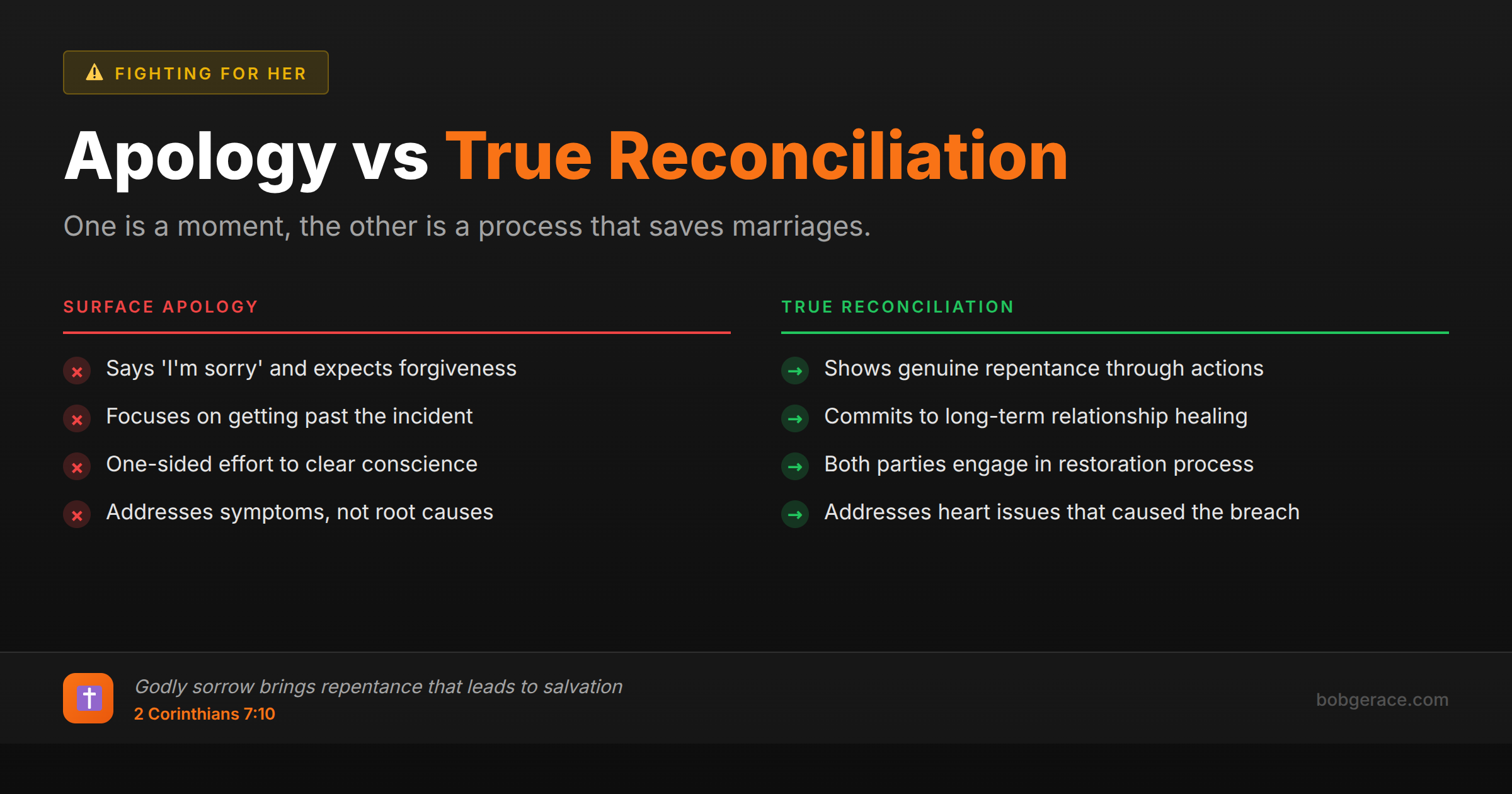
While an apology acknowledges wrongdoing and expresses regret, reconciliation requires a complete restoration of relationship that goes far deeper. Reconciliation demands genuine repentance (a 180-degree turn from harmful behavior), rebuilding of trust through consistent actions over time, and often requires both parties to participate in the healing process. Apology is a moment - reconciliation is a process. An apology can be one-sided, but reconciliation requires both people to engage. Most importantly, reconciliation involves addressing the root issues that caused the breach, not just the surface symptoms. It's the difference between saying 'I'm sorry I hurt you' and actually doing the hard work to ensure you never hurt them that way again.
The Full Picture
Here's what most people get wrong about apologies and reconciliation - they think they're the same thing. They're not even close.
An apology is like putting a band-aid on a gunshot wound. It might stop the immediate bleeding, but it doesn't address the deeper damage. You can apologize for forgetting to take out the trash, for being late to dinner, or for saying something thoughtless. These are surface-level issues that a sincere apology can often resolve.
But when your wife has checked out emotionally, when trust has been shattered by betrayal, when years of neglect have created a chasm between you - that requires reconciliation, not just an apology.
Reconciliation is a complete restoration process that involves:
- Genuine repentance - not just feeling bad, but completely turning away from the destructive behavior - Truth-telling - full disclosure and transparency about what went wrong - Making amends - actively working to repair the damage you've caused - Rebuilding trust - proving through consistent actions over time that you've truly changed - Addressing root causes - dealing with the deeper issues that led to the breakdown - Mutual participation - both parties engaging in the healing process
An apology can happen in a moment. Reconciliation takes months or even years. An apology is about the past - 'I'm sorry for what I did.' Reconciliation is about the future - 'Here's how I'm going to be different moving forward, and here's how we're going to rebuild what was broken.'
When your wife has emotionally checked out, she's not looking for your words. She's looking for evidence that real, lasting change is possible.
What's Really Happening
From a clinical perspective, the distinction between apology and reconciliation reflects different levels of psychological and relational healing. When someone has 'checked out' of a marriage, they've often moved into a state of emotional self-protection - their nervous system has essentially decided that the relationship is unsafe.
An apology, while important, only addresses the cognitive level of hurt. It's information processing - 'I understand I did wrong.' But reconciliation engages what we call the attachment system - the deep neurological patterns that govern how we bond and trust.
Research in attachment theory shows us that rebuilding trust after significant relational trauma requires what I call 'earned security.' This happens through consistent, predictable, emotionally attuned responses over time. The brain needs to see new patterns, not just hear new words.
Reconciliation also requires what we call 'dyadic regulation' - both partners learning to co-regulate each other's emotional states. This is impossible without active participation from both people. The checked-out spouse needs to gradually re-engage their vulnerability, while the offending spouse needs to prove their reliability through actions, not words.
Neurologically speaking, apology activates the prefrontal cortex - our thinking brain. But reconciliation requires rewiring deeper structures like the amygdala and limbic system - our emotional safety centers. This is why reconciliation takes time and why surface-level apologies often feel hollow to someone who's emotionally withdrawn. Their brain is literally scanning for evidence of safety, not just expressions of remorse.
What Scripture Says
Scripture makes a clear distinction between surface-level remorse and true reconciliation. God doesn't just want our apologies - He wants our hearts fundamentally changed.
2 Corinthians 7:10 teaches us: *'Godly sorrow brings repentance that leads to salvation and leaves no regret, but worldly sorrow brings death.'* This shows us that true reconciliation starts with godly sorrow - a deep grief over sin that leads to actual change, not just feeling bad about getting caught.
Matthew 3:8 commands us to *'produce fruit in keeping with repentance.'* Fruit takes time to grow. Anyone can say sorry, but producing fruit means your life actually looks different. Your wife needs to see the fruit, not just hear the apology.
Luke 19:8-9 gives us Zacchaeus as the perfect example. He didn't just apologize for his theft - he gave back four times what he stole. Jesus declared salvation had come to his house because Zacchaeus made restitution. Reconciliation requires making things right, not just saying you're sorry.
Ephesians 4:22-24 calls us to *'put off your old self... and put on the new self, created to be like God in true righteousness and holiness.'* This is the heart of reconciliation - not just stopping bad behavior, but becoming a fundamentally different person.
God models this for us. When He reconciled us to Himself, He didn't just forgive our sins - He gave us new hearts, new identities, and the Holy Spirit to ensure we could actually change. Biblical reconciliation is always transformational, never just transactional.
What To Do Right Now
-
1
Stop focusing on apologies and start planning for reconciliation - write out what genuine repentance looks like in your specific situation
-
2
Identify the root issues that caused the breakdown, not just the surface symptoms your wife complains about
-
3
Create a specific plan for making amends - what concrete actions will you take to repair the damage you've caused?
-
4
Establish accountability with other godly men who will hold you to genuine change, not just good intentions
-
5
Begin the process of truth-telling - full transparency about your failures and a clear commitment to ongoing honesty
-
6
Accept that reconciliation is a long-term process and commit to proving your change through consistent actions over months, not days
Related Questions
- What is an 'apology' vs. 'repair' vs. 'attunement'?
- What does genuine repair look like for old wounds?
- Why didn't my past apologies work?
- What is 'felt understanding' and how do I give it?
- Can old attachment injuries be healed?
- What is restitution and do I owe it?
- What does real forgiveness look like?
- What's the difference between forgiveness and reconciliation?
- What does 'taking responsibility' actually look like?
- What does 'godly sorrow' look like in practice?
Also find Bob on
Subscribe for weekly videos on Christian marriage.
Your Marriage Needs More Than Theory
Reconciliation is specific work—what broke trust in your marriage, what she actually needs to see from you, how long this really takes. A coach who knows your story can map that.
Talk to Bob →