How have these texts been interpreted historically?
6 min read
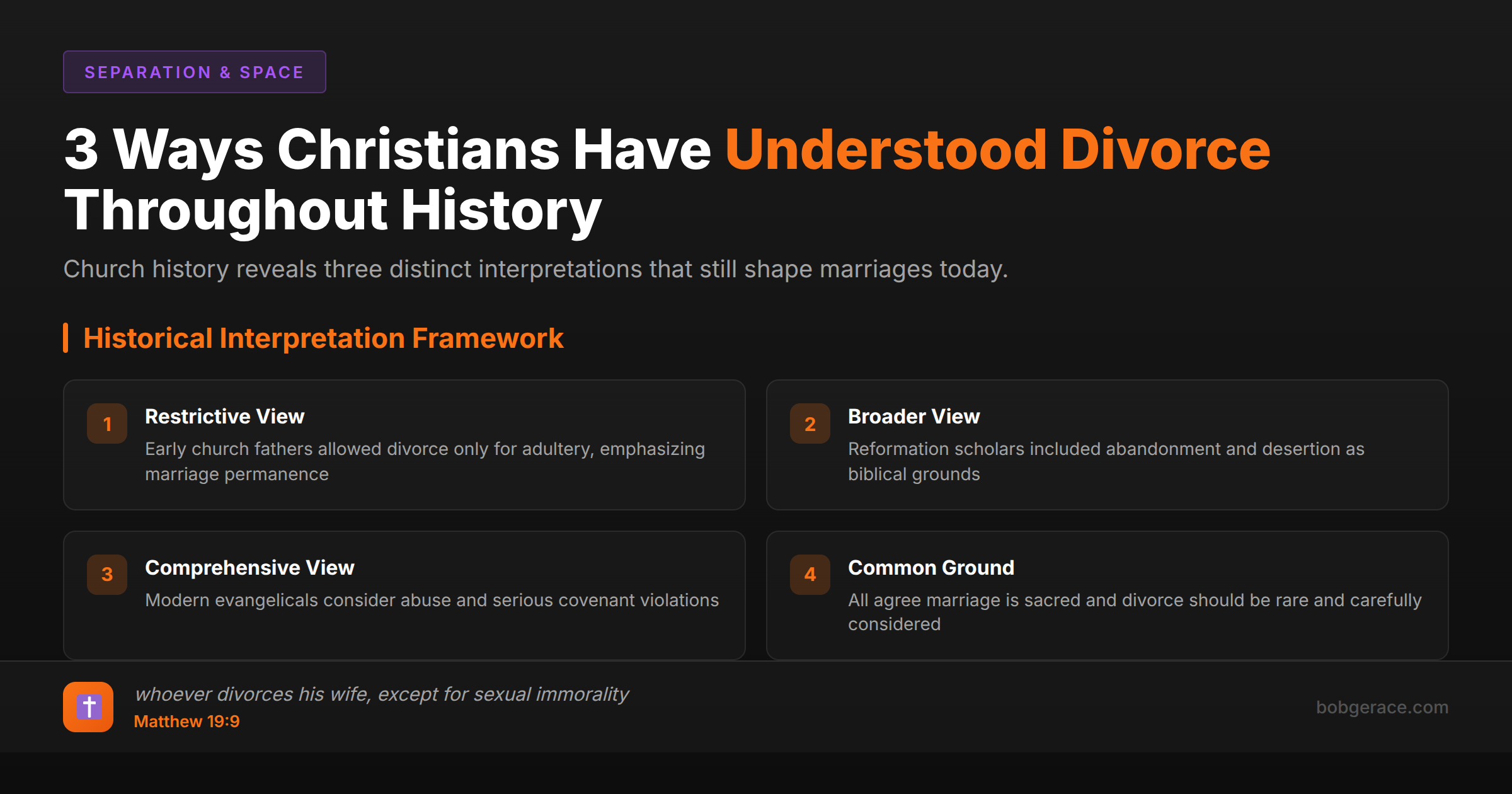
Throughout church history, biblical texts on marriage and divorce have been interpreted through three primary lenses: the restrictive view (allowing divorce only for adultery), the broader view (including abandonment), and the comprehensive view (including abuse and other serious violations). The early church fathers generally held strict positions, while the Reformation brought more nuanced interpretations. Modern evangelical scholarship continues to debate these passages, with most agreeing that marriage is sacred and divorce should be rare, but disagreeing on specific circumstances that justify separation.
The Full Picture
## Historical Development of Biblical Interpretation
The interpretation of biblical marriage and divorce texts has evolved significantly throughout church history, reflecting both cultural contexts and theological developments. Understanding this historical progression helps us appreciate the complexity of these passages and why sincere believers can reach different conclusions.
Early Church Period (100-500 AD)
The early church fathers, including Augustine and Jerome, generally took restrictive positions on divorce. They lived in a Roman culture where divorce was common and easy, so they emphasized the permanence of marriage as a Christian distinctive. Augustine viewed marriage as a sacrament, making divorce nearly impossible except in cases of adultery, and even then, remarriage was often prohibited.
Medieval Period (500-1500 AD)
The Catholic Church developed a comprehensive sacramental theology of marriage during this period. Marriage became one of seven sacraments, and the church gained exclusive jurisdiction over marriage and divorce. The concept of annulment developed as a way to address truly impossible situations while maintaining the principle of marriage permanence.
Reformation Era (1500-1700 AD)
Reformers like Martin Luther and John Calvin brought fresh perspectives to biblical interpretation. They moved away from purely sacramental views while maintaining marriage's sacred nature. Calvin's interpretation of the "exception clause" in Matthew 19:9 became influential, and Protestant churches began allowing divorce for adultery and desertion, based on Paul's teaching in 1 Corinthians 7.
Modern Evangelical Interpretations
Today's evangelical scholars generally fall into three camps, each with solid biblical reasoning and historical precedent.
What's Really Happening
As a marriage therapist, I see how historical interpretations directly impact couples in crisis today. Many couples come to therapy carrying the weight of different denominational teachings about divorce, creating additional stress during already difficult times.
What's fascinating is how historical context shaped interpretations. The early church fathers were responding to Roman culture's casual approach to divorce, so they emphasized permanence. Medieval Catholic theology developed in a context where marriage was often political and economic, leading to complex annulment procedures. The Reformers were reacting against what they saw as legalistic Catholic positions.
In my practice, I help couples understand that sincere biblical scholars throughout history have reached different conclusions about these texts, not because Scripture is unclear, but because these passages address complex human situations that require careful, prayerful interpretation.
The danger I see is when couples use historical interpretations as weapons against each other rather than seeking to understand God's heart for marriage. Some spouses will cite Augustine's strict position to prevent any consideration of separation, even in abusive situations. Others will use more permissive interpretations to justify leaving for selfish reasons.
What remains consistent throughout church history is the recognition that marriage is sacred, divorce is serious, and these decisions require wisdom, prayer, and often pastoral guidance. The goal isn't to find the interpretation that supports what we want to do, but to understand what honors God and promotes human flourishing within biblical boundaries.
What Scripture Says
Understanding how these texts have been interpreted requires examining the key passages that have shaped church thinking throughout history.
Matthew 19:3-9 - Jesus' teaching on divorce has been the cornerstone of Christian interpretation. The "exception clause" (porneia) has been understood differently: some limiting it to adultery, others including broader sexual immorality, and some interpreting it as referring to invalid marriages.
> "And I say to you: whoever divorces his wife, except for sexual immorality, and marries another, commits adultery." - Matthew 19:9
1 Corinthians 7:10-16 - Paul's instructions about marriage to unbelievers introduced the concept of desertion as grounds for divorce, leading to what became known as the "Pauline Privilege" in church history.
> "But if the unbeliever leaves, let it be so. The brother or the sister is not bound in such circumstances; God has called us to live in peace." - 1 Corinthians 7:15
Malachi 2:16 - God's statement "I hate divorce" has been interpreted both as an absolute prohibition and as expressing God's heart while allowing for human failure.
> "'I hate divorce,' says the Lord God of Israel, 'and him who covers his garment with wrong,' says the Lord of hosts. 'So take heed to your spirit, that you do not deal treacherously.'" - Malachi 2:16
Ephesians 5:22-33 - Paul's marriage metaphor comparing Christ and the church has historically shaped understanding of marriage's sacred, permanent nature.
> "This mystery is profound, and I am saying that it refers to Christ and the church." - Ephesians 5:32
Throughout history, faithful interpreters have sought to honor both God's design for marriage permanence and His compassion for those in destructive situations.
What To Do Right Now
-
1
Study the primary biblical passages yourself, asking God for wisdom rather than looking for predetermined answers
-
2
Research your church's historical position and understand the biblical reasoning behind their interpretation
-
3
Consult with mature believers from different traditions to gain broader perspective on these texts
-
4
Focus on God's heart for marriage restoration rather than justification for predetermined decisions
-
5
Seek pastoral counseling that takes both Scripture and historical interpretation seriously
-
6
Remember that historical interpretations inform but don't replace personal Bible study and prayer
Related Questions
- What does Scripture say about divorce?
- What did Jesus say about divorce?
- What is Paul's teaching in 1 Corinthians 7?
- What are the main evangelical positions on divorce?
- What is 'porneia' and what does it include?
- Does the exception clause allow divorce or require it?
- What does biblical forgiveness require of me?
- What's the difference between forgiveness and reconciliation?
- What does faithfulness require when she won't reciprocate?
Also find Bob on
Subscribe for weekly videos on Christian marriage.
Ready to Apply This to Your Marriage?
Theology matters. But your actual situation—what happened, where she is now, what you're facing—needs a coach who knows your story.
Talk to Bob →