What if I was the innocent party?
6 min read
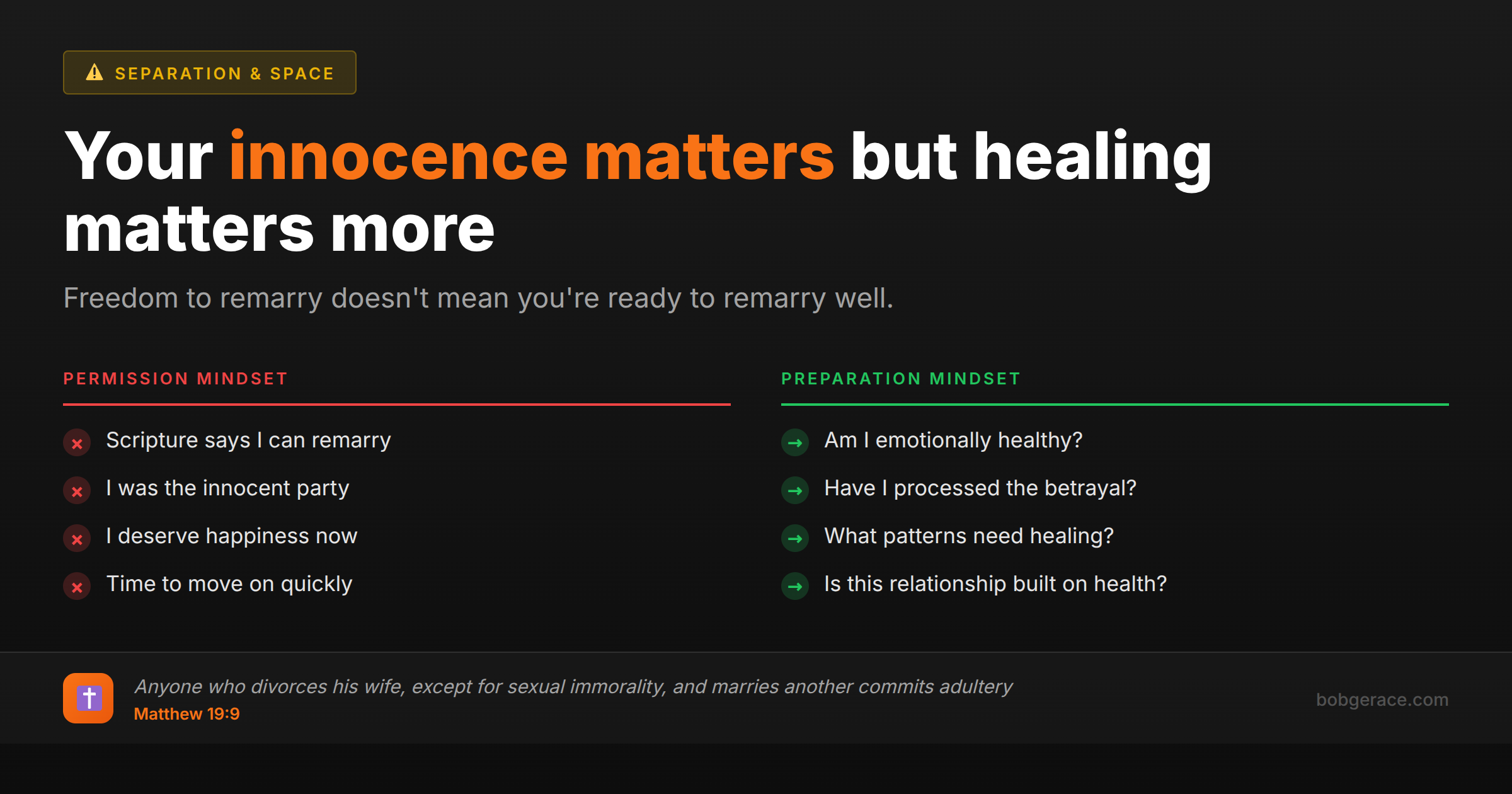
Being the 'innocent party' in a divorce brings unique pain and questions about remarriage. While Scripture does provide certain allowances for the innocent party, the real question isn't just 'Can I remarry?' but 'Am I ready to remarry well?' Your innocence in the divorce doesn't automatically mean you're prepared for a new marriage. God's heart is always for healing and restoration. Yes, Scripture gives freedom for remarriage in certain circumstances, particularly involving adultery or abandonment. But freedom doesn't mean obligation or immediate readiness. The deeper work involves processing the betrayal, understanding your own patterns, and ensuring you're entering a new relationship from health rather than hurt. Your innocence matters, but your healing matters more.
The Full Picture
Let's be clear about something: being the innocent party in a divorce is real, and it matters. Your spouse may have committed adultery, abandoned the marriage, or violated the covenant in ways that left you with no choice but divorce. That pain is valid, and God sees it.
But here's what I've learned after years of marriage coaching: innocence in divorce doesn't automatically equal readiness for remarriage. I've seen too many 'innocent' parties rush into new relationships carrying unhealed wounds, unresolved trust issues, and unrealistic expectations that their new spouse will fix what the previous one broke.
The real question isn't about your legal or biblical right to remarry. It's about whether you're emotionally, spiritually, and relationally prepared to build something healthy with someone new. Your innocence gives you certain freedoms, but wisdom should guide how you use them.
Consider this: even as the innocent party, you lived through a broken marriage. That experience shaped you. Maybe you developed unhealthy coping mechanisms, learned to protect yourself in ways that might hinder intimacy, or carry fears that could sabotage future relationships. None of this makes you guilty of your divorce, but it does mean you have work to do.
The goal isn't to rush back into marriage to prove you're loveable or to escape loneliness. The goal is to become the healthiest version of yourself so that if and when you do remarry, you're bringing your best self to that covenant. Your innocence in the past doesn't guarantee success in the future without intentional growth and healing.
What's Really Happening
From a therapeutic perspective, individuals who identify as the 'innocent party' in divorce often carry what we call 'betrayal trauma.' This isn't just hurt feelings—it's a profound disruption of trust that affects how your nervous system responds to intimacy and vulnerability.
Even when you weren't responsible for the divorce, your attachment system was damaged. You may find yourself hypervigilant in new relationships, constantly scanning for signs of betrayal. Or conversely, you might ignore red flags because you're desperate to prove you're worthy of faithful love. Both responses are normal but can be destructive.
What's particularly challenging for innocent parties is the pressure—both internal and external—to 'move on' because 'you deserve happiness.' While well-intentioned, this pressure often leads to premature relationship decisions. Research shows that individuals who take time to process their divorce trauma and develop secure attachment patterns are significantly more likely to have successful subsequent marriages.
The work involves grieving not just the loss of your marriage, but the loss of innocence about relationships themselves. You learned that people you trust can betray you. That's a profound loss that requires time to integrate. The goal isn't to become cynical, but to develop what we call 'earned security'—the ability to trust wisely while maintaining appropriate boundaries. This process typically takes 2-5 years, depending on various factors including the length of the marriage and severity of the betrayal.
What Scripture Says
Scripture does provide guidance for the innocent party, and it's important to understand both the freedom and responsibility that comes with it.
Matthew 19:9 gives us Jesus' words: 'I tell you that anyone who divorces his wife, except for sexual immorality, and marries another woman commits adultery.' This passage suggests that the innocent party in cases of adultery has biblical grounds for both divorce and remarriage.
1 Corinthians 7:15 addresses abandonment: 'But if the unbeliever leaves, let it be so. The brother or the sister is not bound in such circumstances; God has called us to live in peace.' Again, this suggests freedom for the abandoned spouse.
But notice what Scripture emphasizes alongside this freedom. 1 Corinthians 7:7-8 shows Paul's preference: 'I wish that all of you were as I am. But each of you has your own gift from God; one has this gift, another has that. Now to the unmarried and the widows I say: It is good for them to stay unmarried, as I do.'
Jeremiah 3:1 reminds us of God's heart for restoration, even after betrayal. And Isaiah 61:3 promises that God will give 'a crown of beauty instead of ashes, the oil of joy instead of mourning, and a garment of praise instead of a spirit of despair.'
The biblical pattern is clear: freedom exists, but so does the call to wisdom, healing, and patient trust in God's timing. Psalm 27:14 counsels: 'Wait for the Lord; be strong and take heart and wait for the Lord.' Your innocence gives you options, but God's wisdom should guide your choices.
What To Do Right Now
-
1
Take an honest inventory of your emotional and spiritual health—don't rush major life decisions while still processing trauma
-
2
Seek professional counseling to work through betrayal trauma and develop healthy relationship patterns
-
3
Spend focused time in prayer asking God for wisdom about timing, not just permission for remarriage
-
4
Build a strong support system of mature believers who can speak truth into your life about readiness
-
5
If you're in a relationship, slow down and ensure it's built on health, not just mutual neediness or loneliness
-
6
Focus on becoming the person you want to attract—work on your own character, healing, and spiritual growth
Related Questions
- What if I was the guilty party but have repented?
- What about divorce before I was a Christian?
- Does divorce always prohibit remarriage?
- What does 'commits adultery' in Matthew 19 mean?
- What does the church say about remarriage?
- How do I discern what's right for me?
- What does biblical forgiveness require of me?
- Does the Bible require me to stay after an affair?
- What's the difference between forgiveness and reconciliation?
- How do I make this decision?
Also find Bob on
Subscribe for weekly videos on Christian marriage.
Your Story Deserves More Than a Rulebook
Innocence in the divorce doesn't mean you're ready for what's next. A coach who knows your specific situation can help you process the betrayal and rebuild from health, not just hurt.
Talk to Bob →