What is 'earned avoidance' from marriage pain?
6 min read
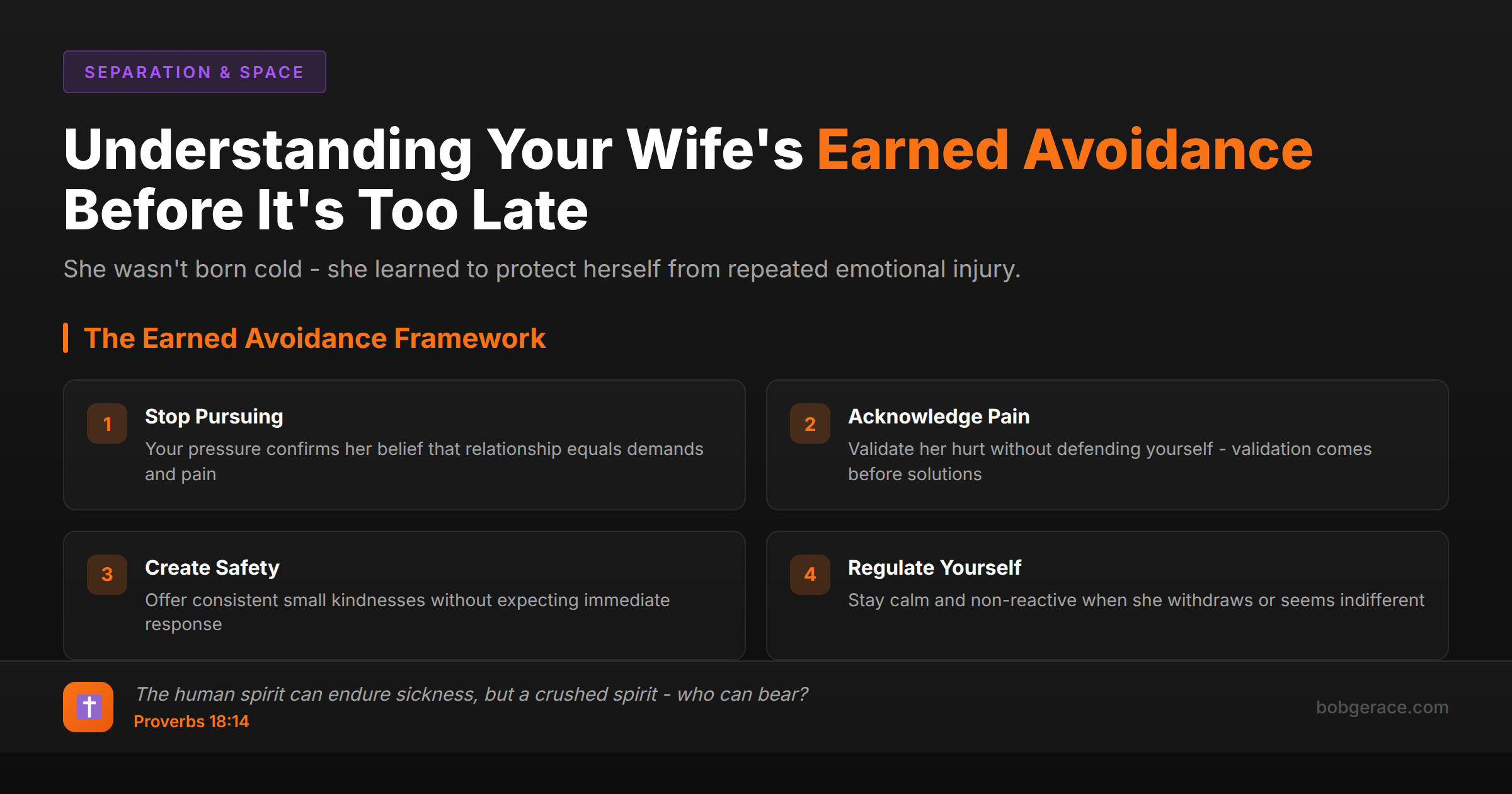
Earned avoidance is when someone develops protective withdrawal patterns after experiencing repeated emotional injury in their marriage. Unlike natural avoidant attachment, this is learned behavior - your spouse wasn't born this way, but has adapted to survive ongoing relational pain. When attempts at connection consistently result in hurt, criticism, or dismissal, the brain learns that emotional distance equals safety. This creates a protective shell where your spouse may be physically present but emotionally unavailable. They've essentially 'earned' this avoidance through painful experiences that taught them vulnerability leads to injury. Understanding this helps you see their withdrawal not as rejection, but as a wounded person's attempt to protect themselves from further harm.
The Full Picture
Earned avoidance is fundamentally different from natural avoidant attachment. Someone with earned avoidance didn't start this way - they learned to protect themselves after experiencing repeated emotional injuries in the relationship. Think of it like developing a limp after being kicked in the same leg repeatedly. The limp isn't the real problem; it's the body's way of protecting an injured area.
This pattern typically develops over years of accumulated hurts. Maybe your spouse tried to share their feelings but got met with defensiveness or criticism. Perhaps they attempted to address problems but were dismissed or blamed. Each failed attempt at connection creates a small withdrawal, and over time, these withdrawals compound into a protective wall.
The cruel irony is that earned avoidance often develops in people who desperately wanted connection. They didn't choose to become distant - they adapted to survive. Their nervous system learned that emotional openness leads to pain, so it began shutting down those vulnerable feelings before they could surface.
Recognizing earned avoidance is crucial because it means the capacity for connection is still there, buried under layers of protection. Unlike someone with natural avoidant attachment who genuinely struggles with intimacy, your spouse likely has the emotional wiring for deep connection - it's just been suppressed by pain.
This understanding should give you hope while also highlighting the seriousness of the situation. The good news is that earned avoidance can be healed when safety is restored. The sobering news is that it developed because your spouse experienced your marriage as emotionally dangerous. Healing requires acknowledging this pain and creating new experiences that prove connection can be safe again.
What's Really Happening
From a clinical perspective, earned avoidance represents a trauma response within the attachment system. When someone experiences repeated relational injuries, their nervous system adapts by suppressing the attachment drive - essentially turning down the volume on their need for connection to reduce the pain of unmet longing.
Neurologically, this involves the amygdala becoming hypervigilant to signs of emotional threat while the prefrontal cortex develops sophisticated strategies to maintain distance. The person isn't consciously choosing to withdraw; their brain is automatically protecting them from perceived danger.
What makes earned avoidance particularly challenging is that it often includes 'emotional numbing' - the suppression of positive feelings alongside negative ones. Your spouse may seem indifferent rather than angry because their nervous system has learned to shut down emotional responsiveness altogether.
The key clinical insight is that this adaptation served a protective function. In an environment where emotional openness led to pain, avoidance was actually a healthy response. The problem occurs when this protection continues even after conditions change.
Recovery requires what we call 'earned security' - new experiences that gradually convince the nervous system that connection can be safe. This isn't about talking your spouse out of their avoidance; it's about creating enough positive emotional experiences to rewire their automatic responses. The process requires patience because the brain changes slowly, and trust must be rebuilt through consistent safety rather than promises or explanations.
What Scripture Says
Scripture acknowledges that pain can cause people to withdraw and protect themselves. Proverbs 18:14 says, 'The human spirit can endure in sickness, but a crushed spirit - who can bear?' When someone develops earned avoidance, they're dealing with a crushed spirit that has learned to protect itself through distance.
Psalm 55:12-14 captures this relational pain: 'If an enemy were insulting me, I could endure it... But it is you, a man like myself, my companion, my close friend, with whom I once enjoyed sweet fellowship.' The deepest wounds often come from those closest to us, and the Bible acknowledges how devastating this betrayal feels.
Yet God's heart is always toward healing and restoration. Isaiah 61:1 speaks of binding up the brokenhearted and setting captives free. Your spouse's avoidance is a kind of emotional captivity - they're trapped in protective patterns that limit their freedom to love and be loved.
Ephesians 4:32 calls us to 'be kind and compassionate to one another, forgiving each other, just as in Christ God forgave you.' Healing earned avoidance requires extending this kind of patient compassion, recognizing that your spouse's withdrawal comes from pain, not malice.
1 Peter 4:8 reminds us that 'love covers over a multitude of sins.' This doesn't mean ignoring problems, but approaching them with the kind of persistent, gentle love that creates safety for vulnerable hearts to open again.
God specializes in restoration. Joel 2:25 promises, 'I will repay you for the years the locusts have eaten.' Even when years of pain have created deep avoidance patterns, God can restore what's been lost when we cooperate with His healing process.
What To Do Right Now
-
1
Stop pursuing and pressuring your spouse for connection - this confirms their belief that relationship equals demands and pain
-
2
Acknowledge the pain they've experienced without defending yourself or explaining your intentions - validation comes before solutions
-
3
Create consistent small moments of safety and kindness without expecting immediate emotional response or gratitude
-
4
Work on your own emotional regulation so you can remain calm and non-reactive when they withdraw or seem indifferent
-
5
Focus on rebuilding trust through actions rather than words - show them through behavior that you're becoming emotionally safe
-
6
Get professional help to understand your role in creating the conditions that led to their earned avoidance and develop healthier patterns
Related Questions
- What is 'emotional disengagement'?
- Is her shutdown protective or permanent?
- What is 'deactivation' and did I cause it?
- Can deactivated attachment reactivate?
- What attachment injuries lead to this kind of withdrawal?
- What does avoidant attachment look like in a wife?
- What is 'accumulated resentment'?
- What are 'attachment injuries' and how many did I cause?
- What does chronic anger do to my nervous system?
- How does attachment style relate to affair risk?
Also find Bob on
Subscribe for weekly videos on Christian marriage.
Your Marriage Isn't a Textbook Case
Earned avoidance looks different in every relationship. A coach who knows your specific story can help you see what's actually driving the distance in your marriage — and what will work with your spouse.
Talk to Bob →