What role does resentment play in sexual shutdown?
6 min read
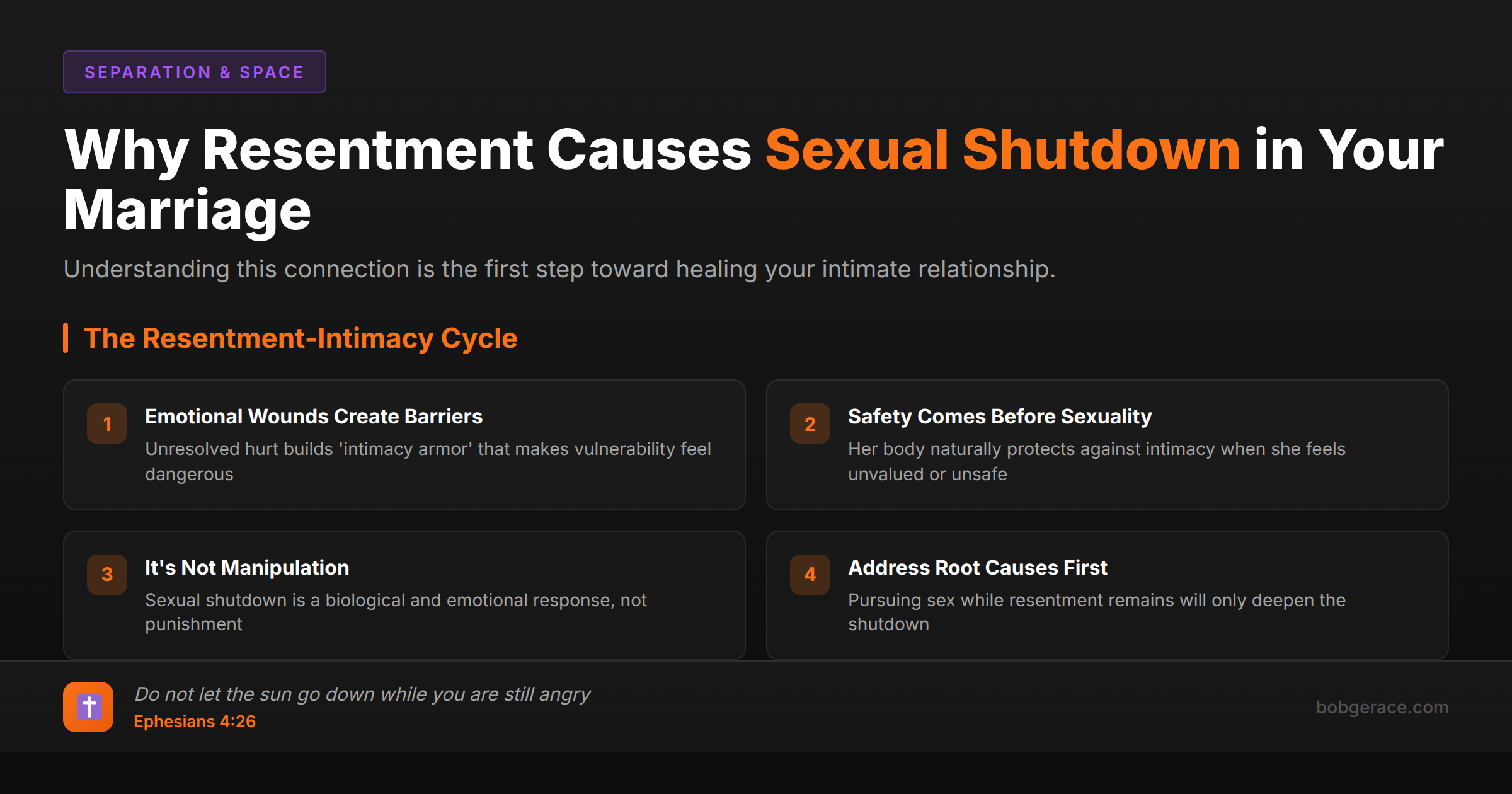
Resentment is one of the most destructive forces behind sexual shutdown in marriage. When a wife carries unresolved hurt, anger, or disappointment toward her husband, her body and mind naturally create protective barriers against intimacy. This isn't manipulation or punishment - it's a biological and emotional response to feeling unsafe or unvalued in the relationship. The connection between emotional safety and sexual openness is profound. When resentment builds up over time through unmet needs, broken promises, or repeated hurts, it creates what I call 'intimacy armor' - a protective mechanism that makes genuine vulnerability feel dangerous. Understanding this dynamic is the first step toward healing both the resentment and restoring the intimate connection you both desire.
The Full Picture
Resentment doesn't appear overnight - it's the accumulation of countless small wounds that never properly healed. In marriage, these wounds often stem from feeling unheard, unvalued, or unseen by your spouse. Maybe it started with dismissive comments, broken promises, or simply the gradual erosion of emotional connection.
Here's what most men don't understand: for women, emotional safety and physical intimacy are deeply interconnected. When resentment builds, it doesn't just affect her feelings - it literally changes her body's response to you. Her nervous system begins to associate you with stress rather than safety, making sexual desire feel not just unlikely, but physiologically difficult.
The process typically unfolds like this: First, small hurts accumulate without proper resolution. Second, she begins to withdraw emotionally as a form of self-protection. Third, physical intimacy starts feeling forced or disconnected. Finally, what began as hurt transforms into hardened resentment, creating what feels like an impenetrable wall.
This isn't about keeping score or withholding sex as punishment. It's about a fundamental breach in the trust and safety that intimate relationships require. When a woman doesn't feel emotionally safe with her husband, her body's natural response is to create distance - and sexual shutdown is often the most visible symptom of this deeper disconnection.
The tragedy is that this creates a destructive cycle: the more sexually distant she becomes, the more rejected and frustrated he feels, leading to behaviors that often increase rather than decrease her resentment.
What's Really Happening
From a clinical perspective, resentment-driven sexual shutdown involves both psychological and neurobiological processes. When a woman experiences repeated emotional injuries in her marriage, her brain's threat detection system becomes hypervigilant around her spouse. The amygdala - our brain's alarm system - begins to associate her husband with potential emotional danger rather than safety and connection.
This creates what we call 'defensive detachment.' Her nervous system essentially goes into protection mode, shutting down the vulnerable openness that healthy sexuality requires. It's not a conscious choice - it's an automatic survival response. The very hormones necessary for sexual desire and arousal become suppressed when the brain perceives ongoing emotional threat.
Research shows that unresolved resentment triggers chronic stress responses that directly inhibit sexual function. Cortisol levels remain elevated, while oxytocin (the bonding hormone) and testosterone (crucial for female libido) drop significantly. This creates a physiological state where sexual desire becomes nearly impossible.
What makes this particularly challenging is that resentment often builds through 'micro-betrayals' - small, repeated instances of feeling dismissed, criticized, or emotionally abandoned. These don't register as major trauma, but their cumulative effect is devastating to intimate connection. The woman may not even consciously recognize how much resentment she's carrying until it has already created significant barriers to physical intimacy.
Healing requires addressing both the underlying relational dynamics that created the resentment and helping her nervous system learn to associate her spouse with safety again.
What Scripture Says
Scripture speaks directly to the destructive power of unresolved anger and resentment in relationships. Ephesians 4:26-27 warns us: *'In your anger do not sin: Do not let the sun go down while you are still angry, and do not give the devil a foothold.'* This isn't just good marriage advice - it's a recognition that unresolved hurt creates spiritual and relational strongholds.
The Bible also reveals God's design for marital intimacy in 1 Corinthians 7:3-5, emphasizing that physical intimacy flows from mutual care and consideration: *'The husband should fulfill his marital duty to his wife, and likewise the wife to her husband... Do not deprive each other except perhaps by mutual consent and for a time.'* Notice this assumes a context of mutual love and respect - conditions that resentment destroys.
Colossians 3:19 gives husbands a crucial command: *'Husbands, love your wives and do not be harsh with them.'* The Greek word for 'harsh' (pikraino) literally means 'to embitter' - suggesting that husbands have the power to either cultivate love or breed resentment through their words and actions.
Perhaps most importantly, 1 Peter 3:7 instructs: *'Husbands, in the same way be considerate as you live with your wives, and treat them with respect as the weaker partner and as heirs with you of the gracious gift of life, so that nothing will hinder your prayers.'* God connects marital harmony directly to spiritual intimacy - when resentment poisons the marriage, it affects every dimension of the relationship.
Healing requires the humility described in James 5:16: *'Therefore confess your sins to each other and pray for each other so that you may be healed.'* Both spouses must be willing to acknowledge their contributions to the cycle of hurt and resentment.
What To Do Right Now
-
1
Stop pursuing sex until you've addressed the underlying resentment - pushing for physical intimacy while emotional wounds remain will only deepen her shutdown.
-
2
Have an honest conversation where you ask what specific hurts she's carrying and listen without defending yourself or trying to fix anything immediately.
-
3
Acknowledge your role in creating the conditions that led to her resentment - take ownership without making excuses or shifting blame.
-
4
Begin consistently demonstrating care through actions, not just words - show up in the small daily moments that rebuild trust and emotional safety.
-
5
Give her time and space to heal while proving through sustained changed behavior that you're committed to being a different kind of husband.
-
6
Consider professional counseling together to work through deep-rooted patterns and learn healthier ways of handling conflict and connection.
Related Questions
- What kills female sexual desire in marriage?
- What is 'sexual aversion' and does she have it?
- What's the relationship between emotional safety and sexual desire?
- What conditions need to be in place for desire to return?
- Why is sex about safety not just desire for women?
- How do I rebuild emotional intimacy first?
- She brings up things from years ago
- What is 'accumulated resentment'?
- How does unaddressed hurt compound?
- What are 'attachment injuries' and how many did I cause?
Also find Bob on
Subscribe for weekly videos on Christian marriage.
Your Marriage Has Its Own Resentment Map
A coach who knows your specific story can help you identify what's driving her shutdown and what she actually needs to feel safe again. You don't have to keep guessing alone.
Talk to Bob →