How do I not badmouth her when I'm furious?
6 min read
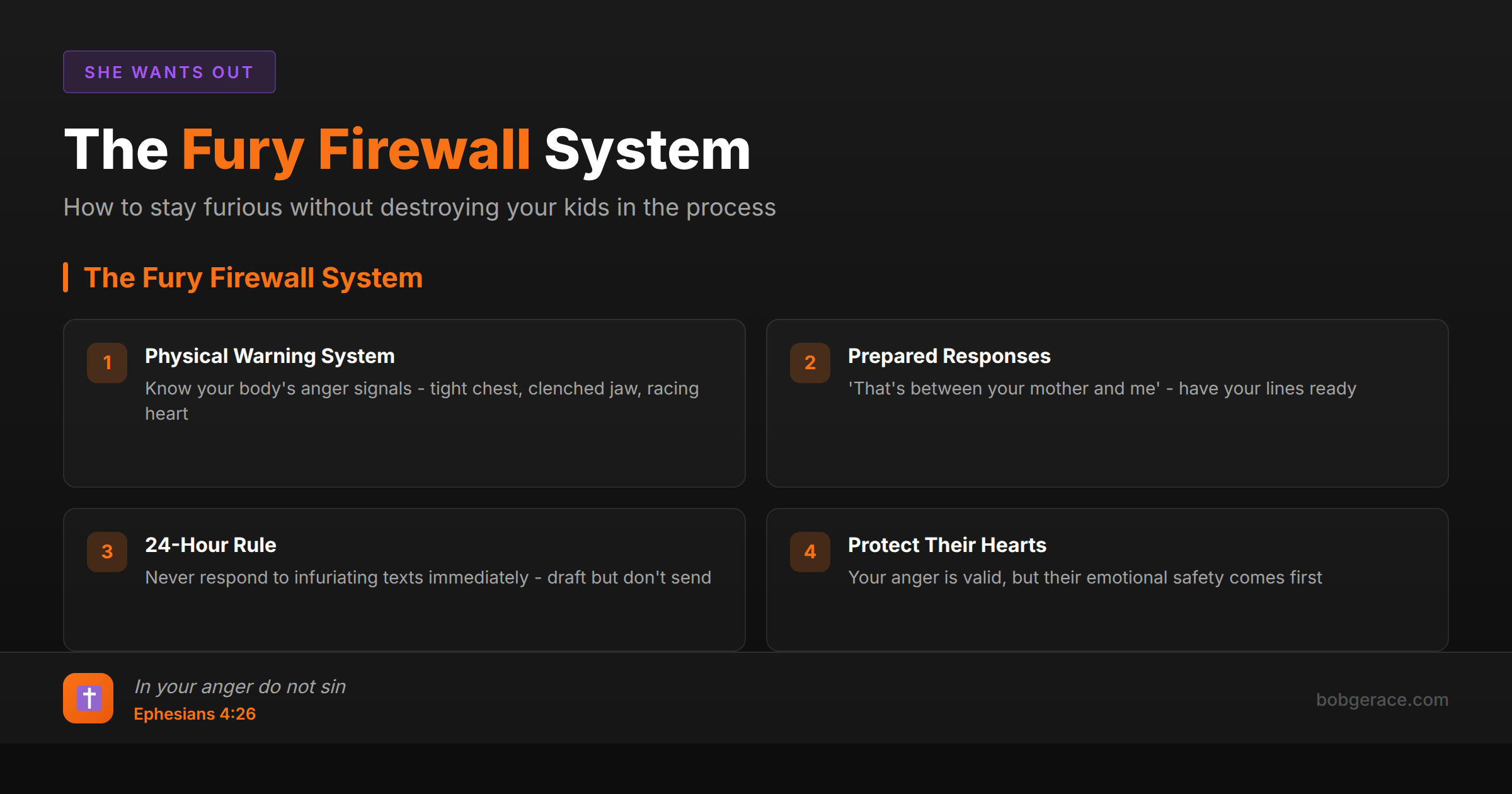
The fury you feel is real and valid - she's probably doing things that genuinely warrant your anger. But here's the hard truth: your children don't need to carry the weight of your rage. When you badmouth their mother, you're not just attacking her - you're attacking part of them. The key isn't to stop being angry. It's to create a firewall between your legitimate anger and your children's emotional safety. This means having a plan before the fury hits, because in the moment of rage, good intentions evaporate. You need practical systems that work when your emotions are running white-hot and your judgment is compromised.
The Full Picture
Your anger probably isn't irrational. Maybe she's manipulating the custody schedule, bad-mouthing you to the kids, or making unilateral decisions that affect your children. The frustration of feeling powerless while watching someone damage your kids is maddening.
But here's what happens when you give in to that fury:
• Your children absorb the message that their mother - half of their genetic identity - is terrible • They learn that explosive anger is an acceptable way to handle conflict • You lose credibility as the "stable parent" they desperately need • Court systems view parental alienation as disqualifying behavior
The most common mistakes fathers make:
Thinking the kids "need to know the truth" about their mother. They don't. They need to feel safe and loved by both parents, even when one parent is behaving poorly. Making sarcastic comments that seem harmless but carry poison. Kids are emotional detectives - they pick up on everything.
Assuming that staying quiet means being weak or letting her "win." Actually, it means you're strong enough to absorb pain to protect your children. That's not weakness - that's heroic.
The reality is this: Your children will eventually see the truth about both of you through your consistent actions, not your heated words. The parent who remains steady, loving, and refuses to drag them into adult conflicts is the one they'll trust and respect long-term. Your restraint today becomes their emotional security tomorrow.
What's Really Happening
From a psychological standpoint, what you're experiencing is emotional dysregulation triggered by perceived threats to your parental role and your children's wellbeing. The anger serves an evolutionary purpose - it's your brain's attempt to protect your offspring from perceived danger.
Research on Parental Alienation Syndrome shows that children exposed to one parent consistently badmouthing the other develop what we call "loyalty conflicts." They feel forced to choose sides, which creates anxiety, depression, and long-term relationship difficulties. Studies indicate that children of high-conflict divorces who are protected from inter-parental hostility show significantly better psychological adjustment.
The neurological reality is that when you're in a state of fury, your prefrontal cortex - responsible for decision-making and impulse control - is essentially offline. Your amygdala has hijacked your brain, making it nearly impossible to make rational choices in the moment.
The solution involves creating what therapists call "emotional scaffolding" - predetermined structures that support you when your natural regulatory systems fail. This includes identifying your physical warning signs (tension, heat, racing thoughts), having a prepared response script, and implementing immediate self-soothing techniques.
Cognitive Behavioral Therapy research shows that the most effective approach combines thought restructuring (changing how you interpret her actions) with behavioral interventions (specific actions that interrupt the anger cycle). The goal isn't to eliminate anger but to create space between the trigger and your response, protecting your children from the fallout.
What Scripture Says
Scripture addresses this battle directly. Ephesians 4:26-27 says, "In your anger do not sin: Do not let the sun go down while you are still angry, and do not give the devil a foothold." Notice it doesn't say don't be angry - it says don't sin in your anger. Your fury might be justified, but what you do with it determines whether it becomes destructive.
Proverbs 17:27-28 teaches, "The one who has knowledge uses words with restraint, and whoever has understanding is even-tempered. Even fools are thought wise if they keep silent, and discerning if they hold their tongues." Your restraint isn't weakness - it's wisdom that protects your children and preserves your witness.
James 1:19-20 instructs, "Everyone should be quick to listen, slow to speak and slow to become angry, because human anger does not produce the righteousness of God." Your children need to see godly character modeled, especially in the midst of conflict.
1 Corinthians 13:4-7 reminds us that love "is not easily angered" and "keeps no record of wrongs." This doesn't mean being a doormat - it means your love for your children supersedes your need to vent about their mother.
Proverbs 29:11 warns, "Fools give full vent to their rage, but the wise bring calm in the end." Your children are watching to see which kind of man their father is. Psalm 37:8 commands, "Refrain from anger and turn from wrath; do not fret - it leads only to evil." The evil here isn't just what happens to you - it's what happens to your children when they're caught in the crossfire of your rage.
What To Do Right Now
-
1
Create a physical anger warning system - identify the first physical signs (tight chest, clenched jaw, racing heart) and use them as immediate stop signals
-
2
Write down three prepared responses for when kids ask about mom: 'That's between your mother and me,' 'What matters is that we both love you,' 'I'm not going to discuss that with you'
-
3
Establish a 24-hour rule - never respond to infuriating texts or calls about co-parenting within 24 hours; draft responses but don't send them until you've cooled down
-
4
Find one trusted friend or counselor who can be your anger outlet - someone you can call or text when you need to vent without involving the children
-
5
Practice the redirect technique - when tempted to comment about their mother, immediately redirect to something positive about the child: 'Speaking of that, did I tell you how proud I am of you for...'
-
6
Develop a post-anger ritual - after feeling furious, do something that reconnects you with your role as protector: pray for your children, write them a note, or plan a special activity together
Related Questions
- How do I tell the kids?
- What do I say when kids ask what's happening?
- How do I co-parent during this?
- How do I support their relationship with her when she's hurting me?
- How do I be a good dad through this?
- What does faithful fatherhood look like through divorce?
- I can't control my anger
- How do I stop exploding?
- What does 'be angry and sin not' mean?
- How do I handle righteous anger without sin?
Also find Bob on
Subscribe for weekly videos on Christian marriage.
Your Kids. Your Fury. Your Marriage.
A coach who knows your specific situation can help you build the firewall before the next blowup — not generic advice, but calibrated to what's actually happening in your house.
Talk to Bob →