How do I repair if I've already exposed them to too much?
6 min read
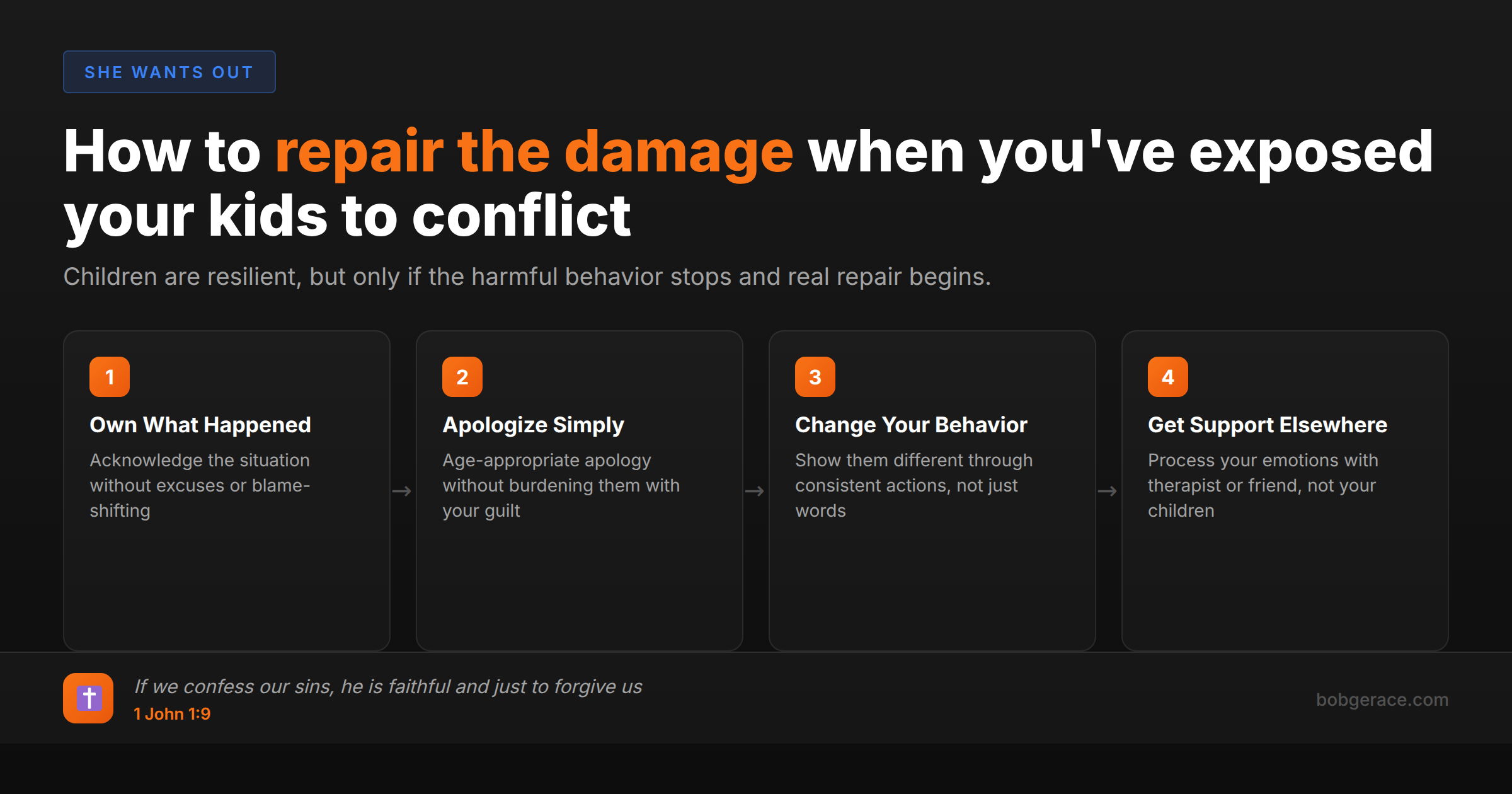
Acknowledge it, apologize appropriately, and change your behavior. Children are remarkably resilient — but only if the harmful behavior stops and repair happens. This doesn't mean burdening them with your guilt. It means a simple, age-appropriate apology ('I'm sorry you saw Daddy so upset. That wasn't your fault, and I'm working on handling things better.'), followed by consistently better behavior. Repair happens through action, not just words.
The Full Picture
You made mistakes. Maybe you fought in front of them. Vented to them. Used them as messengers. Let them see your worst. Now you're wondering if the damage is permanent.
It's not. But repair requires intentionality.
What repair looks like:
Acknowledge without burdening. A brief, age-appropriate acknowledgment that what they witnessed or experienced wasn't okay. 'I'm sorry you heard Mom and Dad fighting. That must have been scary. That's not how I want to handle things.'
Apologize simply. 'I'm sorry' — without justification, explanation, or blame-shifting. Not: 'I'm sorry I got upset, but your mother was being unreasonable.' Just: 'I'm sorry I got so upset. That wasn't fair to you.'
Name what will be different. 'I'm going to work on handling my feelings better. Grown-up problems are for grown-ups to solve, not kids.'
Change the behavior. Apology without change is manipulation. They need to see different, not just hear different.
Don't over-apologize. Excessive guilt and repeated apologies burden children with your emotional needs. Apologize appropriately, then show them through action.
What not to do:
- Don't explain or justify your behavior to them - Don't blame their mother as part of your apology - Don't make them reassure you ('It's okay, Dad') - Don't keep bringing it up — apologize, change, move on - Don't expect immediate forgiveness or behavioral change from them
What's Really Happening
Research on rupture and repair in parent-child relationships offers hope: repair is not only possible but can actually strengthen relationships when done well.
The neuroscience of repair:
When children experience frightening or overwhelming parental behavior, their attachment system becomes activated. They need to restore a sense of safety. Effective repair provides this restoration.
Research by Ed Tronick and others shows that parent-child relationships are characterized by constant cycles of attunement, disruption, and repair. What matters is not perfection but the reliable return to connection after disruption.
What effective repair requires:
1. Acknowledgment — the child needs to know you understand what happened was not okay 2. Accountability — taking responsibility without excuse or blame 3. Attunement — showing you understand how it affected them 4. Action — demonstrable change in behavior
What helps children heal:
- Seeing the parent regulate themselves effectively going forward - Experiencing consistent safety and predictability - Having permission to feel whatever they feel about what happened - Not being asked to caretake the parent's guilt - Time — healing isn't instant
Clinical caution:
If exposure was severe or prolonged — chronic high conflict, involving children in adult matters repeatedly, //blog.bobgerace.com/emotional-overwhelm-christian-marriage-science-solutions/:emotional reliance on children — consider professional support. A child therapist can provide a safe space for processing that may be needed beyond your repair efforts.
What Scripture Says
1 John 1:9: 'If we confess our sins, he is faithful and just to forgive us our sins and to cleanse us from all unrighteousness.' Confession brings cleansing. With God and, appropriately, with those we've harmed — including our children.
James 5:16: 'Therefore, confess your sins to one another and pray for one another, that you may be healed.' Confession to those we've harmed is part of healing — both theirs and ours.
Proverbs 28:13: 'Whoever conceals his transgressions will not prosper, but he who confesses and forsakes them will obtain mercy.' Confession alone isn't enough. Forsaking — stopping the behavior — is required for mercy.
Luke 17:3-4: 'If your brother sins, rebuke him, and if he repents, forgive him.' Repentance includes change. Your children may not immediately respond with trust or warmth. That's okay. Keep demonstrating repentance through action.
Ezekiel 18:21-22: 'If a wicked person turns away from all his sins that he has committed... he shall surely live; he shall not die. None of the transgressions that he has committed shall be remembered against him.' God's model is complete forgiveness when genuine repentance occurs. Your relationship with your children can be restored.
What To Do Right Now
-
1
Acknowledge what happened. Find an appropriate moment: 'I want to talk about what you saw/heard. That wasn't okay, and I'm sorry.'
-
2
Keep it brief and age-appropriate. Don't over-explain or burden them with your process. A few sentences is enough.
-
3
Don't blame their mother as part of your apology. Own your behavior fully.
-
4
Change your behavior. Apology means nothing if the harmful patterns continue. They need to see different.
-
5
Get your emotional support elsewhere. Therapist, friend, support group — so you don't leak onto them again.
-
6
Consider professional help for them. If exposure was significant or prolonged, a child therapist can help them process safely.
Related Questions
- How do I tell the kids?
- What do I say when kids ask what's happening?
- Kids are caught in the middle — how do I protect them?
- What are signs my kids are struggling?
- How do I be a good dad through this?
- What do kids need most from dad during divorce?
- I can't control my anger
- I said things I can't take back
- What does real forgiveness look like?
Also find Bob on
Subscribe for weekly videos on Christian marriage.
You Don't Have to Figure This Out Alone
Repair is real work, and it's specific to your marriage and your kids. A coach who knows your story can help you calibrate what to say, when to back off, and how to rebuild trust without making it worse.
Talk to Bob →