How do I surrender without giving up?
6 min read
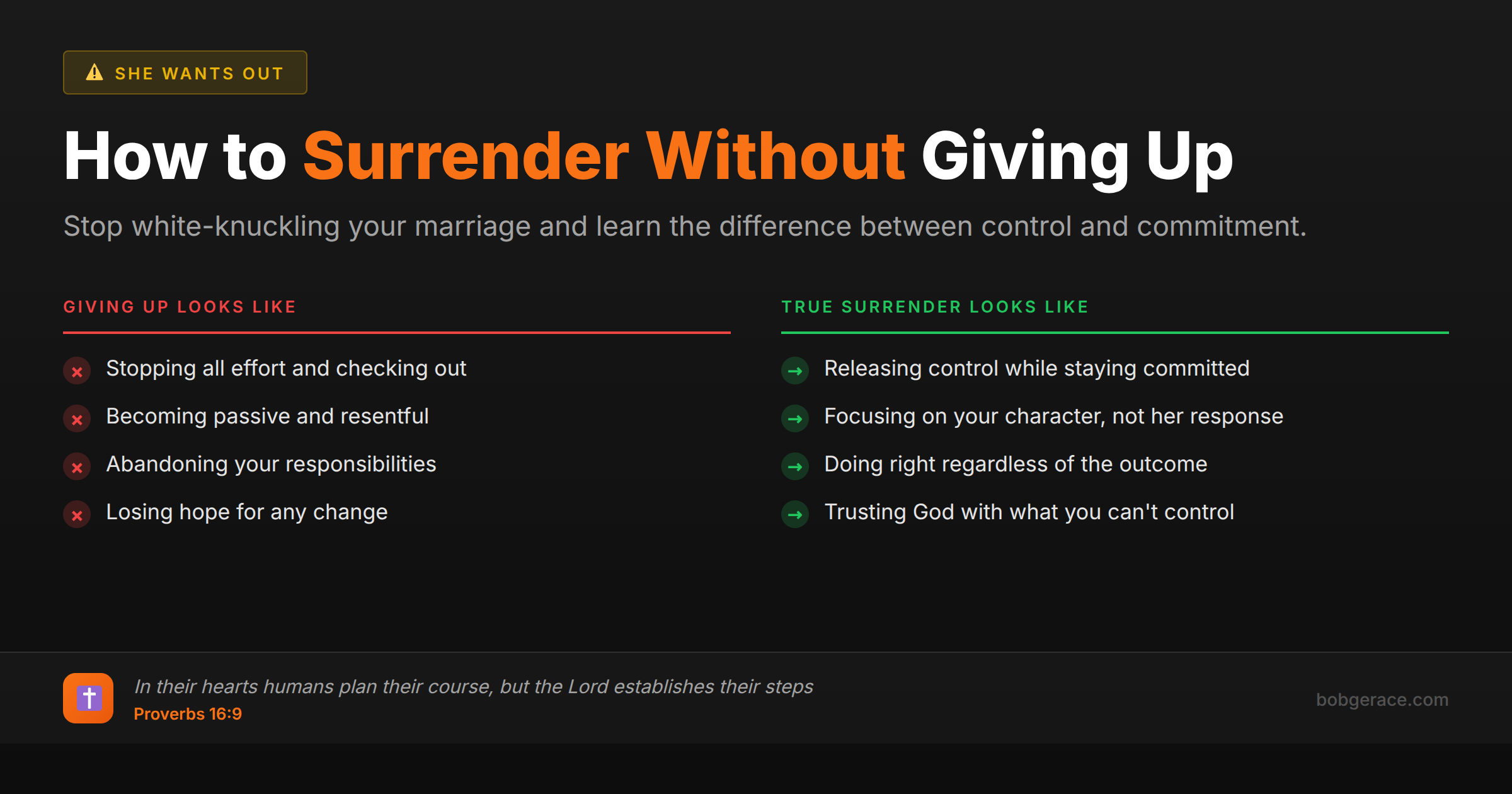
Surrendering without giving up means releasing control while maintaining hope and commitment. It's letting go of your desperate attempts to fix, control, or manipulate the outcome while continuing to do the right things for the right reasons. Think of it like loosening your grip on a rope - you're not letting go entirely, but you're no longer white-knuckling it until your hands bleed. True surrender is actually an act of strength, not weakness. You stop trying to be God in your marriage and start trusting that He can work in ways you can't. You focus on what you can control - your character, your responses, your growth - while releasing what you can't control, which is her heart, her choices, and the timeline for healing.
The Full Picture
Most men confuse surrender with giving up because they've never learned the difference. Giving up is passive resignation - it's throwing in the towel, checking out emotionally, and saying "whatever happens, happens." Surrender is active trust - it's choosing to do the right thing regardless of the outcome.
Here's what surrender actually looks like in a marriage crisis:
• You stop trying to convince her you've changed and start simply being the man you need to be • You release the timeline for reconciliation while staying committed to the process • You quit bargaining with God and start accepting His will, even if it's not what you want • You focus on your character instead of her response to your character • You let go of control over her emotions, decisions, and healing journey
The paradox is that surrender often creates the space for breakthrough. When you stop being desperate and controlling, you become someone worth being attracted to again. When you stop making her recovery about you, she has room to actually heal.
Common mistakes men make: - Confusing surrender with being passive or lazy - Using "surrender" as a manipulation tactic ("See how spiritual I'm being?") - Surrendering for a few days, then going back to control mode when nothing changes - Surrendering the wrong things (like personal responsibility) while controlling the right things (like outcomes)
Real surrender requires you to stay engaged, keep working on yourself, keep showing love, and keep doing the hard work - all without attachment to immediate results.
What's Really Happening
From a psychological perspective, what we call "surrender" is actually a shift from external to internal locus of control. Men in marriage crisis often develop what we call "anxious attachment" behaviors - constantly seeking reassurance, trying to control outcomes, and becoming increasingly desperate as their efforts fail.
This creates a psychological phenomenon called "reactance theory" - the more you push, the more she pulls away. Your attempts to control her response actually trigger her need for autonomy and space. Surrender breaks this cycle by removing the psychological pressure.
Neurologically, chronic stress from trying to control uncontrollable outcomes keeps your brain in fight-or-flight mode. This impairs your prefrontal cortex - the part responsible for emotional regulation, empathy, and wise decision-making. Surrender activates your parasympathetic nervous system, allowing you to think clearly and respond rather than react.
The research supports this approach: Studies on "acceptance-based interventions" show that when individuals focus on what they can control while accepting what they can't, they experience reduced anxiety, improved relationships, and better problem-solving abilities.
Surrender also addresses what psychologists call "outcome dependency" - when your emotional state depends entirely on external results. This creates unstable mood patterns and erratic behavior that pushes your spouse further away. True surrender develops "process focus" - finding satisfaction and identity in doing the right thing regardless of immediate outcomes.
This isn't about becoming passive or indifferent. It's about becoming what we call "differentially engaged" - deeply involved in your own growth and right actions while emotionally detached from controlling her responses.
What Scripture Says
Scripture is filled with examples of surrender that leads to victory, not defeat. Proverbs 16:9 reminds us, "In their hearts humans plan their course, but the Lord establishes their steps." This is the essence of surrendering without giving up - you still make plans and take action, but you trust God with the results.
Matthew 11:28-30 shows us Jesus' model: "Come to me, all you who are weary and burdened, and I will give you rest. Take my yoke upon you and learn from me, for I am gentle and humble in heart, and you will find rest for your souls. For my yoke is easy and my burden is light." Notice He doesn't say to stop working - He says to work with Him instead of against Him.
Philippians 4:6-7 gives us the practical framework: "Do not be anxious about anything, but in every situation, by prayer and petition, with thanksgiving, present your requests to God. And the peace of God, which transcends all understanding, will guard your hearts and your minds in Christ Jesus." Surrender means taking your requests to God while trusting His timing and methods.
Psalm 37:4-5 promises, "Take delight in the Lord, and he will give you the desires of your heart. Commit your way to the Lord; trust in him and he will do this." The key word is "commit" - you're still actively walking a path, just trusting God with where it leads.
Romans 8:28 provides the foundation for hope: "And we know that in all things God works for the good of those who love him, who have been called according to his purpose." Surrender doesn't mean giving up on good outcomes - it means trusting that God can create good outcomes even from broken situations.
Biblical surrender is never passive. It's active trust combined with faithful obedience to what God has already revealed.
What To Do Right Now
-
1
Write down everything you're trying to control about your wife or marriage - then consciously release each item to God in prayer
-
2
Identify three things you CAN control today (your attitude, your words, your actions) and focus entirely on those
-
3
Stop asking "Is this working?" about your efforts and start asking "Is this right?" regardless of her response
-
4
Create a daily surrender ritual - spend 10 minutes each morning giving God your agenda for the day and asking for His instead
-
5
Practice responding to her with love and respect even when she doesn't respond the way you want - this builds surrender muscle
-
6
Set boundaries on your own desperate behaviors (checking her phone, demanding conversations, seeking constant reassurance) and stick to them
Related Questions
- Is my desperation faith or codependency?
- What's the difference between trusting God and being passive?
- How do I pray when I can't form words?
- What does it mean to 'cast my anxiety on Him'?
- How do I know if I'm in denial or in faith?
- What does healthy hope look like vs. fantasy?
- What does biblical forgiveness require of me?
- How do I pray through this?
- What does surrendered prayer look like?
Also find Bob on
Subscribe for weekly videos on Christian marriage.
You Don't Have to Figure This Out Alone
Surrender looks different in your specific marriage. A coach who knows your story can help you tell the difference between letting go and giving up.
Talk to Bob →