How does chronic stress affect her capacity for connection?
6 min read
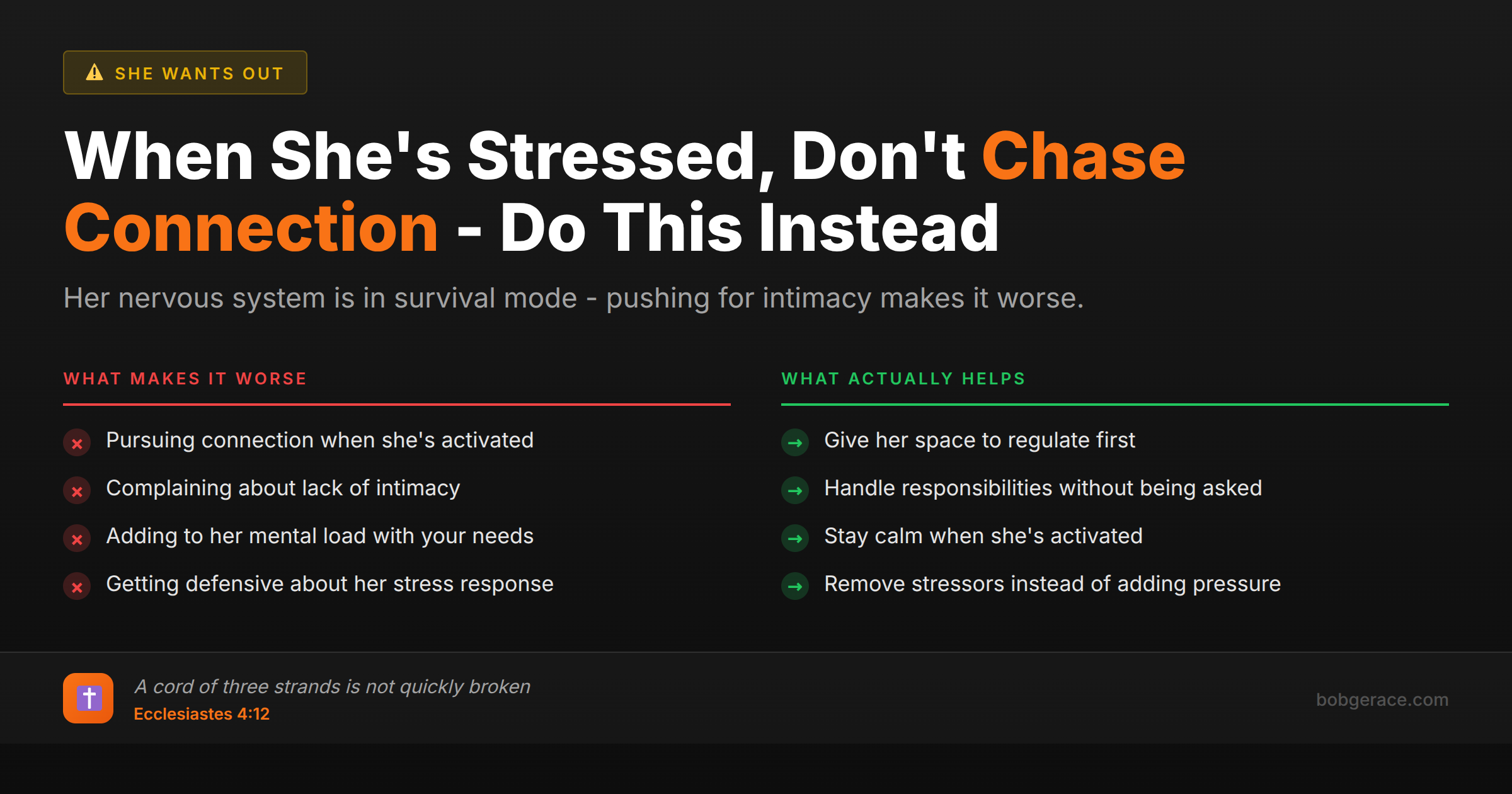
When your wife is chronically stressed, her nervous system gets stuck in survival mode. This isn't a choice she's making - it's biology. Her brain literally prioritizes threat detection over connection, making it nearly impossible for her to be emotionally available to you or anyone else. Think of it like this: when someone's drowning, they can't also give swimming lessons. Her stress response is so activated that connection feels dangerous, not desirable. She's not rejecting you personally; she's in a state where her nervous system can't access the parts of her brain responsible for bonding, empathy, and intimacy. Understanding this changes everything about how you approach her.
The Full Picture
Chronic stress doesn't just make your wife tired or irritable - it fundamentally rewires her nervous system in ways that make connection feel threatening rather than comforting. When stress hormones like cortisol flood her system day after day, her brain gets stuck in what's called hypervigilance - constantly scanning for danger and problems to solve.
In this state, your attempts at connection can actually feel like additional pressure rather than relief. Your touch might feel demanding. Your conversations might feel like more items on her endless to-do list. Even your presence might trigger her stress response if she's worried about disappointing you or managing your emotions on top of everything else.
Here's what chronic stress does to her connection capacity:
• Kills spontaneity - Everything becomes calculated based on energy reserves she doesn't have • Makes vulnerability dangerous - Opening up feels risky when she's already overwhelmed • Hijacks her empathy - She literally can't access the brain regions responsible for reading and responding to your emotions • Creates emotional numbness - Her system shuts down feeling to protect from overwhelm
The cruel irony? Connection is actually what her nervous system needs to heal, but stress makes connection feel impossible. This creates a vicious cycle where the very thing that would help her feels like another burden. Most men make this worse by pursuing harder when she withdraws, not understanding that pursuit feels like pressure when someone's already drowning.
What's Really Happening
From a neurobiological perspective, chronic stress fundamentally alters brain function in ways that directly impact relational capacity. When the nervous system is dysregulated, the prefrontal cortex - responsible for executive function, empathy, and social engagement - goes offline. Meanwhile, the amygdala becomes hyperactive, constantly scanning for threats.
This creates what we call neuroception of danger - Stephen Porges' term for the unconscious detection of threat. In this state, even safe relationships can trigger defensive responses. The autonomic nervous system shifts into sympathetic activation (fight-or-flight) or dorsal vagal shutdown (collapse/withdrawal). Neither state supports the co-regulation necessary for intimate connection.
Research shows that chronic stress: • Reduces oxytocin receptors, making bonding neurochemically more difficult • Increases inflammatory markers that affect mood and social behavior • Disrupts sleep patterns, further compromising emotional regulation • Creates cognitive rigidity, making problem-solving and perspective-taking nearly impossible
The polyvagal theory explains why traditional relationship advice fails here. You can't think your way out of nervous system dysregulation. Logic, communication techniques, and even genuine love can't penetrate a stress response that's been activated for months or years. What's needed is co-regulation - the process by which one regulated nervous system helps calm another. This requires the non-stressed partner to provide consistent, patient, non-demanding presence while the dysregulated partner's system slowly learns safety again.
What Scripture Says
Scripture provides profound insight into how we're designed for connection and how stress disrupts God's intent for marriage. Ecclesiastes 4:12 reminds us that "a cord of three strands is not quickly broken," but chronic stress frays those connecting strands, making what God designed to be strong feel fragile and vulnerable.
Isaiah 40:31 promises that "those who hope in the Lord will renew their strength. They will soar on wings like eagles; they will run and not grow weary, they will walk and not be faint." This speaks directly to how God designed us to handle life's pressures - through dependence on Him, not through white-knuckling our way through endless stress.
Matthew 11:28-30 shows Jesus' understanding of how overwhelming life can become: "Come to me, all you who are weary and burdened, and I will give you rest. Take my yoke upon you and learn from me, for I am gentle and lowly in heart, and you will find rest for your souls. For my yoke is easy and my burden is light." Notice that Jesus offers rest, gentleness, and lightness - exactly what a stress-flooded nervous system needs.
1 Peter 5:7 instructs us to "cast all your anxiety on him because he cares for you." This isn't just spiritual advice - it's neurobiological wisdom. Our systems were designed to find regulation through connection with our Creator.
Galatians 6:2 calls us to "carry each other's burdens," which in marriage means creating space for your wife's stress rather than adding to it. Ephesians 4:2 instructs us to "be completely humble and gentle; be patient, bearing with one another in love" - precisely what a dysregulated nervous system needs to find safety again.
What To Do Right Now
-
1
Stop pursuing connection when she's obviously stressed - give her nervous system space to regulate without the pressure of managing your needs
-
2
Create predictable moments of safety by handling responsibilities without being asked or acknowledged
-
3
Practice co-regulation by staying calm and grounded when she's activated - your regulated nervous system can help calm hers
-
4
Eliminate any behaviors that add to her stress load, including complaints about lack of connection or intimacy
-
5
Offer practical support without expecting gratitude or connection in return - let service be its own reward
-
6
Create buffer zones by protecting her from additional stressors you can control, like extended family pressure or social obligations
Related Questions
- What does 'dorsal vagal shutdown' look like in marriage?
- What would help her nervous system feel safe again?
- Why does she seem numb/flat/dead inside?
- What is 'freeze' in polyvagal terms?
- Can neural bonding pathways reopen?
- What have I done that made connection feel unsafe?
- What is 'betrayal trauma' and do I have it?
- What does chronic anger do to my nervous system?
- What does nervous system regulation look like?
- What is 'window of tolerance' and how do I widen mine?
Also find Bob on
Subscribe for weekly videos on Christian marriage.
Your Wife's Stress Isn't Generic
Neither is the path back to connection. A coach who knows your specific marriage can show you what to do when her nervous system is stuck and nothing you've tried is working.
Talk to Bob →