What happens neurologically when she sees my number pop up?
6 min read
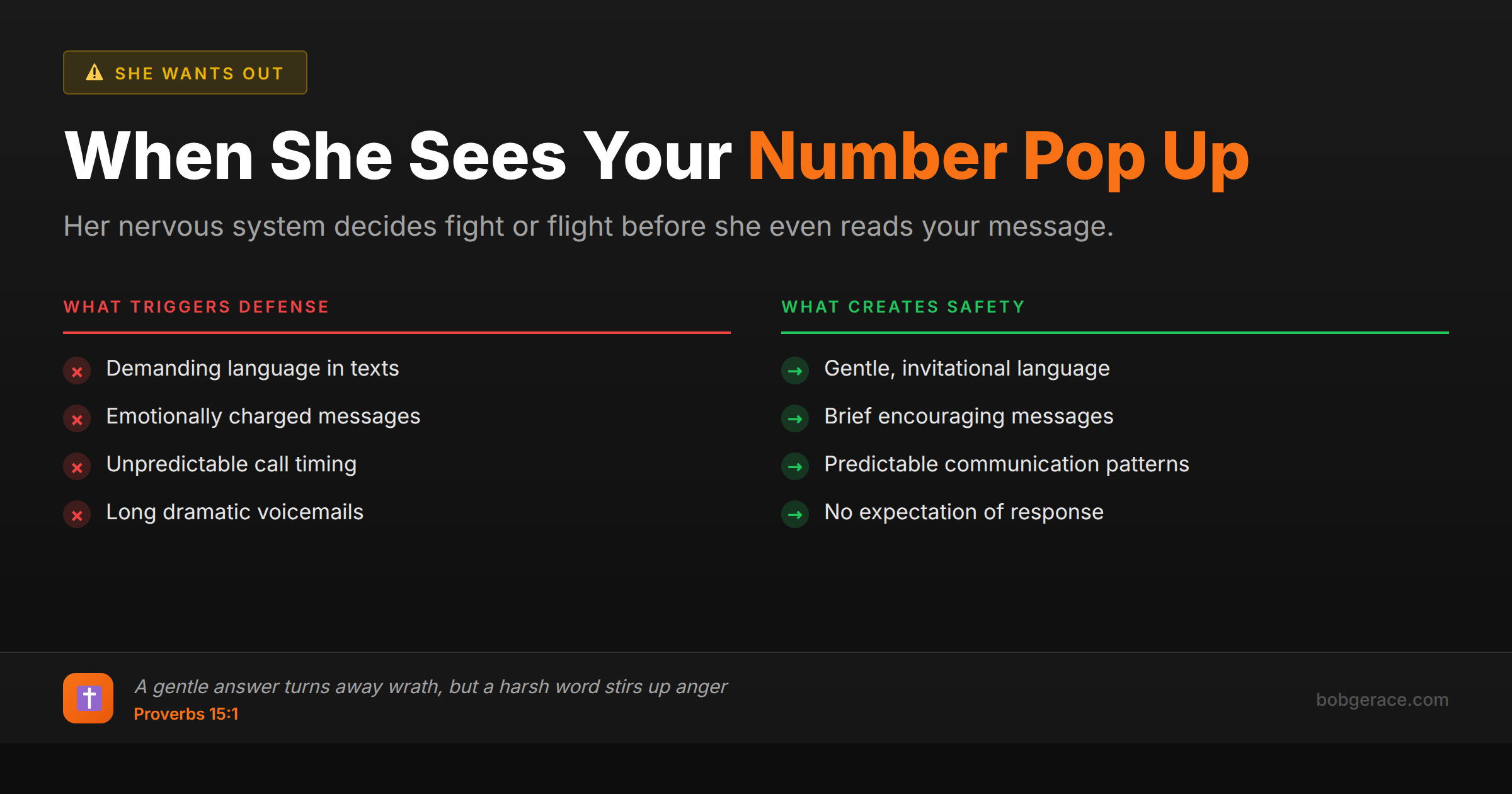
When your wife sees your number, her nervous system likely shifts into a defensive state - what researchers call sympathetic activation. Her amygdala, the brain's alarm center, scans for threat based on past interactions. If those interactions have been painful, her body literally prepares for danger: elevated heart rate, muscle tension, even shallow breathing. This isn't a conscious choice - it's her nervous system protecting her from what it perceives as potential emotional harm. The good news? Neural pathways can be rewired. Every positive interaction deposits safety into her nervous system account, gradually shifting her from fight-or-flight to connection and openness.
The Full Picture
Your wife's nervous system is constantly scanning for safety or threat. When your relationship has been strained, her brain has learned to associate your contact with potential conflict, disappointment, or emotional pain. This creates what neuroscientists call negative neural pathways.
Here's what's actually happening in her brain:
• Amygdala activation - Her threat detection center fires before rational thought kicks in • Stress hormone release - Cortisol and adrenaline flood her system • Memory recall - Past negative interactions surface automatically • Physical preparation - Her body literally prepares for conflict
The brutal truth? You might have unknowingly trained her nervous system to see you as a source of stress. Maybe through:
• Conversations that turned into arguments • Texts that felt demanding or needy • Calls during her overwhelmed moments • Messages that required emotional labor she didn't have
But here's what most men miss: her nervous system can learn safety again. Every interaction is either making a deposit or withdrawal from her emotional safety account. The key isn't grand gestures - it's consistent, predictable interactions that her nervous system can trust.
When she starts associating your contact with safety instead of stress, everything changes. Her shoulders relax when she sees your name. She actually looks forward to hearing from you. That's not wishful thinking - that's neuroscience working in your favor.
What's Really Happening
From a clinical perspective, what we're observing is conditioned emotional response combined with attachment system activation. Research in interpersonal neurobiology shows that our closest relationships literally shape our neural networks. When a marriage becomes distressed, the partner's presence can trigger what we call relational trauma responses.
Dr. John Gottman's research reveals that when couples are in distress, even neutral communications are perceived negatively. The wife's nervous system enters what Stephen Porges calls a polyvagal defensive state - either hypervigilance (fight/flight) or shutdown (freeze/fawn).
Here's the neurological sequence:
1. Visual stimulus (seeing his contact) triggers memory networks 2. Emotional memory activates faster than rational processing 3. Autonomic nervous system responds before conscious thought 4. Behavioral response follows neurological preparation
The therapeutic approach focuses on earned security - gradually reconditioning the nervous system through consistent, safe interactions. This process, called memory reconsolidation, allows new positive experiences to overwrite old negative neural patterns.
Clinically, I see transformation when men understand that rebuilding neural safety requires patience, consistency, and genuine behavior change. It's not about convincing her rationally - it's about helping her nervous system learn that he's safe again. This process typically takes 3-6 months of consistent positive interactions to create lasting change.
What Scripture Says
Scripture speaks directly to how we impact others through our words and presence. Proverbs 15:1 reminds us, *"A gentle answer turns away wrath, but a harsh word stirs up anger."* Our communication literally shapes our spouse's emotional state - including their nervous system response.
Ephesians 4:29 instructs: *"Do not let any unwholesome talk come out of your mouths, but only what is helpful for building others up according to their needs, that it may benefit those who listen."* Every text, every call should build her up, not tear her down.
The principle of 1 Peter 3:7 is crucial: *"Husbands, in the same way be considerate as you live with your wives, and treat them with respect as the weaker partner and as heirs with you of the gracious gift of life."* Being "considerate" includes understanding how your contact affects her emotionally and neurologically.
Proverbs 18:21 declares, *"The tongue has the power of life and death."* Your communications carry the power to bring life to her nervous system or trigger death-like defensive responses.
Jesus modeled perfect relational safety. Matthew 11:28-30 shows His invitation: *"Come to me, all you who are weary and burdened, and I will give you rest... For my yoke is easy and my burden is light."* When she sees your number, does her spirit expect rest or burden?
Colossians 4:6 provides the blueprint: *"Let your conversation be always full of grace, seasoned with salt, so that you may know how to answer everyone."* Grace-filled communication creates neural safety, allowing her nervous system to receive your contact as a gift, not a threat.
What To Do Right Now
-
1
Audit your recent texts and calls - identify patterns that might trigger her defensive responses
-
2
Implement the "24-hour rule" - wait a day before sending emotionally charged messages
-
3
Send one brief, encouraging text daily with no expectation of response
-
4
Make your calls predictable and brief - same time, clear purpose, respectful ending
-
5
Replace demanding language with invitational language in all communications
-
6
Track her response patterns to identify which types of contact feel safest to her
Related Questions
- Why does her nervous system need space from me?
- Am I a threat to her system right now?
- What does 'neuroception of danger' mean?
- How do I become a safe presence again?
- What is 'co-regulation' and why can't we do it?
- How does chronic stress affect her capacity for connection?
- What does my rage communicate to her attachment system?
- Why does my anger make her less safe not more attached?
- What does 'dorsal vagal shutdown' look like in marriage?
- What would help her nervous system feel safe again?
Also find Bob on
Subscribe for weekly videos on Christian marriage.
Your Marriage Isn't a Textbook Case
Understanding the neuroscience is one thing. Knowing what to do differently in your specific marriage—when she won't answer, when your timing's off, when you're guessing—is another. A coach sees what you can't.
Talk to Bob →