What indicators should I watch for?
6 min read
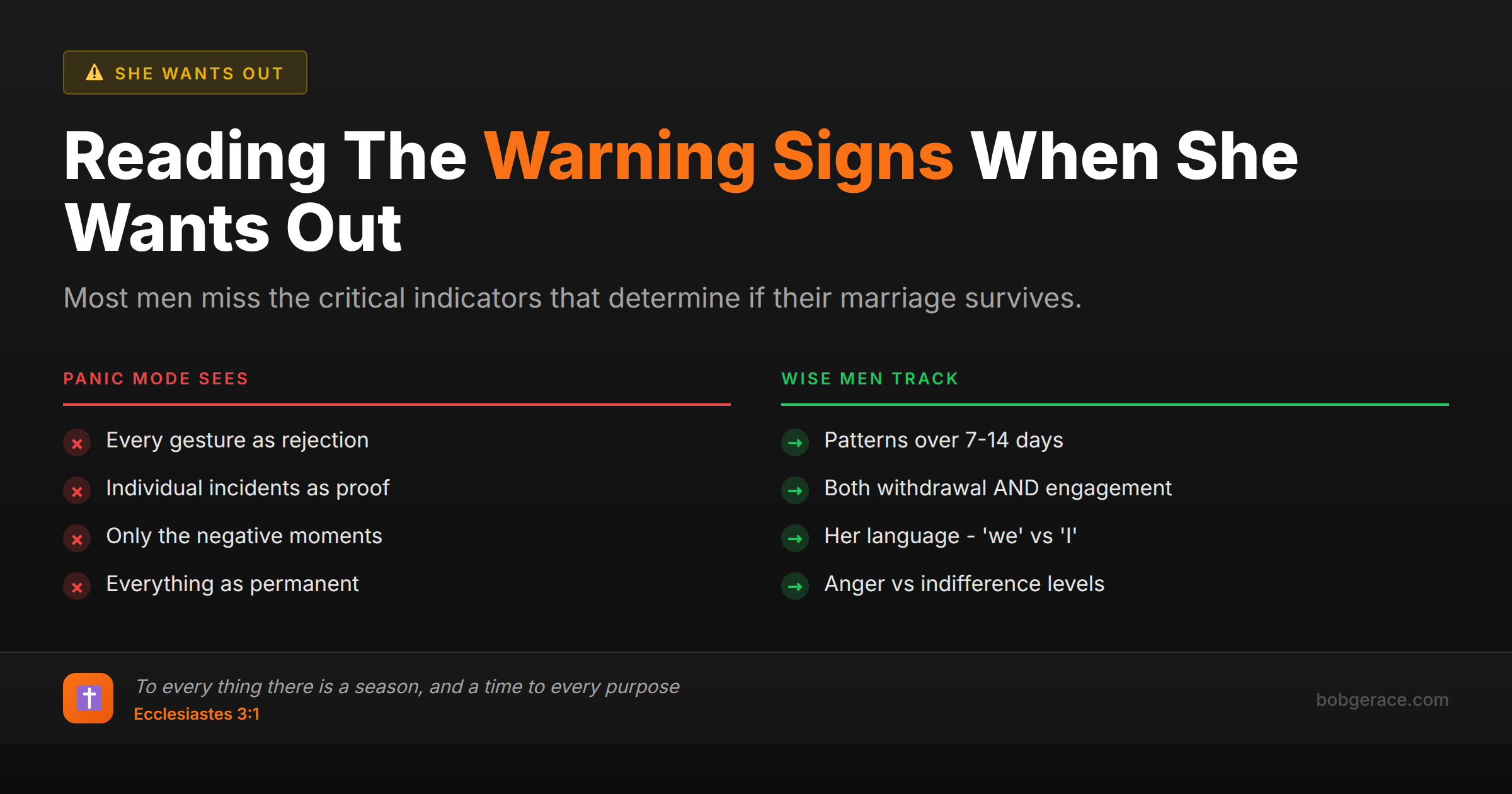
When your wife wants out, you need to become a student of both crisis indicators and signs of hope. The research is clear: there are specific behavioral patterns that predict whether a marriage will survive this crisis or not. Watch for withdrawal indicators - decreased communication, emotional distance, and disengagement from shared activities. But equally important are engagement indicators - moments when she still responds, shows concern, or participates in problem-solving. These aren't just random behaviors; they're data points that tell you where you really stand and what your next move should be. The key isn't obsessing over every gesture, but developing the emotional intelligence to recognize patterns that matter. Most men miss the subtleties because they're either in panic mode or denial. Neither serves you well right now.
The Full Picture
The Gottman Institute's research identifies four critical warning signs that predict divorce with 94% accuracy: contempt, criticism, defensiveness, and stonewalling. But when your wife already wants out, you're looking for different indicators - signs that tell you whether there's still fight left in her or if she's already emotionally divorced.
Crisis Indicators to Monitor: • Emotional temperature - Is she angry (still invested) or indifferent (checked out)? • Future language - Does she still use "we" or has everything become "I" and "you"? • Investment in conflict - Fighting can actually be good; silence is deadly • Physical presence - Is she avoiding shared spaces or still engaging in daily routines? • Decision-making patterns - Is she including you or making unilateral choices?
Hope Indicators to Recognize: • Moments of softness - Brief returns to old patterns of connection • Asking questions - Even critical ones show she's still engaged • Emotional reactions - Tears, frustration, even anger mean she still feels something • Participating in solutions - Willingness to try counseling, read books, or have difficult conversations
The biggest mistake men make is interpreting these indicators through their own emotional filter. When you're desperate to save your marriage, you'll either see hope where there isn't any or miss genuine opportunities because you're too focused on the negative. Context matters more than individual incidents. A week of cold distance after a major fight is different from months of gradual withdrawal.
What's Really Happening
From a clinical perspective, when a spouse expresses desire to leave, they're typically operating from one of three psychological states: acute crisis, chronic dissatisfaction, or emotional detachment. Each requires different indicators to monitor and different intervention strategies.
In acute crisis, emotions run high but attachment bonds remain. You'll see intense emotional reactions, continued engagement in conflict, and oscillation between connection and distance. Research shows these marriages have the highest recovery potential because the emotional system is still active.
Chronic dissatisfaction presents as persistent criticism, expressed frustration, and ongoing attempts to change the relationship dynamic. The key indicator here is continued investment in the outcome - she's still trying to make it work, even if it doesn't feel that way.
Emotional detachment is the most challenging state. Indicators include flat affect, absence of emotional reactivity, independent decision-making, and what we call 'emotional gray-rock' - minimal engagement without overt hostility. Neurologically, this represents deactivation of the attachment system.
Neurobiological indicators are particularly revealing. When someone is still emotionally invested, their nervous system remains reactive - you'll see physiological responses during important conversations. When they've detached, you'll notice an almost eerie calmness, even during discussions about divorce.
The trauma response also matters. If your relationship has involved betrayal or emotional injury, watch for signs of hypervigilance, emotional flooding, or complete shutdown. These aren't personal attacks - they're nervous system responses to perceived threat.
Clinically, the most reliable predictor isn't any single indicator but rather trajectory over time. Are the positive moments becoming more or less frequent? Is engagement increasing or decreasing? This temporal pattern reveals more about prognosis than any snapshot moment.
What Scripture Says
Scripture calls us to be wise observers who understand the times and seasons of our relationships. Ecclesiastes 3:1 reminds us, *"To every thing there is a season, and a time to every purpose under the heaven."* Recognizing indicators isn't about control - it's about stewardship of what God has entrusted to you.
Proverbs 27:14 warns us about misreading signs: *"He that blesseth his friend with a loud voice, rising early in the morning, it shall be counted a curse to him."* Sometimes what we interpret as positive indicators - her tolerance of our efforts, polite responses - might actually signal emotional distance rather than genuine engagement.
Wisdom requires discernment. Proverbs 20:5 says, *"Counsel in the heart of man is like deep water; but a man of understanding will draw it out."* Your wife's true feelings run deeper than surface behaviors. The indicators you should watch for aren't just her actions, but the heart behind them.
Matthew 7:20 teaches us, *"Wherefore by their fruits ye shall know them."* The fruit of genuine hope looks different from the fruit of obligation or fear. When your wife engages with you out of authentic desire to heal versus mere duty, the quality of that engagement will be evident over time.
Luke 14:28-30 speaks about counting the cost: *"For which of you, intending to build a tower, sitteth not down first, and counteth the cost, whether he have sufficient to finish it?"* Watching indicators isn't passive observation - it's active assessment of where to invest your limited emotional and relational resources.
God calls us to hope (Romans 15:13), but also to wisdom (James 1:5). These aren't contradictory. Biblical hope is grounded in truth, not wishful thinking. Watch for God's movement in your marriage, but don't manufacture signs that aren't there.
What To Do Right Now
-
1
Create a simple daily journal tracking her emotional temperature, engagement level, and any positive moments - no analysis, just facts
-
2
Stop interpreting individual incidents and start looking for patterns over 7-14 day periods
-
3
Ask yourself honestly: 'Is she angry or indifferent?' - anger means she still cares, indifference means she's checking out
-
4
Notice her language patterns - does she still say 'we' when talking about future plans or problems?
-
5
Pay attention to physical indicators - eye contact, body language, and whether she's creating or reducing physical distance
-
6
Track her willingness to engage in difficult conversations - avoidance is concerning, but participation (even angry participation) shows investment
Related Questions
- How long do I wait before giving up?
- When is it actually over?
- Is there a point of no return?
- What factors predict successful reconciliation?
- What distinguishes marriages that make it from those that don't?
- How do I know if I'm in denial or in faith?
- What are markers of genuine remorse vs. guilt?
- How do I know if he's really changing?
- What are the markers of genuine behavior change?
- What does real transformation look like?
Also find Bob on
Subscribe for weekly videos on Christian marriage.
Can't Tell What You're Actually Seeing?
A coach who knows your marriage can tell you what these patterns mean in your specific situation—and what to do next.
Talk to Bob →