What is 'closure' and do I need it to move on?
5 min read
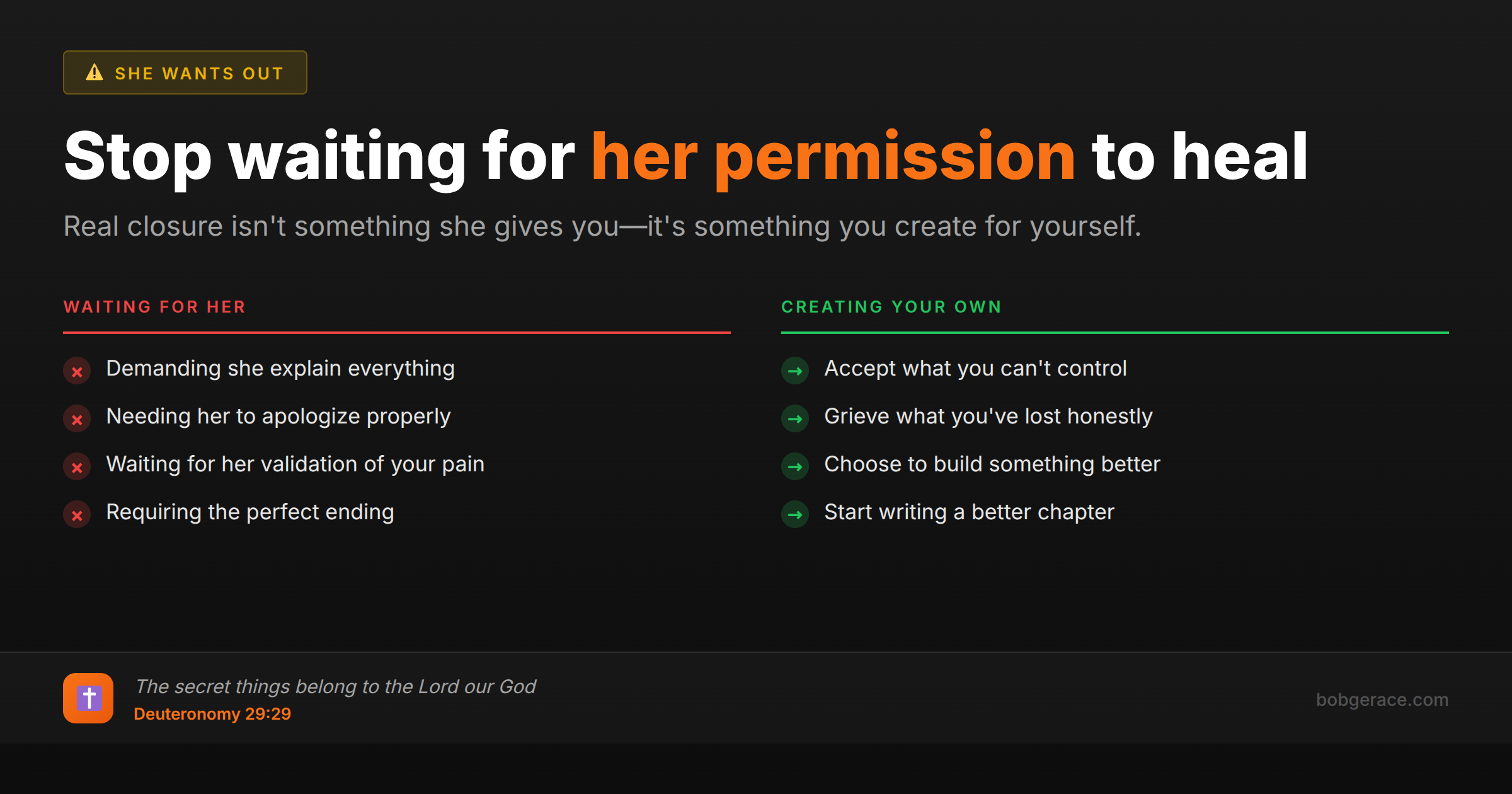
Closure is the mythical moment when everything makes perfect sense, all your questions get answered, and you feel complete peace about what happened. Here's the hard truth: you don't need her permission to heal. Closure isn't something she gives you—it's something you create for yourself. Most men wait for their wife to explain everything, apologize properly, or validate their pain before they'll allow themselves to move forward. That's giving her control over your healing process. Real closure comes from accepting what you can't control, grieving what you've lost, and choosing to build something better with or without her cooperation. You don't need the perfect ending to start writing a better chapter.
The Full Picture
The concept of closure has become one of the most destructive myths in modern relationships. We've been sold this idea that healing requires a neat, tidy conclusion where everyone understands everything and walks away feeling good. That's not how real life works.
Closure is often just another form of trying to control the uncontrollable. You're waiting for her to:
• Fully explain her reasons in a way that makes sense to you • Acknowledge your pain and validate your perspective • Give you permission to feel okay about the situation • Provide the "right" ending to your story
But here's what actually happens: the more you chase closure, the more power you give her over your healing. You become dependent on her cooperation to feel whole again. You put your emotional recovery in the hands of someone who may not be capable of giving you what you need.
Real closure isn't about getting answers—it's about accepting that some questions don't have satisfying answers. It's about grieving the relationship you thought you had and the future you planned together. It's about taking responsibility for your part without needing her to do the same.
The men who heal fastest aren't the ones who get the best explanations from their wives. They're the ones who stop waiting for external validation and start doing the internal work. They create their own sense of completion by focusing on what they can control: their choices, their growth, and their response to the situation.
What's Really Happening
From a psychological perspective, the pursuit of closure often represents an attempt to restore a sense of control and meaning after a traumatic relationship disruption. Research in attachment theory shows us that humans have a fundamental need for coherent narratives about their relationships, especially when those relationships end unexpectedly.
However, closure-seeking behavior can become a form of rumination—repetitive thinking that actually prolongs distress rather than resolving it. Studies indicate that people who actively pursue closure from their ex-partners show higher levels of depression and anxiety over time compared to those who focus on self-directed healing activities.
The brain's default mode network keeps searching for patterns and explanations, which is why you might find yourself replaying conversations or analyzing her behavior obsessively. This is normal, but it becomes problematic when it prevents forward movement.
What we see clinically is that genuine healing occurs through meaning-making, not answer-getting. This involves processing the emotional impact of the relationship, identifying lessons learned, and developing new coping strategies. The therapeutic concept of 'post-traumatic growth' suggests that people can actually emerge stronger from relationship trauma when they focus on internal development rather than external validation.
Effective closure is self-generated. It involves accepting ambiguity, tolerating uncertainty, and finding peace without needing every question answered. This shift from external to internal locus of control is often the turning point in recovery for men experiencing marital crisis.
What Scripture Says
Scripture offers a radically different perspective on closure than our culture promotes. Rather than requiring perfect understanding or complete resolution, biblical wisdom calls us to trust God's sovereignty even in confusing circumstances.
Deuteronomy 29:29 reminds us: *"The secret things belong to the Lord our God, but the things revealed belong to us and to our children forever."* Some things aren't meant to be fully understood by us. Your wife's complete motivations, her internal struggles, her decision-making process—these may remain mysteries, and that's okay.
Isaiah 55:8-9 declares: *"For my thoughts are not your thoughts, neither are your ways my ways, declares the Lord. As the heavens are higher than the earth, so are my ways higher than your ways and my thoughts than your thoughts."* God's plan often doesn't make sense from our limited perspective, but we're called to trust His goodness regardless.
Romans 8:28 provides the ultimate framework for closure: *"And we know that in all things God works for the good of those who love him, who have been called according to his purpose."* This doesn't mean everything that happens is good, but that God can work even painful circumstances for our ultimate benefit.
Philippians 3:13-14 shows us how to move forward: *"Brothers and sisters, I do not consider myself yet to have taken hold of it. But one thing I do: Forgetting what is behind and straining toward what is ahead, I press on toward the goal to win the prize."* Biblical closure involves releasing the past and pursuing God's future for you.
The biblical model isn't about getting all your questions answered—it's about trusting God's character when life doesn't make sense.
What To Do Right Now
-
1
Write down every question you're waiting for her to answer, then consciously choose to release your need for those specific answers
-
2
Create your own meaning from this experience by identifying three ways you've grown or learned, regardless of her participation
-
3
Set a specific deadline for ending closure-seeking behaviors—no more asking for explanations or demanding deeper conversations about the past
-
4
Focus your energy on controllable actions: your health, your relationship with God, your personal development, your friendships
-
5
Practice accepting uncertainty by daily choosing trust over understanding, especially when anxiety about unanswered questions arises
-
6
Begin building new routines and goals that don't depend on her cooperation or validation to feel meaningful
Related Questions
- How long do I wait before giving up?
- When is it actually over?
- Is there a point of no return?
- How do I grieve a marriage that isn't dead yet?
- What does the 'ambiguous loss' of marital limbo do to a person?
- What's the difference between standing and stagnating?
- Will I ever get over this?
- How long does recovery take?
- What does full recovery actually look like?
- What is 'post-traumatic growth'?
Also find Bob on
Subscribe for weekly videos on Christian marriage.
You Don't Have to Figure This Out Alone
A coach who knows your specific marriage can help you stop waiting and start building the closure you need. Bring your story to someone in your corner.
Talk to Bob →