What role does sleep/exercise/nutrition play in change capacity?
6 min read
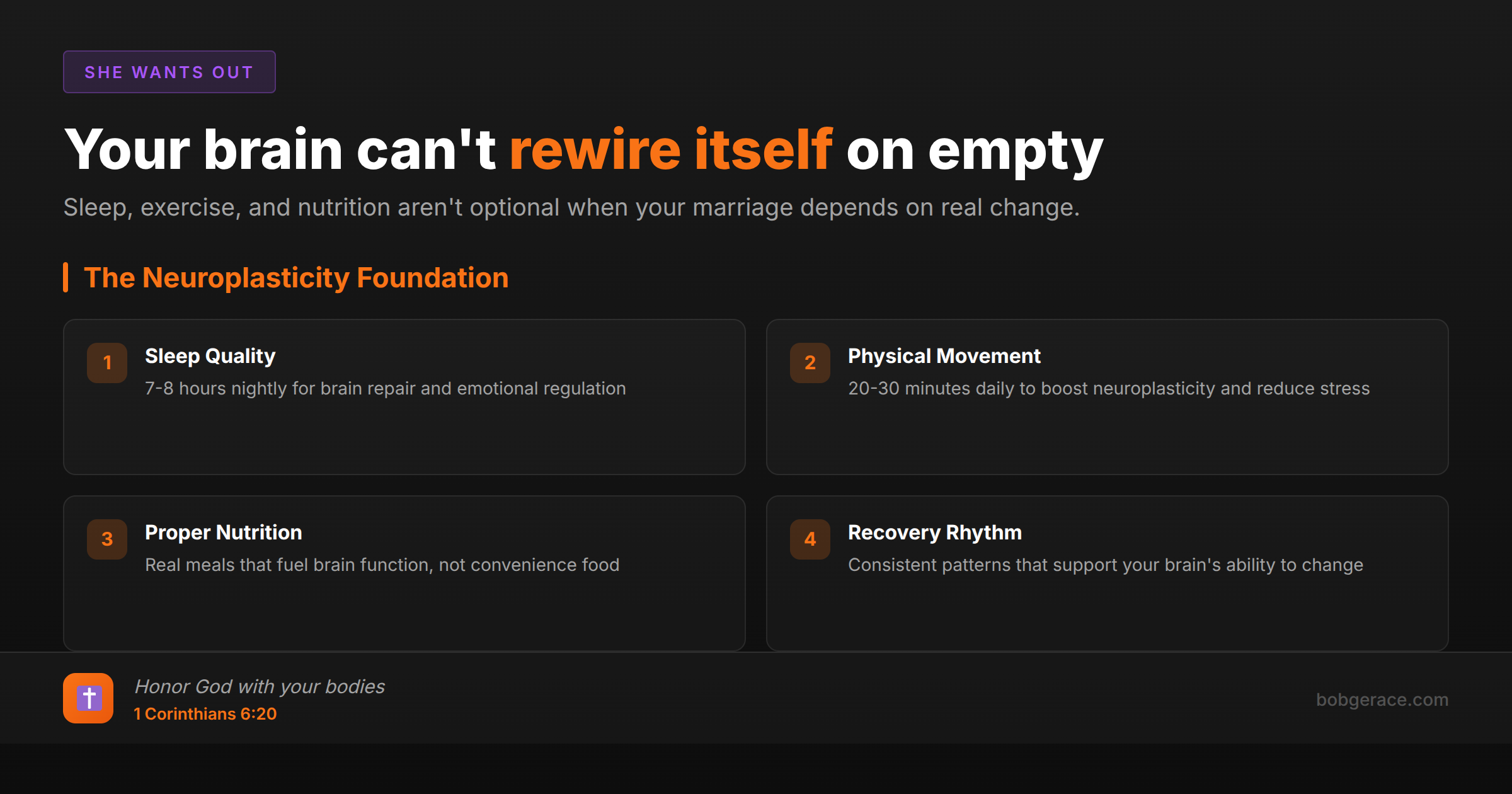
Your brain's ability to change - what scientists call neuroplasticity - is directly tied to how well you sleep, move, and fuel your body. When you're running on four hours of sleep, living on fast food, and haven't moved your body in weeks, you're asking your brain to perform miracles with subpar equipment. It's like expecting a car to run well on empty while the engine is overheating. The harsh truth? Your wife has been watching you neglect the basics while expecting massive personal transformation. Your brain needs optimal conditions to rewire old patterns, process emotions, and build new neural pathways. Without proper sleep, exercise, and nutrition, you're fighting an uphill battle against your own biology.
The Full Picture
Your brain is not a computer that runs the same regardless of conditions. It's more like a high-performance athlete that needs proper rest, fuel, and training to perform. When marriages are in crisis, men often abandon self-care, thinking it's selfish or unnecessary. This is backward thinking that sabotages your change efforts.
Sleep is where your brain consolidates new learning. During deep sleep, your brain literally reorganizes itself, strengthening new neural pathways and clearing out toxins. When you're sleep-deprived, you lose emotional regulation, decision-making capacity, and the ability to form new memories. Studies show that even one night of poor sleep reduces your prefrontal cortex function - the part of your brain responsible for impulse control and emotional regulation.
Exercise acts like fertilizer for your brain. Physical activity increases BDNF (brain-derived neurotrophic factor), which helps grow new brain cells and connections. It also reduces cortisol, the stress hormone that can literally shrink your hippocampus over time. Men who exercise regularly show better emotional regulation and stress management.
Nutrition provides the building blocks for neurotransmitters. Your brain runs on glucose, but it also needs amino acids to make serotonin and dopamine, the chemicals that regulate mood and motivation. Poor nutrition creates brain fog, mood swings, and reduced willpower.
Here's what most guys miss: your wife notices when you don't take care of yourself. She sees the late-night scrolling, the skipped meals, the sedentary lifestyle. It signals that you don't value yourself enough to maintain basic health, which makes her question your ability to value the marriage enough to change.
What's Really Happening
From a neurobiological perspective, sleep, exercise, and nutrition form what we call the 'triangle of neuroplasticity.' Each point supports the brain's ability to form new neural pathways and break old, destructive patterns.
Sleep research shows that REM sleep is crucial for emotional processing and memory consolidation. Men in marital crisis often experience sleep disruption due to stress, creating a vicious cycle. Poor sleep leads to increased cortisol, which further disrupts sleep architecture. This directly impairs the prefrontal cortex's ability to regulate the amygdala, leading to more emotional reactivity and less thoughtful responses.
Exercise research demonstrates that aerobic activity increases hippocampal volume and enhances executive function. For men working on behavioral change, this translates to better impulse control, improved mood regulation, and enhanced cognitive flexibility - all essential for breaking ingrained relationship patterns.
Nutritionally, the gut-brain axis plays a crucial role in mood regulation. The majority of serotonin is produced in the gut, and inflammatory foods can trigger neuroinflammation, affecting cognitive function and emotional stability. Men consuming high-processed diets show increased rates of depression and anxiety.
What's particularly relevant for marriage work is that these three factors directly impact what psychologists call 'cognitive load' - your brain's capacity to handle complex information and make good decisions. When you're running on empty physically, you have less mental resources available for the hard work of relationship change, conflict resolution, and emotional regulation.
What Scripture Says
Scripture consistently presents our bodies as temples that deserve honor and care, not obstacles to spiritual growth. 1 Corinthians 6:19-20 reminds us: "Do you not know that your bodies are temples of the Holy Spirit, who is in you, whom you have received from God? You are not your own; you were bought at a price. Therefore honor God with your bodies."
This isn't about vanity - it's about stewardship. God gave you a physical body to house your spirit and accomplish His purposes, including loving your wife well.
1 Corinthians 9:27 shows Paul's approach: "But I discipline my body and keep it under control, lest after preaching to others I myself should be disqualified." Paul understood that physical discipline supported spiritual effectiveness.
Ecclesiastes 3:1 teaches us that there is "a time for everything," including rest. The concept of Sabbath isn't just about worship - it's about recognizing our human limitations and need for restoration. Psalm 127:2 warns that "it is in vain that you rise up early and go late to rest, eating the bread of anxious toil."
Daniel 1:8-16 demonstrates how physical choices affect mental and spiritual capacity. Daniel's commitment to proper nutrition resulted in better health and wisdom than those who neglected these basics.
The biblical principle is clear: caring for your physical body isn't selfish - it's essential for being the husband God called you to be. When you neglect sleep, exercise, and nutrition, you're not being more spiritual or sacrificial. You're being a poor steward of the resources God gave you to love and serve others.
What To Do Right Now
-
1
Set a non-negotiable bedtime that gives you 7-8 hours of sleep and stick to it for seven days straight
-
2
Schedule 20-30 minutes of movement daily - walking, lifting, swimming - whatever you'll actually do consistently
-
3
Plan and prep three real meals for tomorrow instead of grabbing whatever's convenient
-
4
Remove your phone from your bedroom tonight and use an actual alarm clock
-
5
Write down your current sleep, exercise, and eating patterns for three days to see the real picture
-
6
Ask your wife what she's noticed about your self-care habits - then listen without defending
Related Questions
- What is 'neuroplasticity' and how do I leverage it?
- How long until new behaviors become automatic?
- What is 'white-knuckling' vs. real transformation?
- Why do old patterns come back when I'm triggered?
- How do I rewire trauma responses?
- What are the 'stages of change' and where am I?
- How do I manage my nervous system through legal proceedings?
- What does self-care look like in this season?
- What is 'window of tolerance' and how do I widen mine?
- What does chronic anger do to my nervous system?
Also find Bob on
Subscribe for weekly videos on Christian marriage.
Your Biology Isn't the Only Variable
Sleep and exercise matter, but so does having someone who knows your specific marriage—what's actually blocking change for you, not just what blocks change in general.
Talk to Bob →