How do I know if my hypervigilance is appropriate or pathological?
6 min read
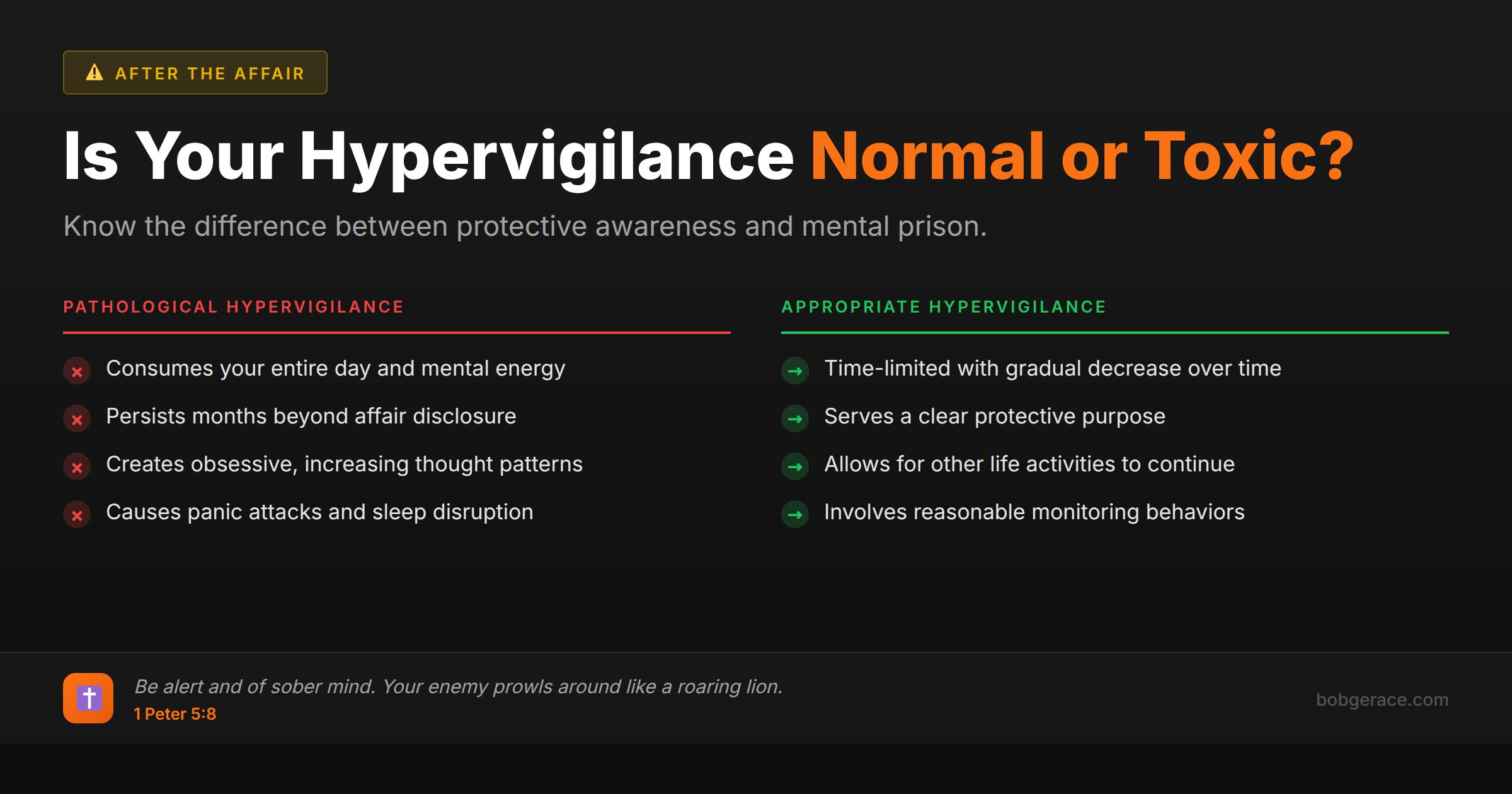
Appropriate hypervigilance after an affair is time-limited, purposeful, and gradually decreases as trust rebuilds. It involves reasonable monitoring behaviors that don't consume your entire day or mental energy. Pathological hypervigilance, however, persists months beyond disclosure, interferes with daily functioning, and creates obsessive thought patterns that increase rather than decrease over time. The key difference lies in functionality and duration. Normal post-affair vigilance serves a protective purpose and allows for other life activities. Pathological hypervigilance becomes an all-consuming mental prison that prevents healing and relationship progress. If your vigilance is causing panic attacks, sleep disruption, or inability to focus on work or family for weeks on end, you've crossed into pathological territory and need professional intervention.
The Full Picture
After discovering an affair, your brain shifts into survival mode, and hypervigilance becomes your default setting. This isn't weakness—it's your mind's attempt to prevent future harm. But understanding when this natural response becomes problematic is crucial for your recovery.
Normal post-affair vigilance typically: - Lasts 3-6 months at peak intensity - Focuses on specific, relevant behaviors - Allows for moments of peace and other activities - Gradually decreases as safety increases - Responds positively to reassurance and evidence
Pathological hypervigilance shows these patterns: - Persists beyond 6-12 months without improvement - Expands to monitor irrelevant details - Consumes 80% or more of your mental energy - Increases in intensity despite positive evidence - Creates physical symptoms like chronic fatigue or panic
The difference often lies in trauma processing. When the initial shock isn't properly worked through, your nervous system remains stuck in threat-detection mode. Your brain keeps scanning for danger even when the immediate crisis has passed.
Consider the functionality test: Can you still parent effectively? Perform at work? Enjoy a meal or conversation without intrusive thoughts? If hypervigilance has hijacked these basic functions for more than a few months, you're dealing with trauma that needs professional attention.
Remember, seeking help for pathological hypervigilance isn't giving up on accountability—it's ensuring you're mentally equipped to do the hard work of rebuilding your marriage.
What's Really Happening
From a clinical perspective, hypervigilance exists on a spectrum from adaptive to maladaptive. After infidelity, some level of increased monitoring is not only normal but evolutionarily protective. The challenge //blog.bobgerace.com/biblical-headship-marriage-feminist-lies/:lies in recognizing when this response has shifted from helpful to harmful.
Neurologically, pathological hypervigilance indicates that your amygdala—your brain's alarm system—has become hypersensitive and is firing constantly. This creates a cascade of stress hormones that, over time, can lead to anxiety disorders, depression, and PTSD-like symptoms.
I use several clinical markers to assess hypervigilance severity: Intensity (how strong are the feelings?), Duration (how long do episodes last?), Frequency (how often do they occur?), and Functional Impairment (what life areas are affected?). When clients report that vigilant thoughts occupy more than 4-6 hours daily after the initial crisis period, we're typically looking at pathological levels.
The good news is that pathological hypervigilance responds well to targeted interventions. EMDR, cognitive behavioral therapy, and somatic approaches can help reset your nervous system. The key is early intervention—the longer these patterns persist, the more entrenched they become.
It's also important to distinguish between hypervigilance and appropriate boundary-setting. Checking your spouse's phone occasionally might be reasonable; forensically analyzing every text timestamp is not. The former serves relationship repair; the latter serves anxiety.
What Scripture Says
Scripture acknowledges both the need for wisdom in relationships and the call to find peace in God's sovereignty. The Bible doesn't ask us to be naive, but it also warns against the destructive power of anxiety and obsessive thoughts.
"Be alert and of sober mind. Your enemy the devil prowls around like a roaring lion looking for someone to devour." (1 Peter 5:8) This verse validates appropriate vigilance—we're called to be alert, not oblivious to genuine threats.
"Therefore do not worry about tomorrow, for tomorrow will worry about itself. Each day has enough trouble of its own." (Matthew 6:34) Jesus directly addresses the futility of obsessive worry about future possibilities, which is exactly what pathological hypervigilance creates.
"You will keep in perfect peace those whose minds are steadfast, because they trust in you." (Isaiah 26:3) God's design for our minds is peace, not constant turmoil. When hypervigilance prevents this peace for months on end, we've moved beyond biblical wisdom into harmful anxiety.
"Above all else, guard your heart, for everything you do flows from it." (Proverbs 4:23) This isn't about paranoid guarding but wise protection. There's a difference between guarding your heart and imprisoning it.
"Cast all your anxiety on him because he cares for you." (1 Peter 5:7) God invites us to transfer our hypervigilant burden to Him, recognizing that constant self-monitoring was never His intention for marriage recovery.
Biblical vigilance trusts God's justice while taking reasonable precautions. Pathological hypervigilance trusts only our own ability to detect and prevent every possible threat—a burden too heavy for any human to carry.
What To Do Right Now
-
1
Track your vigilant thoughts for one week using a simple tally system—mark each time you check, monitor, or investigate something affair-related
-
2
Assess functionality by rating (1-10) how well you're performing basic tasks like work, parenting, or self-care compared to before the affair
-
3
Set specific times for 'checking behaviors' rather than doing them impulsively—limit phone checks or questions to designated periods
-
4
Practice the 5-4-3-2-1 grounding technique when hypervigilant thoughts spiral: name 5 things you see, 4 you hear, 3 you touch, 2 you smell, 1 you taste
-
5
Create a safety plan with your spouse that includes specific transparency measures, reducing the need for constant monitoring
-
6
Schedule professional assessment if vigilant thoughts consume more than 3-4 hours daily or persist beyond 6 months without improvement
Related Questions
- What is 'hypervigilance' and why am I doing it?
- Why can't I stop obsessing over details?
- When does wanting to know become obsessive?
- How do I stop the mental movies?
- What is the 'trauma loop' and how do I interrupt it?
- What are the stages of betrayal trauma recovery?
- What is 'window of tolerance' and how do I widen mine?
- What's happening in my nervous system right now?
- What does nervous system regulation look like?
- What is triggered vs. legitimately upset?
Also find Bob on
Subscribe for weekly videos on Christian marriage.
Bring Your Actual Pattern to Bob
If you're not sure whether what you're doing is normal or stuck, a coach who knows your marriage can tell you. Bob calibrates to where you are, not a textbook.
Talk to Bob →