How do I model grace without enabling?
6 min read
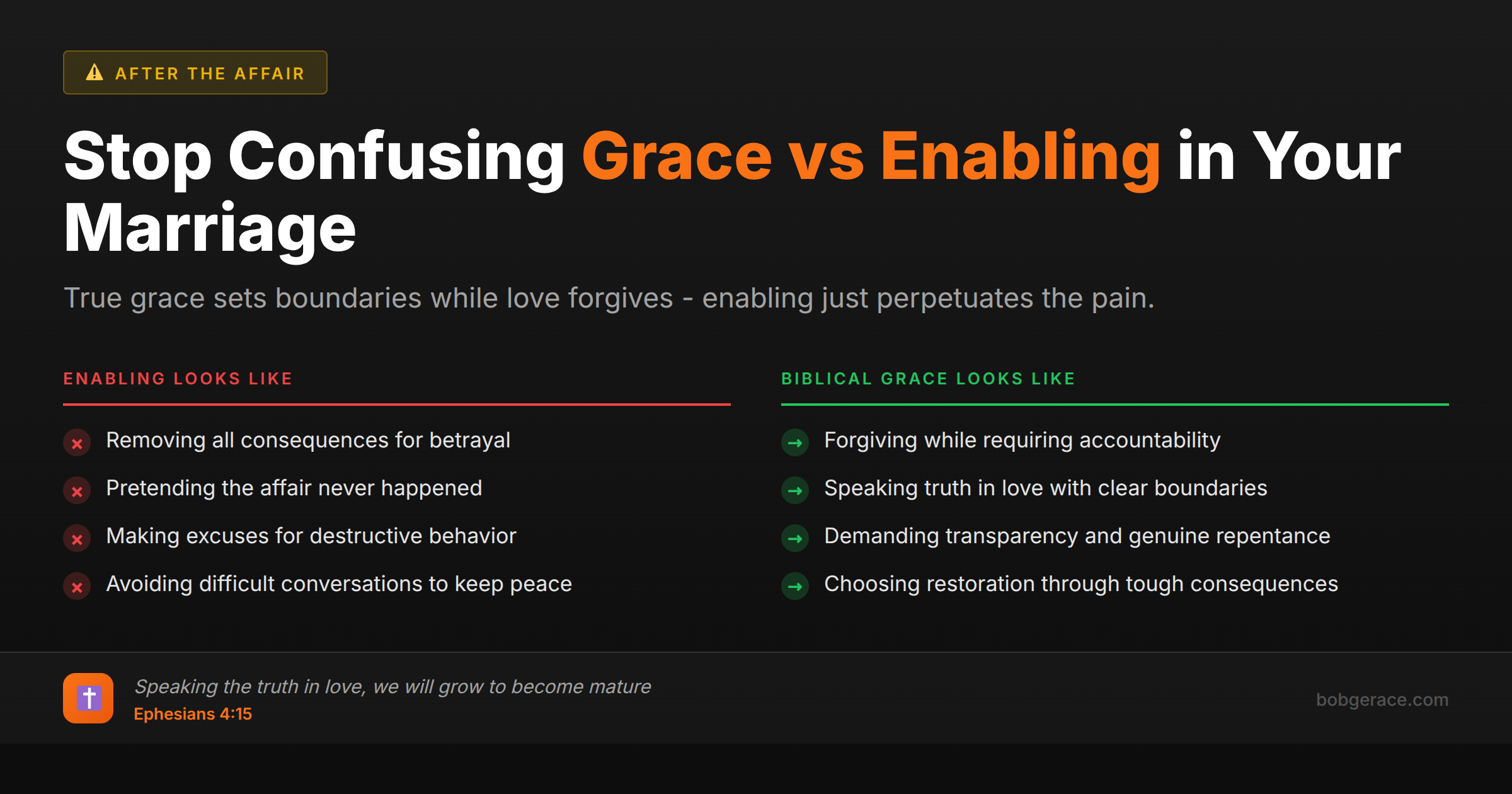
Grace and enabling are fundamentally different. Grace offers forgiveness and love while maintaining clear boundaries and expectations for change. Enabling removes consequences and perpetuates destructive behavior. You model biblical grace by forgiving your spouse while still requiring accountability, transparency, and genuine repentance. True grace doesn't ignore sin or pretend betrayal didn't happen. It acknowledges the hurt while choosing to love and work toward restoration. This means you can forgive your spouse for their affair while still insisting they cut contact with the other person, attend counseling, and rebuild trust through their actions. Grace empowers healing; enabling prevents it.
The Full Picture
The confusion between grace and enabling destroys more marriages than almost any other misunderstanding in affair recovery. I've watched countless spouses think they're being "Christ-like" by accepting continued betrayal, lies, or contact with the affair partner. That's not grace—that's enabling, and it's actually unloving to everyone involved.
Grace with boundaries looks like this: "I forgive you, and I want our marriage to work, but you must end all contact with her immediately, give me full access to your phone and accounts, and commit to counseling. I love you enough to fight for us, but I won't tolerate continued betrayal."
Enabling without boundaries sounds like: "I forgive you, so we don't need to talk about it anymore. I trust you to handle the situation with her. Let's just move forward and forget this happened."
The first approach creates space for genuine healing and repentance. The second ensures the destructive patterns continue. Grace actually requires more courage than enabling because it demands difficult conversations, uncomfortable boundaries, and the willingness to enforce consequences.
Remember, Jesus showed perfect grace, but He also called sin what it was and demanded repentance. He didn't enable the woman caught in adultery—He forgave her and told her to "go and sin no more." That's your model: full forgiveness paired with clear expectations for change.
What's Really Happening
From a clinical perspective, enabling often stems from fear—fear of losing the relationship, fear of conflict, or fear of being seen as "unforgiving." But enabling actually increases anxiety and trauma symptoms in betrayed spouses because it perpetuates the very behaviors that created the trauma in the first place.
Healthy boundaries after infidelity serve multiple psychological functions. They help restore the betrayed spouse's sense of safety and control, which are essential for trauma recovery. They also create the external structure necessary for the unfaithful spouse to break destructive patterns and develop healthier coping mechanisms.
When we remove natural consequences through enabling, we inadvertently reinforce the neural pathways associated with deceptive and impulsive behaviors. The brain learns that betrayal doesn't carry significant cost, making future betrayals more likely. Conversely, consistent boundaries paired with genuine love create the optimal environment for //blog.bobgerace.com/christian-marriage-success-blueprint-lasting-legacy/:lasting behavioral change.
I often tell my clients that love without boundaries isn't really love at all—it's codependency masquerading as virtue. True love wants what's best for the other person, even when it's difficult. Sometimes the most loving thing you can do is refuse to participate in someone else's destructive choices.
What Scripture Says
Scripture consistently shows us grace paired with truth, love combined with accountability. This isn't contradiction—it's the perfect balance God models for us.
Ephesians 4:15 - "Instead, speaking the truth in love, we will grow to become in every respect the mature body of him who is the head, that is, Christ." Grace speaks truth, even when it's uncomfortable. Enabling avoids difficult truths to keep peace.
Matthew 18:15-17 gives us the biblical process for addressing sin: private confrontation, witnesses, and ultimately separation if there's no repentance. Jesus doesn't suggest we ignore destructive behavior or pretend it doesn't matter.
Galatians 6:1-2 - "Brothers and sisters, if someone is caught in a sin, you who live by the Spirit should restore that person gently. But watch yourselves, or you also may be tempted. Carry each other's burdens." Notice it says "restore" the person, not enable their continued sin.
1 Corinthians 13:6 tells us love "does not delight in evil but rejoices with the truth." Love cannot coexist with participation in deception or betrayal.
Proverbs 27:5-6 - "Better is open rebuke than hidden love. Wounds from a friend can be trusted, but an enemy multiplies kisses." Sometimes the most loving thing is the most difficult thing.
John 8:11 - After forgiving the adulterous woman, Jesus said, "Go now and leave your life of sin." Forgiveness came with clear expectations for changed behavior.
What To Do Right Now
-
1
Write down your non-negotiable boundaries - what behaviors you will and won't accept moving forward
-
2
Communicate these boundaries clearly to your spouse, explaining they come from love, not punishment
-
3
Identify specific consequences for boundary violations and be prepared to enforce them consistently
-
4
Practice phrases like 'I love you AND I won't accept this behavior' to balance grace with strength
-
5
Find an accountability partner who will support your boundaries, not pressure you to 'just forgive and forget'
-
6
Pray for wisdom to distinguish between genuine repentance and manipulation disguised as remorse
Related Questions
- What does biblical forgiveness require of me?
- What's the difference between forgiveness and reconciliation?
- Does forgiveness mean no consequences?
- What does restoration look like in Scripture?
- What is 'cheap grace' and is forgiveness enabling?
- Can I forgive and still have boundaries?
- What is a boundary vs. an ultimatum?
- How do I enforce without controlling?
- What does loving confrontation look like biblically?
- When does grace become enabling sin?
Also find Bob on
Subscribe for weekly videos on Christian marriage.
Grace with boundaries is hard alone
A coach who knows your marriage can help you calibrate what grace actually looks like in your specific situation—not theory, your story.
Talk to Bob →