How do I stop the mental movies?
6 min read
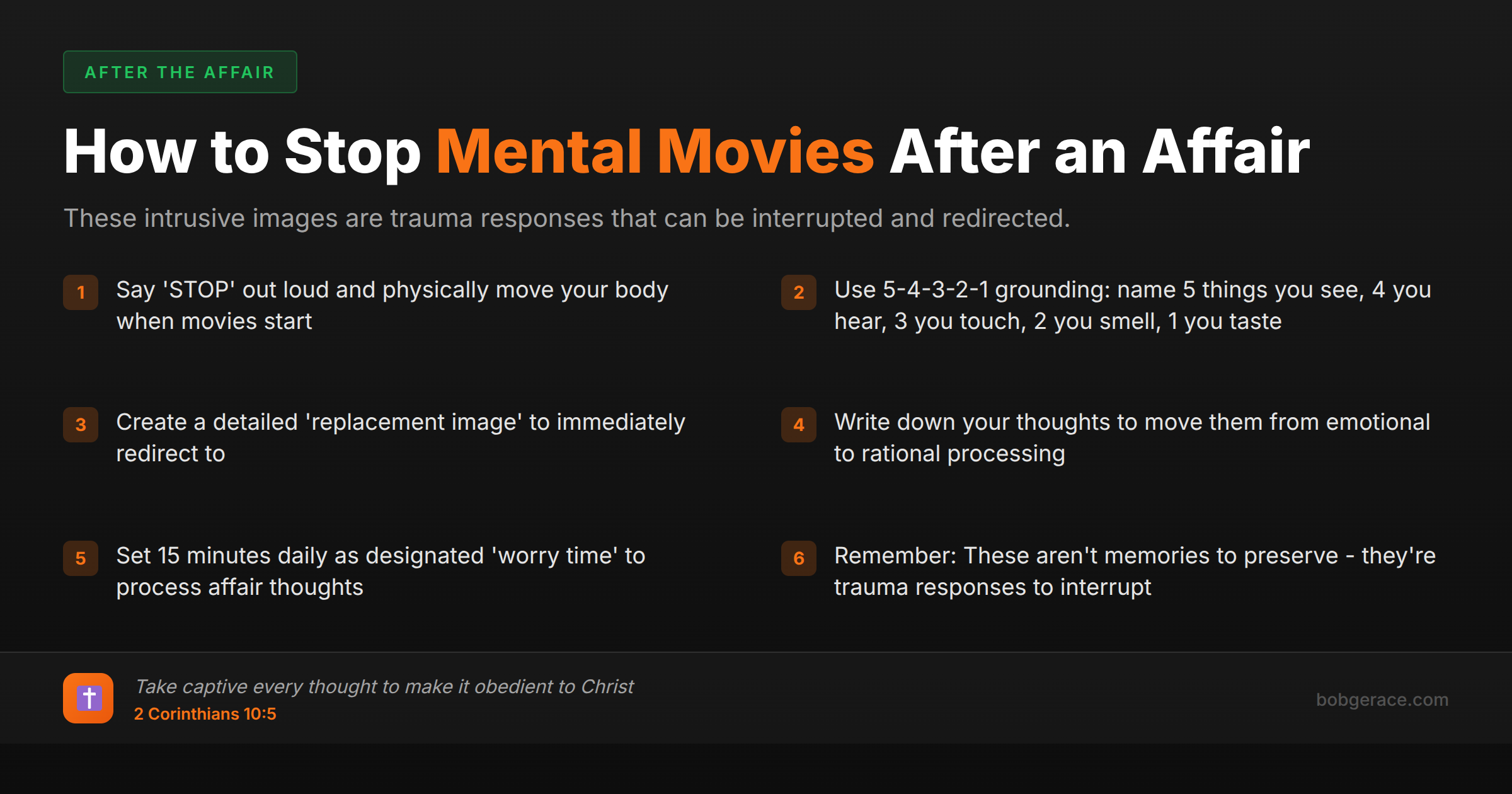
Those intrusive mental images - what I call 'mental movies' - are one of the most torturous aspects of affair recovery. Your brain is trying to process trauma by replaying scenarios, but this actually keeps you stuck in pain. The key is understanding that these aren't memories you need to preserve - they're trauma responses that need to be interrupted and redirected. You can stop them through immediate intervention techniques like the 'STOP' method (literally say 'STOP' out loud), grounding exercises that engage your senses, and replacing the images with predetermined positive visuals. This isn't about denial - it's about taking control of your healing process instead of letting trauma control you.
The Full Picture
Mental movies are intrusive, vivid images that play in your mind - usually depicting your spouse with their affair partner. They feel completely real and can be triggered by anything: a song, a location, even random moments during your day. You might see them embracing, talking intimately, or being physical together. These images are often more detailed and disturbing than anything you actually know happened.
Here's what's actually occurring: Your brain is trying to make sense of incomplete information by filling in gaps with imagined scenarios. It's a trauma response designed to help you prepare for future threats, but instead it's torturing you with possibilities that may not even be accurate.
These mental movies serve no productive purpose in your healing. They don't provide clarity, they don't help you process emotions constructively, and they certainly don't move you toward restoration. Instead, they:
- Keep you stuck in victim mode - Increase anxiety and depression - Make forgiveness nearly impossible - Damage your self-esteem further - Create obsessive thought patterns - Interfere with sleep and daily functioning
The good news? You have more control than you think. These aren't unstoppable forces - they're habits your traumatized brain has developed. And habits can be changed with consistent, intentional effort. The goal isn't to pretend the affair didn't happen, but to stop allowing your imagination to torture you with scenarios that aren't helping your recovery.
Understand this: stopping mental movies is not denial, it's wisdom. You're choosing to focus your mental energy on healing rather than on imagined scenes that only deepen your wounds.
What's Really Happening
From a neurological standpoint, mental movies are a form of intrusive imagery common in trauma responses. When we experience betrayal trauma, our brain's threat detection system becomes hypervigilant, constantly scanning for danger. The prefrontal cortex - responsible for rational thinking - becomes less active, while the amygdala - our alarm system - goes into overdrive.
These vivid mental images aren't actually memories - they're constructions. Your brain is attempting to //blog.bobgerace.com/marriage-healing-leadership-create-recovery-field/:create a coherent narrative from fragments of information, filling in gaps with imagined details. This is why the scenes often feel so real and detailed, even when you have limited actual information about what occurred.
The repetitive nature of these mental movies creates what we call 'rumination loops.' Each time you replay these images, you're strengthening the neural pathways associated with them, making them more likely to occur again. It becomes a self-reinforcing cycle that can feel impossible to break.
However, neuroplasticity - your brain's ability to form new neural connections - means you can interrupt these patterns. Techniques like thought stopping, cognitive restructuring, and mindfulness-based interventions can literally rewire your brain's response to these triggers. The key is consistent practice and understanding that initial discomfort when interrupting these thoughts is normal - you're breaking established neural pathways and creating new, healthier ones.
Remember: your brain created these patterns as a misguided attempt to protect you. With proper techniques, you can train it to respond differently.
What Scripture Says
Scripture gives us clear direction about managing our thought life and taking control of destructive mental patterns. God doesn't expect us to be passive victims of our own minds.
2 Corinthians 10:5 tells us to "take captive every thought to make it obedient to Christ." This isn't just spiritual advice - it's a practical command. You have the authority and responsibility to reject thoughts that don't align with God's purposes for your healing.
Philippians 4:8 provides the replacement strategy: "Finally, brothers and sisters, whatever is true, whatever is noble, whatever is right, whatever is pure, whatever is lovely, whatever is admirable—if anything is excellent or praiseworthy—think about such things." Mental movies of your spouse's affair meet none of these criteria.
Isaiah 26:3 promises that God "will keep in perfect peace those whose minds are steadfast, because they trust in you." A steadfast mind isn't one that's constantly replaying trauma - it's one that's fixed on God's character and promises.
Romans 12:2 calls us to "be transformed by the renewing of your mind." This renewal requires actively rejecting old thought patterns and replacing them with truth. Mental movies aren't truth - they're often imagined scenarios that keep you trapped.
God hasn't given you a mind to torture yourself with. 1 Corinthians 14:33 reminds us that "God is not a God of disorder but of peace." These intrusive images create disorder and chaos in your inner life. It's not only permissible to stop them - it's biblical wisdom to do so.
What To Do Right Now
-
1
Use the STOP technique - when a mental movie starts, literally say 'STOP' out loud and physically move your body
-
2
Practice the 5-4-3-2-1 grounding method - name 5 things you see, 4 you hear, 3 you touch, 2 you smell, 1 you taste
-
3
Create a 'replacement image' - a detailed positive scene you immediately redirect to when movies start
-
4
Write down your thoughts when movies occur - this moves them from emotional to rational processing
-
5
Set specific 'worry times' - 15 minutes daily to process affair-related thoughts, then redirect outside these times
-
6
Remove or minimize obvious triggers - photos, songs, places that consistently start the mental movies
Related Questions
- How do I deal with intrusive images?
- What is 'mind movies' and how do I stop them?
- Why do I keep replaying the discovery?
- Why am I having intrusive thoughts/images?
- What is the 'trauma loop' and how do I interrupt it?
- Why can't I stop obsessing over details?
- What is 'betrayal trauma' and do I have it?
- How do I regulate my own system?
- What does trauma recovery look like?
- What is EMDR and could it help?
Also find Bob on
Subscribe for weekly videos on Christian marriage.
You Don't Have to White-Knuckle This Alone
The mental movies hit different in your marriage than anyone else's. A coach who knows your specific story can help you interrupt them faster—and stay interrupted.
Talk to Bob →