Will I ever get over this?
6 min read
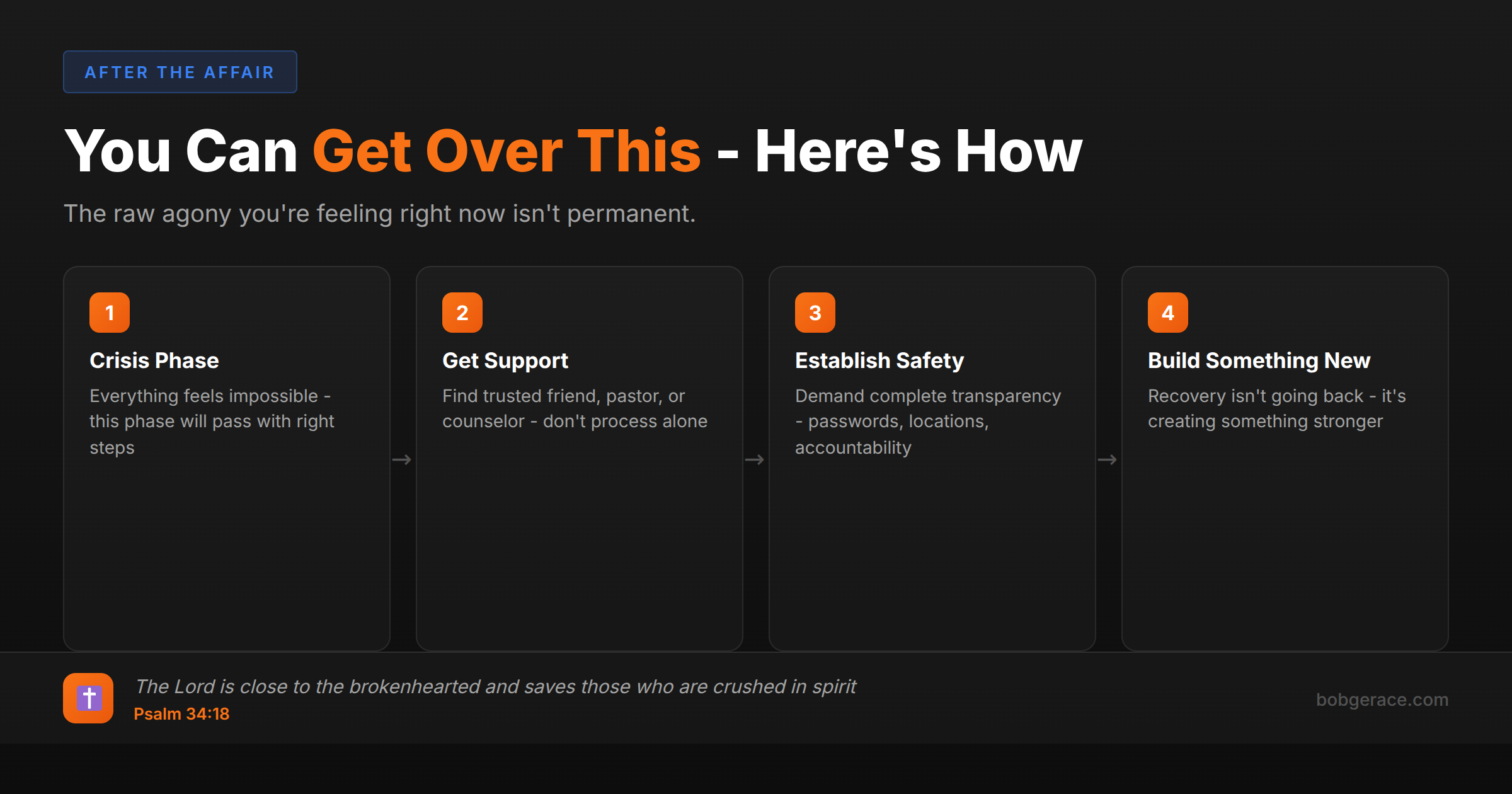
Yes, you can and will get over this - but it's going to be one of the hardest things you've ever done. The raw agony you're feeling right now isn't permanent, though I won't sugarcoat it: the road ahead is long and difficult. Most couples who commit to the process see significant healing within 12-18 months, with deeper restoration continuing for years. Recovery isn't about forgetting or going back to how things were. It's about building something entirely new - often stronger than what you had before. The key is understanding that healing happens in stages, and right now you're in the crisis phase where everything feels impossible. That phase will pass, but only if you take the right steps forward.
The Full Picture
Let me be brutally honest with you: what you're experiencing right now is trauma. Your world has been shattered, your reality has been rewritten, and your nervous system is in complete chaos. The obsessive thoughts, the physical pain in your chest, the inability to sleep or eat - these are normal responses to an abnormal situation.
The timeline most people experience looks like this:
Crisis Phase (0-6 months): This is where you are now. Everything feels impossible. You swing between rage and despair. You can't imagine ever trusting again. This phase is characterized by shock, discovery of details, and intense emotional volatility.
Stabilization Phase (6-12 months): The acute crisis begins to subside. You start having moments - maybe just minutes at first - where you're not thinking about the affair. You begin to function better day-to-day, though triggers still hit hard.
Recovery Phase (12-24 months): You start seeing real progress. Trust begins to rebuild slowly. You have more good days than bad days. The obsessive thoughts become less frequent and less intense.
Renewal Phase (2+ years): Many couples report their marriage is actually stronger than before the affair. You've developed new communication skills, deeper intimacy, and a more realistic but stronger foundation.
Here's what I need you to understand: getting through this isn't about being strong enough or having enough faith. It's about having the right information, the right support, and taking the right actions consistently over time. Most people try to white-knuckle their way through this alone, and that's why so many marriages don't make it.
What's Really Happening
From a clinical perspective, you're experiencing what we call betrayal trauma - a specific type of PTSD that occurs when someone we depend on for safety and security violates that trust. Your brain is literally rewiring itself to process this threat, which is why you feel like you're going crazy.
The good news is that betrayal trauma is highly treatable. Research shows that couples who engage in structured //blog.bobgerace.com/marriage-intelligence-network-data-driven-recovery/:recovery programs have a 70-80% success rate in not just surviving but thriving after an affair. The key factors that determine success are:
Full disclosure and transparency from the unfaithful partner - no trickle truth or minimizing. Genuine remorse and accountability - not just guilt about getting caught, but deep sorrow for the pain caused. Professional guidance - couples who work with trained therapists or coaches have significantly better outcomes. Time and patience - rushing the process almost always backfires.
Your nervous system needs time to regulate. The hypervigilance you're experiencing will gradually decrease as safety is rebuilt in the relationship. The intrusive thoughts and images will fade as your brain processes the trauma. But this requires consistent, intentional work from both partners over an extended period.
What you're feeling right now - the intensity, the despair, the physical symptoms - these are temporary. Your brain is designed to heal from trauma when given the right conditions.
What Scripture Says
God's heart toward you in this season is not condemnation but compassion. He sees your pain, He knows your anguish, and He has not abandoned you or your marriage.
Psalm 34:18 reminds us: *"The Lord is close to the brokenhearted and saves those who are crushed in spirit."* You are exactly where God draws near - in the midst of brokenness and crushing pain.
Isaiah 61:3 promises that God will *"bestow on them a crown of beauty instead of ashes, the oil of joy instead of mourning, and a garment of praise instead of a spirit of despair."* This isn't just spiritual metaphor - it's God's commitment to bring restoration out of devastation.
But notice that restoration requires process and participation. Jeremiah 30:17 declares: *"'But I will restore you to health and heal your wounds,' declares the Lord."* The Hebrew word for "restore" implies a rebuilding that takes time and intentional effort.
2 Corinthians 5:17 tells us: *"Therefore, if anyone is in Christ, the new creation has come: The old has gone, the new is here!"* This applies not just to individuals but to marriages. God specializes in making new things from broken things.
The biblical model isn't about going backward to what was, but forward to what God can create. Romans 8:28 doesn't promise that all things are good, but that *"in all things God works for the good of those who love him."* Even this devastating betrayal can become part of a larger story of redemption.
Your marriage may feel dead, but serve a God who specializes in resurrection.
What To Do Right Now
-
1
Get immediate support - Don't try to process this alone. Find a trusted friend, pastor, or counselor who can provide perspective and emotional support.
-
2
Establish safety protocols - If you're staying together, demand complete transparency: passwords, location sharing, detailed accountability for time and activities.
-
3
Document everything - Write down discoveries, conversations, and timeline details while they're fresh. Your memory will be unreliable during trauma.
-
4
Take care of your body - Force yourself to eat protein, stay hydrated, and get some form of physical movement daily. Your body is under assault.
-
5
Set boundaries around disclosure - Agree on when and how additional information will be shared. Random revelations will retraumatize you repeatedly.
-
6
Find professional help - Individual therapy for trauma recovery and couples counseling with someone trained in affair recovery. This isn't optional if you want to succeed.
Related Questions
- How long does recovery take?
- What does full recovery actually look like?
- When do triggers decrease in intensity?
- What are the stages of betrayal trauma recovery?
- How do I stop the mental movies?
- What is 'post-traumatic growth'?
- How long does real transformation take?
- What does trauma recovery look like?
- How do I live with uncertainty?
- What can I learn from this crisis?
Also find Bob on
Subscribe for weekly videos on Christian marriage.
Your Marriage Isn't a Generic Case
Bob works with men in active crisis every week. He'll hear your specific story, see what's actually happening in your marriage, and tell you what to do next.
Talk to Bob →