What if she works with him?
6 min read
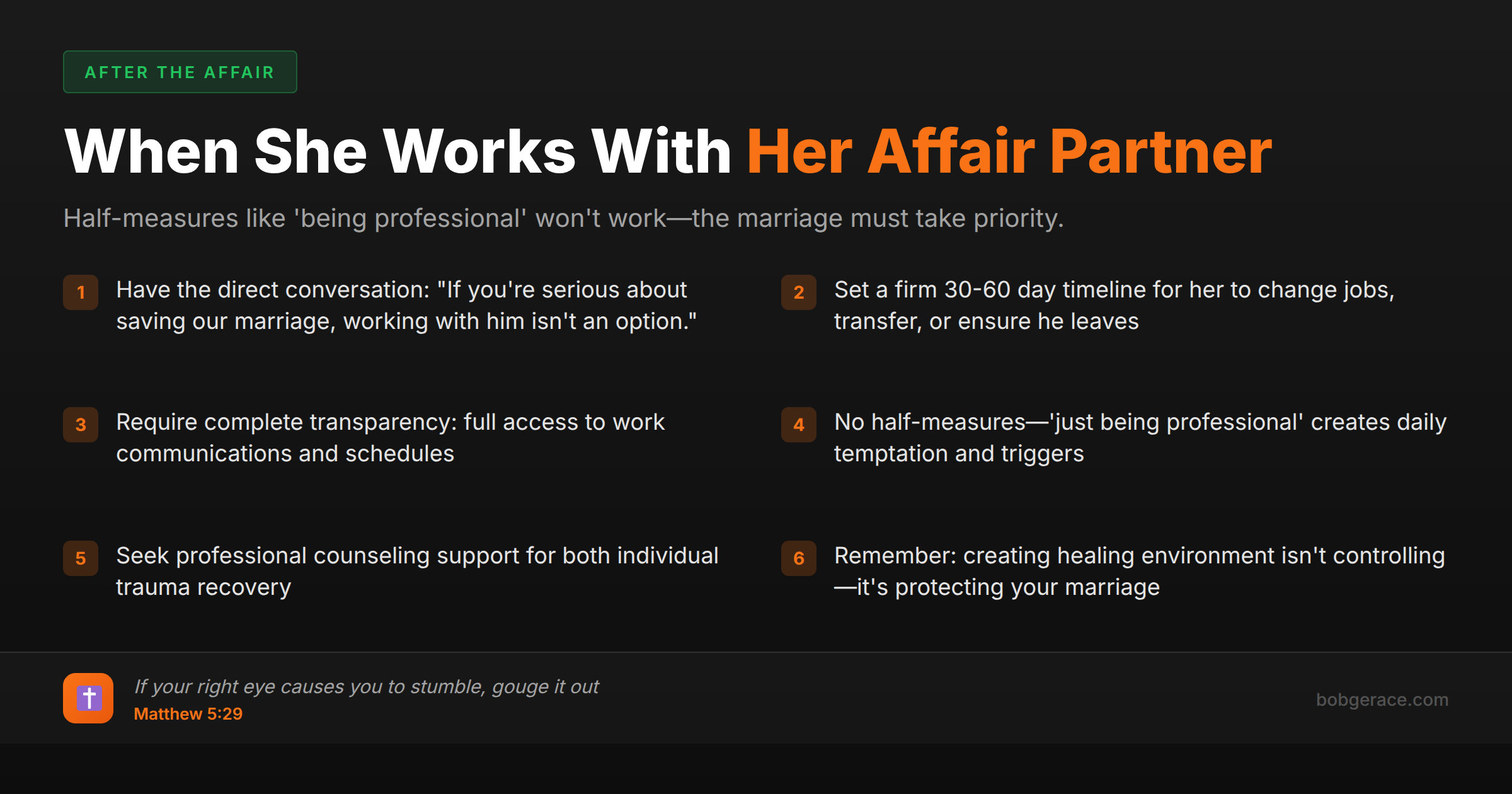
When your wife works with the affair partner, recovery becomes significantly more complicated but not impossible. This situation requires immediate, decisive action and clear boundaries. The ongoing contact makes healing harder because trust can't be rebuilt while the temptation and triggers remain present daily. You need to address this head-on with your wife. If she's serious about saving the marriage, she must either change jobs, request a transfer, or ensure the other person leaves. Half-measures like "just being professional" won't work. The marriage has to take priority over career convenience. This isn't about controlling her—it's about creating the environment necessary for healing and rebuilding trust.
The Full Picture
The workplace affair scenario is one of the most challenging situations in marriage recovery. Unlike other affairs that can be cleanly severed, workplace relationships create ongoing contact that undermines every attempt at healing.
Here's what makes this so difficult: Every day your wife goes to work, you're wondering what's happening. Every late meeting, every business trip, every casual mention of workplace activities becomes a potential trigger. Meanwhile, she's in an environment where she sees this person regularly, creating opportunities for rekindled feelings or continued emotional connection.
The "just being professional" approach rarely works. I've seen too many couples try this middle-ground solution, thinking they can manage the situation through willpower and good intentions. What actually happens is that the daily interaction prevents the necessary emotional detachment from occurring. Small conversations lead to shared projects, which lead to private discussions about the awkwardness, which often reignite the connection.
Your wife may resist making a job change for legitimate reasons—career advancement, financial concerns, specialized skills, or simply the difficulty of finding new employment. These are real concerns that deserve consideration, but they cannot override the marriage's need for a clean break from the affair partner.
Some couples try creative solutions: different departments, different shifts, or having the other person relocate. While these might provide some distance, they often don't create enough separation for true healing. The person is still in the same building, still part of the same organization, still potentially crossing paths.
The bottom line is this: if your wife is genuinely committed to saving the marriage, she must be willing to prioritize it over career convenience. This might mean financial sacrifice, career disruption, or starting over professionally. These are serious costs, but they pale in comparison to losing your marriage and family.
What's Really Happening
From a psychological perspective, workplace affairs create what we call "environmental reinforcement" of the extramarital bond. The brain forms neural pathways connecting the work environment with the //blog.bobgerace.com/male-emotional-validation-marriage-stop-blame-game/:emotional and physical experiences of the affair. Simply deciding to "be professional" doesn't erase these pathways—they're strengthened every time the two people interact.
Trauma bonding is another factor. The secrecy, intensity, and shared experience of the affair create strong psychological bonds that don't disappear overnight. Continued contact, even if "innocent," can reactivate these bonds without either person consciously intending it.
For the betrayed spouse, ongoing workplace contact creates chronic stress and hypervigilance. The nervous system never gets a chance to settle down and begin healing because the threat remains present. This can lead to anxiety, depression, and physical health problems.
There's also the issue of accountability. Recovery requires transparency and the ability to verify changed behavior. When someone continues working with their affair partner, verification becomes nearly impossible. The betrayed spouse is left relying on trust that has already been broken, which is psychologically unsustainable.
I often see wives minimize the impact of continued workplace contact, saying things like "it's over" or "I can handle this." This usually reflects their own internal conflict between wanting to preserve their career and genuinely wanting to repair their marriage. However, the neuroscience is clear: proximity and repeated exposure make emotional detachment extremely difficult, regardless of conscious intentions.
What Scripture Says
Scripture is clear about the seriousness of removing sources of temptation and the priority of marriage. Matthew 5:29-30 gives us Jesus's radical teaching: "If your right eye causes you to stumble, gouge it out and throw it away. It is better for you to lose one part of your body than for your whole body to be thrown into hell. And if your right hand causes you to stumble, cut it off and throw it away."
While Jesus is speaking metaphorically, the principle is literal: remove whatever threatens your spiritual and relational health, even if it costs you significantly. A job, no matter how good, is not worth destroying your marriage.
1 Corinthians 6:18 commands us to "flee from sexual immorality." The Greek word for "flee" means to run away quickly, not to manage or control the situation. Continuing to work with an affair partner is the opposite of fleeing—it's remaining in the place of temptation.
Genesis 2:24 establishes that marriage requires leaving other attachments: "Therefore a man shall leave his father and mother and hold fast to his wife, and they shall become one flesh." This principle applies to any relationship that competes with or threatens the marriage bond.
Proverbs 27:14 warns about the persistence of temptation: "Like a quarrelsome wife is the dripping of a leaky roof in a rainy day." Ongoing contact with an affair partner creates this same kind of persistent erosion of good intentions and marriage commitment.
1 Timothy 6:11 instructs us to "flee from all this" when referring to temptations and pursue righteousness instead. The biblical pattern is clear: when something threatens your spiritual or relational well-being, you don't manage it—you eliminate it.
The marriage covenant, as described in Malachi 2:14, calls the spouse your "companion" and "wife of your covenant." This sacred bond deserves protection above career considerations or personal convenience.
What To Do Right Now
-
1
Have a direct conversation: "If you're serious about saving our marriage, continuing to work with him isn't an option. What's your plan to change this situation?"
-
2
Set a firm timeline: Give her 30-60 days to make a job change, request a transfer, or ensure the other person leaves the company
-
3
Require complete transparency: Full access to work communications, schedules, and any interactions until the situation is resolved
-
4
Seek professional support: Both individual counseling for trauma recovery and couples therapy to navigate this complex situation
-
5
Document everything: Keep records of her commitments, timeline, and actions taken to address the workplace situation
-
6
Prepare for consequences: Be ready to make difficult decisions if she chooses the job over the marriage—this reveals her true priorities
Related Questions
- Should she cut all contact with him?
- How do I stop the mental movies?
- What is the typical betrayal trauma recovery timeline?
- What does rebuilding trust require from her?
- How do I deal with intrusive images?
- What is 'hypervigilance' and why am I doing it?
- What boundaries should I set?
- How do I not lose my mind right now?
- How do I regulate my own system?
- What does healthy coping look like?
Also find Bob on
Subscribe for weekly videos on Christian marriage.
Your Marriage vs. Her Job
This exact scenario—affair partner still in the building—needs a coach who knows your wife's resistance points and your leverage. Bob will map the next 30 days with you.
Talk to Bob →