What is 'anxious-avoidant trap' and did we have it?
6 min read
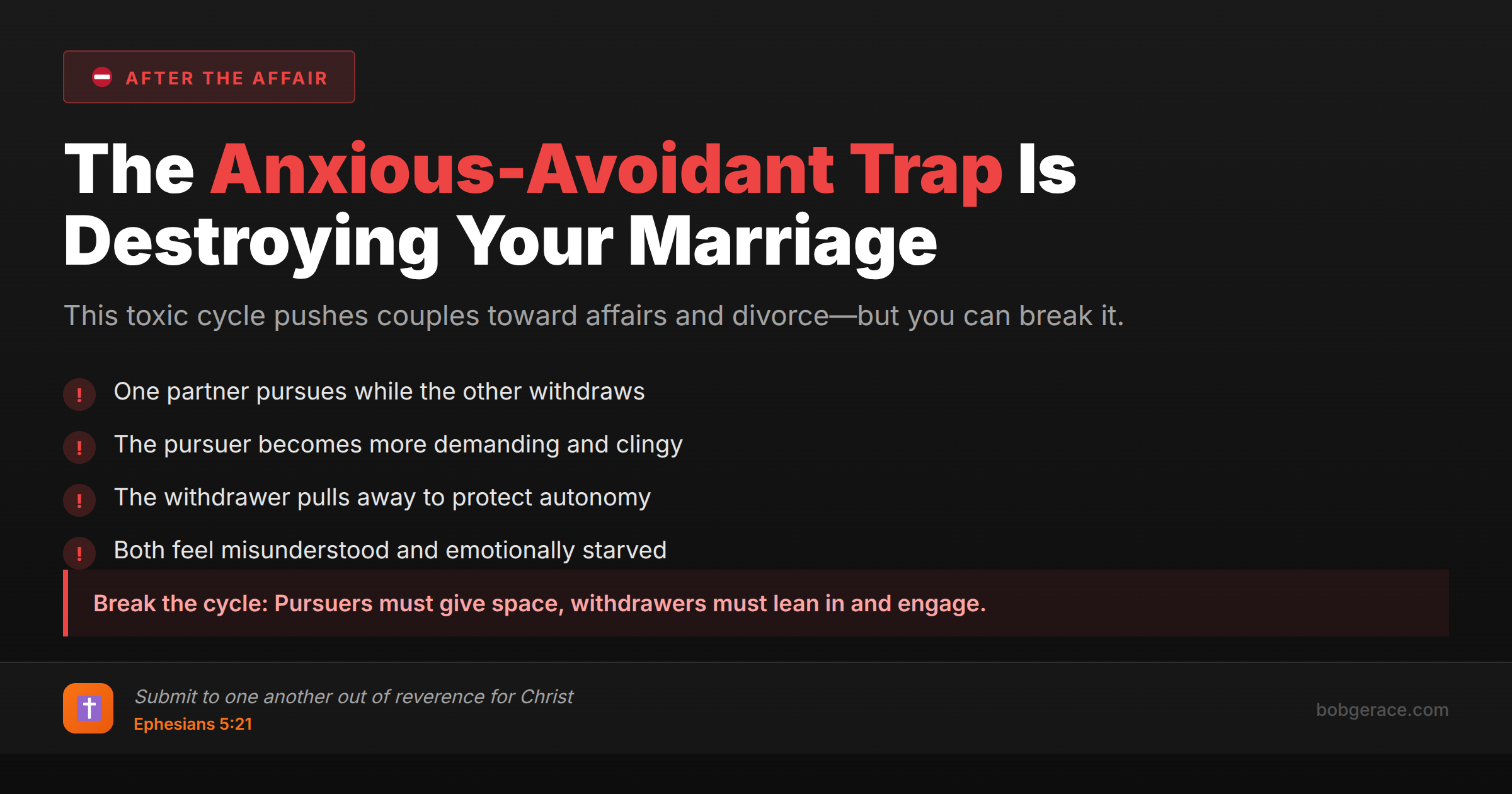
The anxious-avoidant trap is a destructive relationship cycle where one partner (anxious) pursues connection while the other (avoidant) withdraws, creating increasing distance over time. The anxious partner becomes more demanding and clingy, while the avoidant partner pulls further away to preserve their sense of autonomy. This pattern often sets the stage for affairs because it creates emotional disconnection and unmet needs. The anxious partner feels unloved and rejected, while the avoidant partner feels suffocated and criticized. Both become vulnerable to outside relationships that seem to offer what's missing at home. If you're dealing with infidelity, there's a good chance this dynamic was present in your marriage before the affair occurred.
The Full Picture
The anxious-avoidant trap isn't just a relationship theory—it's a real pattern that destroys marriages every day. Here's how it typically unfolds:
The Anxious Partner craves closeness and reassurance. When they sense distance, they pursue harder. They ask more questions, seek more affection, and become increasingly sensitive to any signs of rejection. Their attempts to connect often come across as needy or controlling.
The Avoidant Partner values independence and feels uncomfortable with intense emotional demands. When pursued, they instinctively pull back to maintain their sense of self. They minimize problems, avoid deep conversations, and may seem emotionally unavailable.
The Trap Tightens as each partner's response triggers the other's deepest fears. The anxious partner's pursuit confirms the avoidant partner's belief that relationships are suffocating. The avoidant partner's withdrawal confirms the anxious partner's belief that they're unlovable.
This creates a perfect storm for infidelity. The anxious partner becomes vulnerable to someone who shows them attention and makes them feel wanted. The avoidant partner may be drawn to someone who doesn't make emotional demands and feels "easier" to be with.
The affair often serves different functions for each attachment style. For the anxious partner, it might provide the validation and connection they've been desperately seeking. For the avoidant partner, it might offer intimacy without the pressure of commitment or vulnerability.
Understanding this pattern doesn't excuse the affair, but it helps explain how marriages become vulnerable to infidelity. The good news is that this cycle can be broken when both partners understand their roles and commit to change.
What's Really Happening
From a clinical perspective, the anxious-avoidant trap represents a collision of two different attachment systems that developed in childhood. The anxious partner likely experienced inconsistent caregiving, leading them to hypervigilantly monitor relationships for signs of threat. The avoidant partner probably had caregivers who were uncomfortable with emotions, teaching them that independence equals safety.
Neurologically, these partners literally experience relationships differently. When conflict arises, the anxious partner's nervous system floods with stress hormones, driving them to seek connection as a survival strategy. Meanwhile, the avoidant partner's system shuts down, triggering their need to create space.
This isn't conscious manipulation—both partners are operating from deep-seated survival instincts. The anxious partner isn't trying to be controlling; they're trying to feel secure. The avoidant partner isn't trying to be cruel; they're trying to feel safe.
Affairs often occur when this dynamic reaches a breaking point. The anxious partner may find someone who initially provides abundant attention and validation. The avoidant partner might connect with someone who doesn't trigger their claustrophobia around intimacy.
Healing requires both partners to recognize their patterns and develop new responses. The anxious partner must learn to self-soothe and //blog.bobgerace.com/theater-response-christian-marriage-crisis-communication/:communicate needs without pursuing. The avoidant partner must learn to stay present during emotional conversations and offer reassurance proactively.
This work takes time and often professional support, but couples who understand their attachment dynamics can break free from this destructive cycle and build genuine intimacy.
What Scripture Says
God's design for marriage directly addresses the core issues behind the anxious-avoidant trap. Scripture calls us to move beyond our natural self-protective instincts toward sacrificial love and mutual service.
Ephesians 5:21 tells us to "Submit to one another out of reverence for Christ." This challenges both attachment styles—the anxious partner must submit their need to control outcomes, while the avoidant partner must submit their need for complete independence.
1 Corinthians 13:4-5 describes love as patient and kind, not self-seeking. The anxious partner needs patience to allow their spouse space to respond. The avoidant partner must choose kindness by staying engaged even when uncomfortable, not seeking only their own emotional safety.
Philippians 2:3-4 instructs us to "consider others better than yourselves" and look to their interests, not just our own. This directly counters the trap where each partner becomes focused on getting their own needs met rather than serving their spouse.
1 Peter 4:8 reminds us that "love covers over a multitude of sins." Both partners need grace to recognize that their spouse's difficult behaviors often stem from pain, not malice.
Matthew 7:3-5 warns against focusing on your spouse's "speck" while ignoring your own "plank." The anxious partner must address their pursuit patterns, while the avoidant partner must acknowledge their withdrawal.
Romans 12:10 calls us to "be devoted to one another in love" and "honor one another above yourselves." This creates the foundation for breaking free from self-protective patterns and building the secure connection God intended for marriage.
What To Do Right Now
-
1
Identify your pattern: Honestly assess whether you tend to pursue (anxious) or withdraw (avoidant) when relationship stress occurs.
-
2
Stop the immediate cycle: If you're the pursuer, give your spouse space. If you're the withdrawer, lean in and engage.
-
3
Own your contribution: Confess to your spouse how your pattern has contributed to the distance between you.
-
4
Communicate your underlying needs: Share what you're really seeking—security, autonomy, love, respect—without blame.
-
5
Create new agreements: Establish specific ways to meet each other's core needs without triggering old patterns.
-
6
Get professional help: Consider working with a counselor trained in attachment-based therapy to guide this process effectively.
Related Questions
- What is 'attachment affair' vs. 'exit affair'?
- How does attachment style relate to affair risk?
- What attachment needs was the affair meeting?
- What does affair as 'attachment substitute' mean?
- How do attachment injuries make affairs more likely?
- Did my avoidance push her toward someone else?
- What is anxious attachment and am I doing it right now?
- She seems cold and detached — is that avoidant attachment?
- Why does my pursuing make her pull away more?
- What's the pursue-withdraw cycle and how do I stop it?
Also find Bob on
Subscribe for weekly videos on Christian marriage.
Your Marriage Isn't a Textbook Case
This dynamic shows up differently in every relationship. A coach who knows your specific story can help you see where you're stuck and what moves actually work for you two.
Talk to Bob →