What is 'staggered disclosure' and why is it harmful?
6 min read
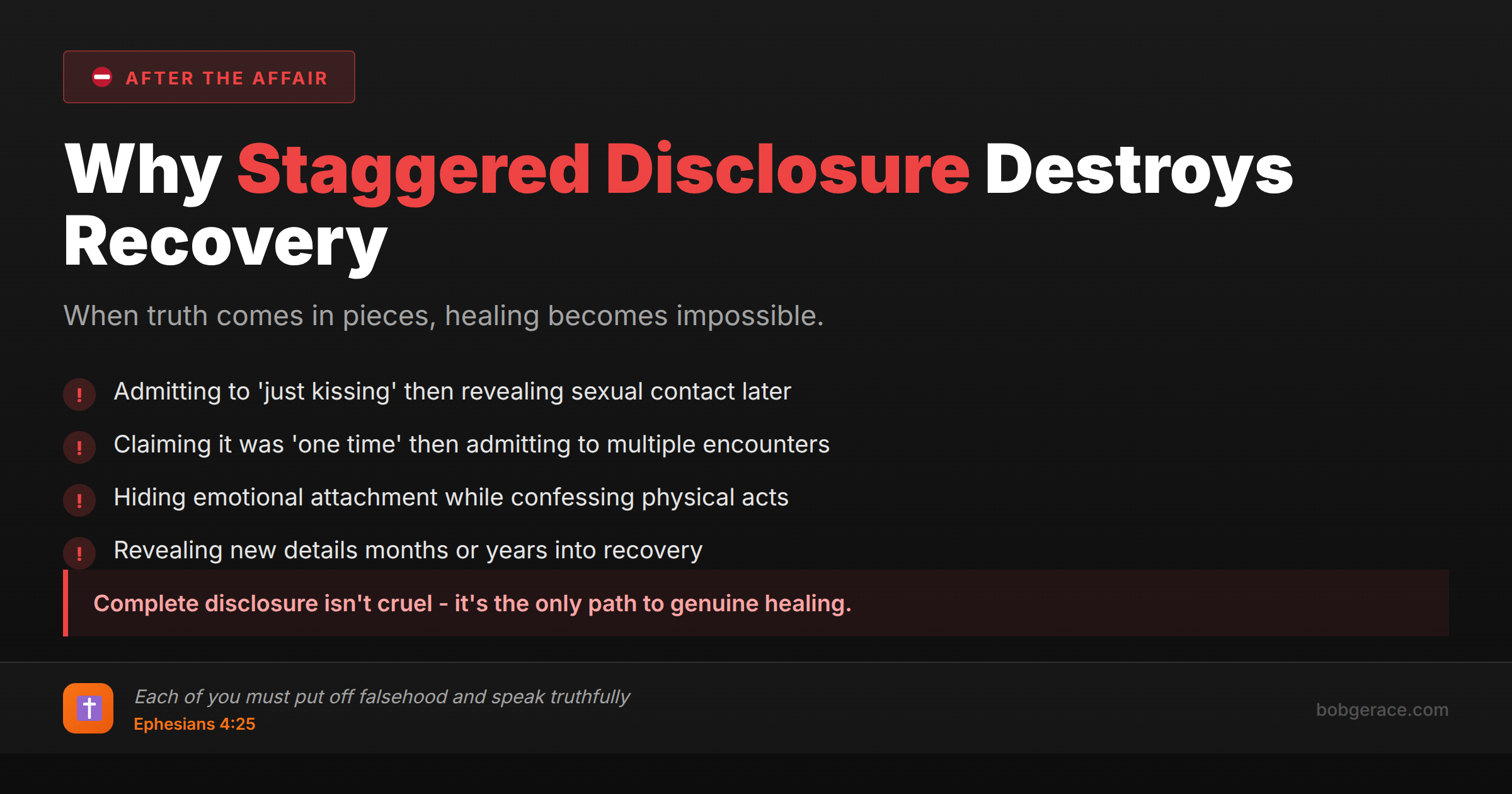
Staggered disclosure is when an unfaithful spouse reveals details about their affair gradually over weeks, months, or even years - rather than providing a complete account all at once. This might look like admitting to 'just kissing' initially, then later revealing sexual contact, then finally admitting to multiple encounters or emotional attachments. This approach is incredibly harmful because it forces the betrayed spouse to relive the trauma repeatedly with each new revelation. Every time another piece of truth emerges, it's like ripping open a wound that was trying to heal. The betrayed spouse loses trust not only in the original relationship but also in their partner's commitment to honesty during recovery. Staggered disclosure destroys the foundation needed for genuine healing.
The Full Picture
Staggered disclosure is one of the most damaging patterns I see in affair recovery. It happens when the unfaithful spouse thinks they're being 'merciful' by revealing information slowly, or when they're trying to minimize consequences by controlling the narrative.
Here's what typically happens: After discovery, the unfaithful spouse admits to some contact but downplays its significance. 'It was just texting.' A week later, under pressure: 'Okay, we met for coffee a few times.' Another week: 'We kissed once.' Months later: 'There was more physical contact.' Eventually: 'It lasted longer than I said.'
Each revelation is a new betrayal. The betrayed spouse experiences fresh trauma with every disclosure. They're forced to question everything they thought they knew, not just about the affair, but about their partner's character and commitment to recovery.
The damage compounds because staggered disclosure proves the unfaithful spouse is still lying, still manipulating, still prioritizing their own comfort over their spouse's healing. It demonstrates that even after being caught, they haven't truly repented or committed to radical honesty.
This pattern often emerges from the unfaithful spouse's desire to: - Minimize consequences - Control their partner's reaction - Avoid facing the full weight of their choices - Protect their self-image - Test the waters before revealing worse details
The betrayed spouse, meanwhile, becomes hypervigilant, constantly wondering what else they don't know. They can't begin genuine healing because they're living in perpetual discovery mode.
What's Really Happening
From a clinical perspective, staggered disclosure creates what we call 'chronic traumatic stress.' Unlike a single traumatic event that can be processed and integrated, staggered disclosure keeps the nervous system in a state of hyperarousal indefinitely. The betrayed spouse's brain interprets each new revelation as a fresh threat, preventing the natural trauma //blog.bobgerace.com/marriage-theater-4-recovery-crisis-climb/:recovery process.
Neurologically, betrayal trauma already disrupts memory consolidation and emotional regulation. When disclosures come in waves, the brain cannot complete its processing of each traumatic event before being hit with new information. This creates a cascade of stress hormones that impair sleep, concentration, and decision-making abilities.
Research shows that betrayed spouses experiencing staggered disclosure develop higher rates of PTSD, depression, and anxiety disorders. They also show increased difficulty with basic trust formation - not just with their spouse, but in their ability to accurately assess reality. This is because staggered disclosure gaslights the betrayed spouse's perception, making them question their intuition and judgment.
The unfaithful spouse, meanwhile, develops what I call 'disclosure addiction' - a pattern where they become accustomed to controlling information flow as a way to manage their partner's emotional state. This prevents them from developing genuine empathy and accountability. Recovery requires what we call 'therapeutic disclosure' - a comprehensive, professionally-guided process where all relevant information is shared at once, allowing both partners to begin healing from a foundation of complete truth.
What Scripture Says
Scripture is abundantly clear about the necessity of complete truth in relationships, especially in the context of healing from betrayal.
Ephesians 4:25 commands us: *'Therefore each of you must put off falsehood and speak truthfully to your neighbor, for we are all members of one body.'* In marriage, this means no partial truths, no controlled revelations - complete honesty is required.
Proverbs 28:13 warns: *'Whoever conceals their sins does not prosper, but the one who confesses and renounces them finds mercy.'* Notice it says 'confesses' - not 'gradually admits to.' True confession is complete and immediate.
Joshua 7 provides a powerful example of staggered disclosure's consequences. When Achan was confronted about his sin, he revealed information piece by piece - first admitting he took 'some' items, then specifying what and where. This partial confession prolonged Israel's suffering and ultimately led to greater judgment. Complete confession from the start would have brought faster restoration.
1 John 1:9 promises: *'If we confess our sins, he is faithful and just and will forgive us our sins and purify us from all unrighteousness.'* The Greek word for 'confess' (homologeo) means 'to say the same thing' - to agree completely with the truth, not to parse it out strategically.
Psalm 51:6 declares God's heart: *'Yet you desired faithfulness even in the womb; you taught me wisdom in that secret place.'* God desires truth in the innermost parts - complete honesty, not managed disclosure.
Biblical repentance requires full acknowledgment of sin's scope and impact, followed by complete commitment to change.
What To Do Right Now
-
1
Betrayed spouse: Stop accepting partial information. Clearly communicate that staggered disclosure is retraumatizing you and must stop immediately.
-
2
Unfaithful spouse: Commit to complete disclosure. Write down everything - timeline, details, lies told, money spent, people involved. Don't strategize what to reveal when.
-
3
Seek professional help for formal disclosure. A trained therapist can guide a proper disclosure session that covers everything comprehensively and safely.
-
4
Set a disclosure deadline. Agree on a specific date (within 1-2 weeks) when complete information will be shared. No more 'I need time to remember.'
-
5
Establish verification methods. Agree on ways the betrayed spouse can verify information - phone records, financial statements, polygraph tests if necessary.
-
6
Plan post-disclosure support. Arrange for counseling, trusted friends, or family support immediately following full disclosure, as this will be emotionally intense but necessary for healing.
Related Questions
- What does research say about disclosure?
- What's the right amount of detail to know?
- Do I need to know all the details?
- What are markers of genuine remorse vs. guilt?
- What does rebuilding trust require from her?
- How do I trust her again?
- How do I know if he's really changing?
- What are the markers of genuine behavior change?
- What does 'taking responsibility' actually look like?
- How do I tell performance from genuine change?
Also find Bob on
Subscribe for weekly videos on Christian marriage.
Your Wife Needs the Truth Today
If you're still holding pieces back, or she's discovering new details every week, you need a coach who knows your specific situation and can help you stop the bleeding now.
Talk to Bob →