What predicts whether she'll leave the affair?
6 min read
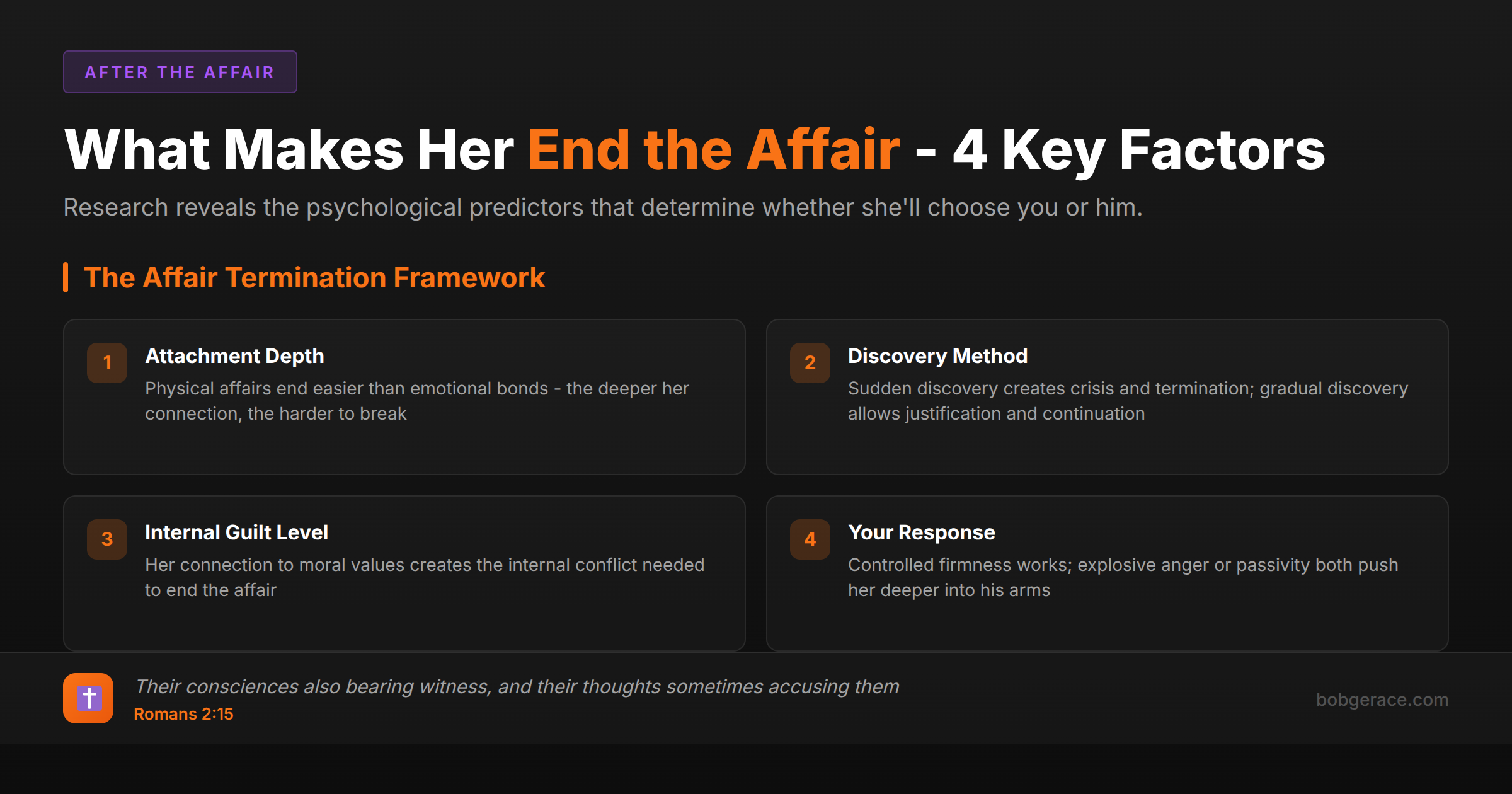
Research shows several key factors predict whether a woman will end her affair. The strongest predictor is the depth of attachment to the affair partner - women in purely physical affairs are more likely to end them than those who've developed emotional bonds. Discovery circumstances matter significantly: affairs discovered gradually allow more time for justification, while sudden discoveries create immediate crisis points that often lead to termination. Her personal guilt level and religious/moral framework strongly influence the decision. Women who maintain connection to their values experience more internal conflict, making affair continuation harder. The husband's response to discovery is crucial - extreme reactions (either complete passivity or explosive anger) often push her deeper into the affair, while firm but controlled responses create space for conscience to work.
The Full Picture
Understanding what predicts affair termination requires looking at multiple interconnected factors that researchers have identified through decades of study.
Attachment Style and Affair Type Women with anxious attachment styles who enter affairs seeking emotional validation are paradoxically more likely to end them when they realize the affair partner can't provide the security they're truly seeking. Those with avoidant attachment who use affairs to maintain emotional distance often continue longer because the affair serves its psychological purpose.
The Role of Discovery How the affair is discovered dramatically impacts its trajectory. Self-disclosure by the unfaithful spouse leads to affair termination 78% of the time within six months. Gradual discovery through suspicious behavior allows time for the affair to become more entrenched and justified. Sudden discovery through evidence creates immediate crisis but also immediate opportunity for intervention.
Social and Environmental Factors The affair partner's availability and pressure significantly influence duration. Married affair partners who can't offer future commitment create natural ending points. Social support systems matter - women with strong friendships and family connections who disapprove of affairs face more external pressure to end them.
Internal Psychological Factors Women who maintain cognitive dissonance about their behavior - feeling guilty while continuing - are in an unstable state that typically resolves within 12-18 months either by ending the affair or fully justifying it. Those who successfully compartmentalize without guilt tend to continue affairs longer, but this compartmentalization often breaks down when faced with major life events or decisions about the future.
What's Really Happening
From a clinical perspective, affair termination follows predictable psychological patterns that we can identify and sometimes influence.
The Cognitive Dissonance Factor Most women experience significant internal conflict during affairs, especially those raised with strong moral frameworks. This dissonance creates psychological pressure that must be resolved. The resolution typically goes one of three ways: ending the affair, ending the marriage, or successfully compartmentalizing the behavior. Our goal is to increase the dissonance while providing a path toward affair termination.
Attachment Dynamics in Play Affairs often begin as attempts to meet unmet attachment needs, but they rarely succeed long-term. Women seeking security find affairs inherently insecure. Those seeking passion discover it's unsustainable without foundation. Those seeking validation find affair-based attention ultimately hollow. Recognizing these patterns helps predict when natural disillusionment will occur.
The Husband's Influence Window Contrary to popular belief, husbands have significant influence over affair outcomes, but only within specific parameters. Extreme responses - whether explosive anger or complete passivity - typically push wives deeper into affairs as they seek either protection from chaos or escape from weakness. Controlled strength - firm boundaries with emotional regulation - creates the psychological space necessary for a wife's conscience to function.
Critical Decision Points Affairs face natural crisis points: holidays, //blog.bobgerace.com/blended-family-christian-marriage-protect-children/:family events, future planning discussions, or when the affair partner pressures for commitment. These moments create opportunities for intervention because the woman must actively choose to continue rather than simply drift along.
What Scripture Says
Scripture reveals profound truths about human nature that directly apply to understanding affair termination patterns.
The Power of Conscience God has written His law on every heart, creating internal conflict when we violate His design: *"They show that the requirements of the law are written on their hearts, their consciences also bearing witness, and their thoughts sometimes accusing them and at other times even defending them"* (Romans 2:15). This internal battle predicts affair outcomes - those who can silence conscience continue, while those who maintain sensitivity to it face increasing pressure to change.
The Deception of Sin Scripture warns that *"sin deceives"* (Hebrews 3:13) and that *"each person is tempted when they are dragged away by their own evil desire and enticed"* (James 1:14). Affairs begin with deception but often end when reality breaks through the fantasy. Understanding this process helps predict when disillusionment will occur.
The Role of Truth Jesus promised that *"you will know the truth, and the truth will set you free"* (John 8:32). Affairs thrive on lies, secrecy, and fantasy. When truth penetrates - about the affair's real nature, its impact on family, or God's design for marriage - freedom to choose righteously returns. This is why discovery, while painful, often marks the beginning of affair termination.
Hope for Restoration *"The Lord is not slow in keeping his promise, as some understand slowness. Instead he is patient with you, not wanting anyone to perish, but everyone to come to repentance"* (2 Peter 3:9). God's heart is for restoration, not destruction. Even in adultery, His patience provides opportunities for repentance and return. This hope should guide our responses and expectations.
What To Do Right Now
-
1
Document the discovery - Write down how and when you discovered the affair, her initial response, and any admissions made
-
2
Control your initial response - Avoid explosive anger or complete withdrawal; both typically drive affairs deeper underground
-
3
Assess the affair type - Determine if it's primarily physical, emotional, or both, as this affects termination probability
-
4
Set clear boundaries - Communicate non-negotiable expectations without ultimatums that you're not prepared to enforce
-
5
Increase healthy pressure - Make affair continuation more difficult while providing a clear path back to the marriage
-
6
Get professional guidance - Work with someone experienced in affair recovery to navigate this critical period effectively
Related Questions
Don't Navigate This Crisis Alone
The next few weeks are critical in determining whether your wife ends the affair or goes deeper. Get the strategic guidance you need to respond effectively during this crucial window.
Get Help Now →