How do I model Christ who 'did not revile in return'?
6 min read
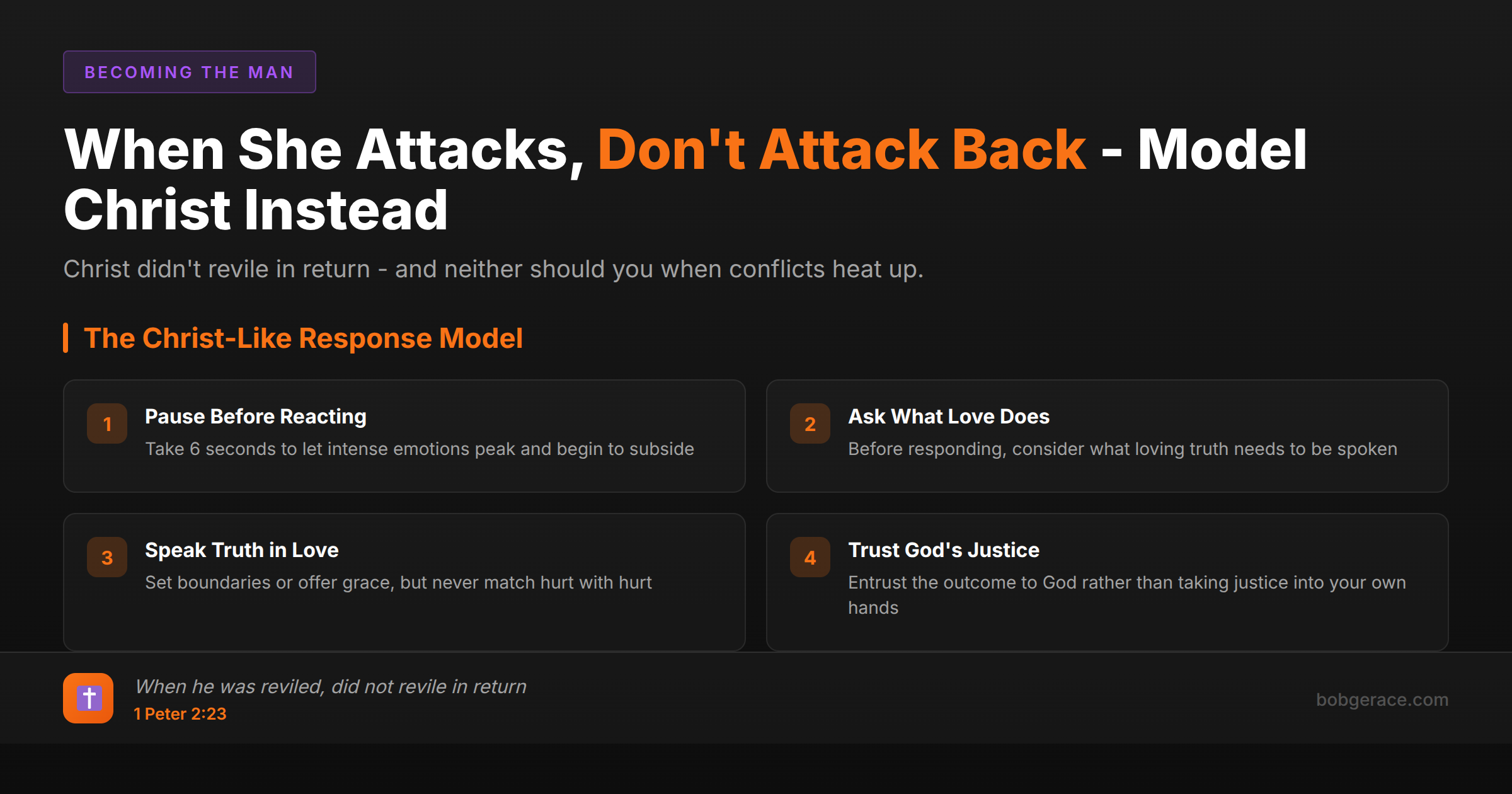
Modeling Christ's non-retaliatory response means choosing restraint and love when your spouse attacks, criticizes, or hurts you. This doesn't mean becoming a doormat or enabling destructive behavior. Instead, it means responding with truth spoken in love rather than defensive anger or counter-attacks. The key is preparation and practice. Before conflicts arise, establish your commitment to respond like Christ. During heated moments, pause, breathe, and ask yourself what loving truth needs to be spoken. Sometimes this means setting a boundary, sometimes it means offering grace, but it never means matching evil with evil or hurt with hurt.
The Full Picture
When Peter wrote about Christ "who, when he was reviled, did not revile in return," he wasn't describing weakness—he was describing the ultimate display of strength and love. Christ had every right and power to retaliate, yet chose a different path that ultimately brought healing and redemption.
In marriage, this principle becomes intensely practical. Your spouse says something cutting, and every fiber of your being wants to fire back with something equally hurtful. Your natural instinct is to defend, deflect, or destroy. But Christ calls us to a radically different response.
This doesn't mean you become a passive victim or enable destructive behavior. Christ himself confronted sin directly and set clear boundaries. The difference is in the motivation and method. When you revile in return, you're operating from hurt, pride, and a desire to win or wound. When you follow Christ's model, you're operating from love, truth, and a desire to heal and restore.
The challenge is that this requires supernatural strength. Your flesh wants revenge. Your pride demands vindication. But the Spirit calls you to something higher—a response that reflects Christ's character and creates space for genuine resolution rather than escalating conflict.
This principle transforms not just individual conversations but the entire trajectory of your marriage. When one spouse consistently chooses non-retaliation, it breaks destructive cycles and often invites the other spouse into healthier patterns of communication.
What's Really Happening
Neurologically, when we feel attacked, our amygdala triggers a fight-or-flight response faster than our prefrontal cortex can engage rational thought. This is why "reviling in return" feels so automatic and justified in the moment. Your brain is literally wired for retaliation as a survival mechanism.
However, chronic patterns of retaliation create what we call "negative sentiment override" in relationships. Each exchange of hurt builds resentment and erodes the foundation of safety and trust that healthy marriages require. Partners begin to interpret even neutral interactions through a lens of threat and defensiveness.
The Christ-like alternative—pausing before responding—allows your prefrontal cortex to come online and engage higher-order thinking. This creates space for empathy, perspective-taking, and strategic responses rather than reactive ones. Research shows that couples who master this pause-and-choose pattern report significantly higher satisfaction and lower divorce rates.
Practically, this means developing what I call "response flexibility"—the ability to choose your reaction based on your values rather than your immediate emotions. This isn't emotional suppression, which is unhealthy, but rather emotional regulation in service of your deeper commitments to your spouse and your faith. The goal isn't to never feel hurt or anger, but to let those emotions inform rather than control your response.
What Scripture Says
Scripture provides a clear framework for Christ-like responses in conflict. 1 Peter 2:23 describes how Christ "when he was reviled, did not revile in return; when he suffered, he did not threaten, but continued entrusting himself to him who judges justly." This is our model—trusting God with the outcome rather than taking justice into our own hands.
Romans 12:17-21 instructs us to "repay no one evil for evil" and "if possible, so far as it depends on you, live peaceably with all." Notice the phrase "so far as it depends on you"—we're responsible for our response, not our spouse's behavior.
Ephesians 4:29 calls us to speak "only such a word as is good for edification according to the need of the moment, so that it will give grace to those who hear." Even in conflict, our words should build up rather than tear down.
Proverbs 15:1 reminds us that "a gentle answer turns away wrath, but a harsh word stirs up anger." Our response can either escalate or de-escalate conflict.
Matthew 5:39 challenges us not to "resist an evil person," but this doesn't mean passivity—Christ himself confronted evil throughout his ministry. It means refusing to meet evil with evil, choosing instead to respond with truth and love that can actually transform the situation.
What To Do Right Now
-
1
Establish a pre-commitment to Christ-like responses before conflicts arise—make this decision when you're calm, not in the heat of the moment
-
2
Practice the 6-second pause—neurologically, intense emotions peak and begin to subside in about 6 seconds if you don't feed them
-
3
Ask yourself: 'What would love do right now?' before responding to attacks or criticism from your spouse
-
4
Develop stock phrases like 'I need a moment to respond well' or 'Help me understand what you're really feeling' to buy time and show care
-
5
Address the underlying issue or hurt rather than just defending against the attack—look for the pain beneath your spouse's anger
-
6
Set appropriate boundaries when needed—Christ-like doesn't mean allowing ongoing abuse or destructive behavior without consequences
Related Questions
Ready to Break Destructive Patterns?
Learning to respond like Christ takes practice and support. Let's work together to transform how you handle conflict in your marriage.
Get Help Now →