How do I track emotional triggers?
6 min read
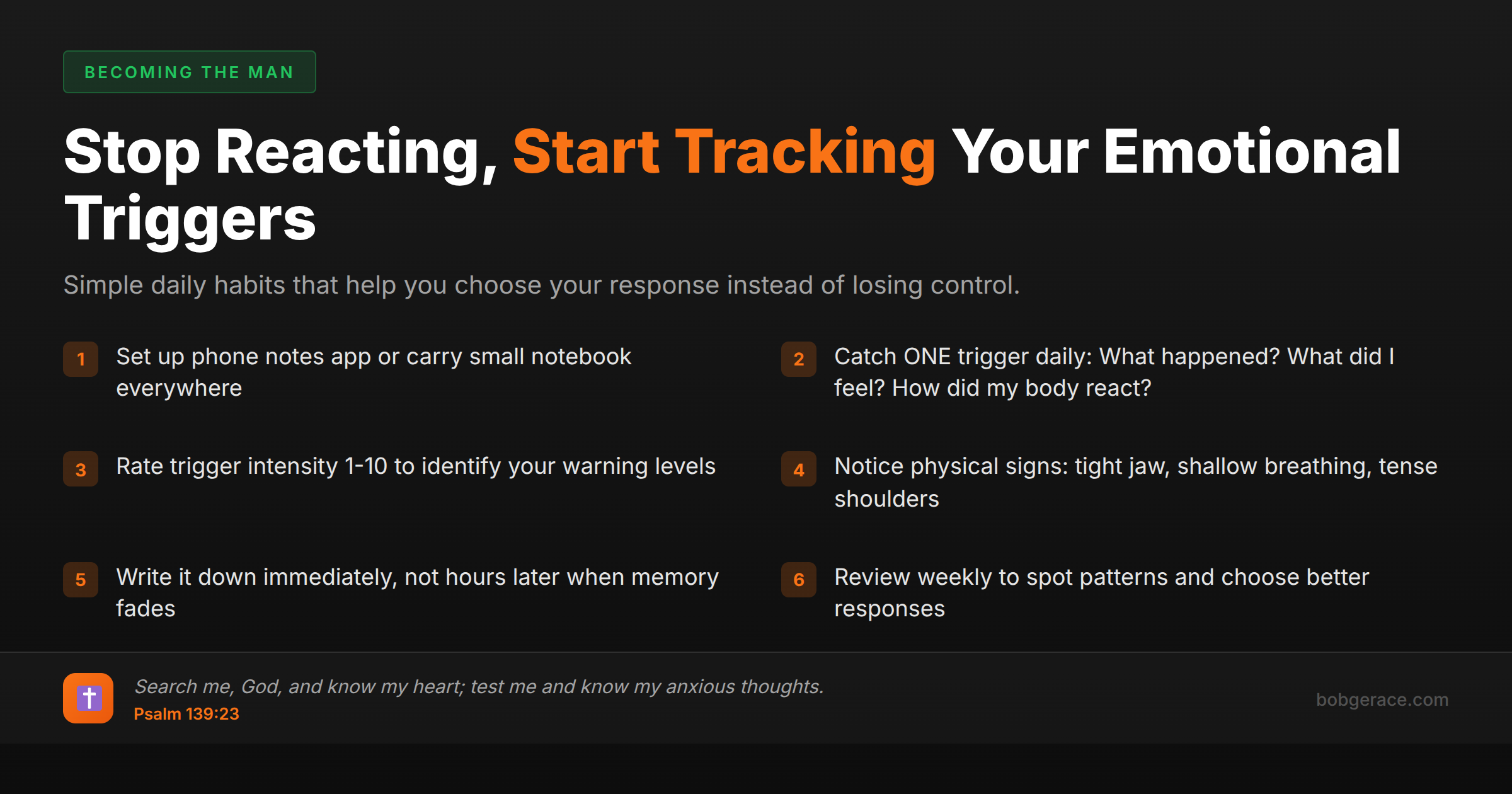
Tracking emotional triggers starts with creating a simple daily log that captures three key elements: the situation that upset you, the emotion you felt, and your physical response. The most effective approach is to write it down immediately after you notice the trigger, not hours later when memory fades. Use your phone's notes app or a small notebook to record: What happened? What did I feel? How did my body react? After a week, you'll start seeing patterns - maybe criticism triggers anger, or feeling dismissed creates withdrawal. The goal isn't to eliminate triggers entirely, but to recognize them faster so you can choose your response instead of reacting automatically.
The Full Picture
Most men go through life completely unaware of their emotional triggers until they explode in their marriage. You're not broken if you struggle with this - you were likely never taught to pay attention to your internal emotional world.
Triggers are automatic responses to specific situations that bypass your rational thinking. They're rooted in past experiences, unmet needs, or core beliefs about yourself. When triggered, your nervous system activates before your brain can process what's happening.
The key to tracking triggers effectively is understanding that they have three distinct phases: the external trigger event, your internal emotional response, and your behavioral reaction. Most men only notice the explosion at the end, missing the warning signs that could help them intervene earlier.
Start with body awareness. Your body gives you trigger warnings before your emotions fully activate - tension in shoulders, tight jaw, shallow breathing, or stomach knots. These physical cues are your early warning system.
Common trigger categories include feeling disrespected, criticized, controlled, ignored, or misunderstood. Your specific triggers depend on your personality, past experiences, and core values. What triggers you might not affect another man at all.
Successful trigger tracking requires consistency over perfection. You don't need to catch every trigger - start with the obvious ones. The goal is building awareness so you can create space between the trigger and your response, giving you the power to choose how you react instead of being controlled by automatic patterns.
What's Really Happening
From a neurological perspective, emotional triggers activate your amygdala - the brain's alarm system - faster than your prefrontal cortex can engage rational thinking. This creates what we call 'amygdala hijack,' where you're literally operating from a more primitive part of your brain.
The most effective trigger tracking method I recommend is the STOP technique: Situation (what happened), Thoughts (what you told yourself), Oemotions (what you felt), Physical sensations (how your body responded). This framework helps you map the complete trigger sequence.
Many men resist tracking because they view it as 'touchy-feely,' but it's actually data collection. You're gathering intelligence about your own operating system so you can optimize it. Think of it like monitoring your car's performance - you check the dashboard to prevent breakdowns.
Trigger intensity varies on a 1-10 scale. Level 3-4 triggers are perfect for practicing new responses because you still have access to your rational brain. By the time you hit 7-8, you're in survival mode and learning becomes nearly impossible.
The goal isn't eliminating triggers - they often point to important values and boundaries. Instead, we're building emotional regulation skills so you can respond from strength rather than react from wounds. This process typically takes 3-6 months of consistent practice before new patterns become automatic.
What Scripture Says
Scripture calls us to examine our hearts and grow in self-awareness. Psalm 139:23-24 says, *"Search me, God, and know my heart; test me and know my anxious thoughts. See if there is any offensive way in me, and lead me in the way everlasting."* Tracking triggers is essentially asking God to reveal our heart patterns.
Proverbs 27:19 teaches us, *"As water reflects the face, so one's life reflects the heart."* Your emotional reactions are mirrors showing you what's really in your heart - your fears, wounds, and areas needing God's healing touch.
Jesus modeled emotional awareness throughout the Gospels. In John 11:35, *"Jesus wept"* - He felt deeply and didn't hide His emotions. In the Garden of Gethsemane, Matthew 26:38 records Him saying, *"My soul is overwhelmed with sorrow to the point of death."* Christ was fully aware of His emotional state.
Proverbs 16:32 reminds us, *"Better a patient person than a warrior, one with self-control than one who takes a city."* Self-control requires self-awareness - you can't manage what you don't monitor.
The ultimate goal isn't just trigger management, but transformation. As 2 Corinthians 3:18 promises, *"And we all, who with unveiled faces contemplate the Lord's glory, are being transformed into his image with ever-increasing glory."* When we honestly examine our hearts, God transforms us from the inside out.
James 1:19 provides the perfect framework: *"Be quick to listen, slow to speak and slow to become angry."* Tracking triggers helps you become 'slow to become angry' by creating space between stimulus and response.
What To Do Right Now
-
1
Set up a simple tracking system - use your phone's notes app or a small notebook you keep with you at all times
-
2
For the next week, catch just ONE trigger per day and write down: What happened? What did I feel? How did my body react?
-
3
Rate trigger intensity 1-10 to identify patterns in your emotional responses and recognize your warning levels
-
4
Notice your physical warning signs - tight jaw, shallow breathing, tense shoulders - these are your early detection system
-
5
After one week, review your notes to identify your top 3 trigger categories and the situations that activate them most
-
6
Practice the 6-second rule: when triggered, count to six before responding - this gives your rational brain time to engage
Related Questions
- How do I identify what I'm feeling?
- How do I notice feelings in my body?
- What is emotional granularity?
- How do I build emotional vocabulary?
- What is 'window of tolerance' and how do I widen mine?
- How do I self-regulate before I connect?
- What is 'hypervigilance' and why am I doing it?
- What are the behavioral markers of defensiveness?
- Why do I keep replaying the discovery?
- What does nervous system regulation look like?
Also find Bob on
Subscribe for weekly videos on Christian marriage.
Track Triggers in Your Actual Marriage
Patterns are easier to see when someone's looking at your specific situation with you. A coach helps you connect what's happening in your marriage to what's happening in your body—and what to do about it.
Talk to Bob →