It's like I'm sabotaging myself
5 min read
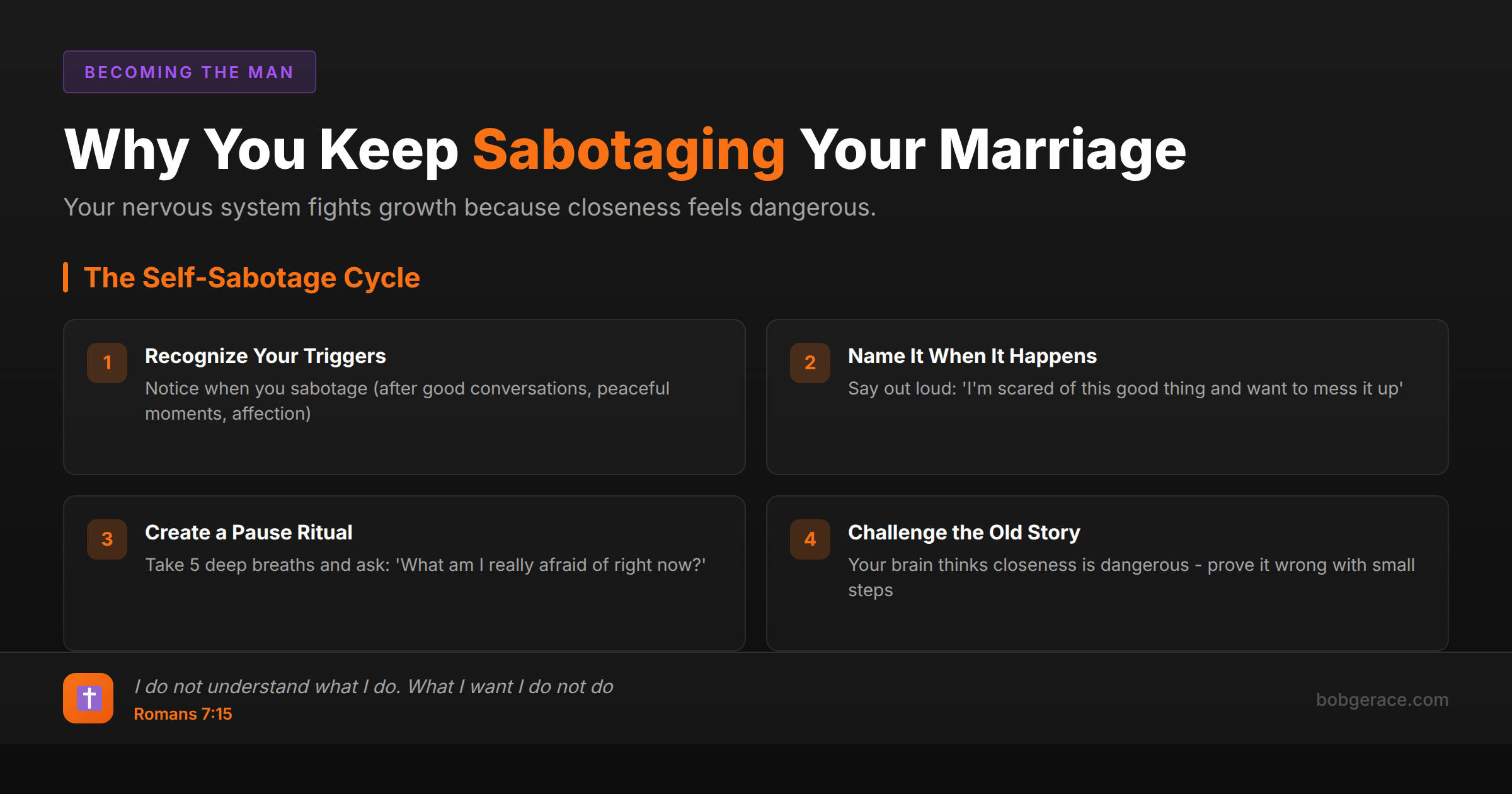
Self-sabotage in marriage happens when you unconsciously undermine your own efforts to build intimacy, often just when things start going well. You might pick fights after a great date night, withdraw when your spouse shows affection, or create drama during peaceful moments. This isn't weakness or stupidity - it's your nervous system trying to maintain familiar patterns, even destructive ones. The core issue is that growth feels dangerous to your subconscious mind. If conflict or distance feels 'normal' from your past, your brain interprets closeness as a threat. You're not actually trying to destroy your marriage; you're trying to return to what feels predictable and safe, even if it's painful.
The Full Picture
Self-sabotage shows up in countless ways in marriage, and most of the time you don't even realize you're doing it. You might finally have a breakthrough conversation with your spouse, feel genuinely connected, then wake up the next morning picking apart everything they say. Or you'll make real progress in counseling, then 'forget' to do the homework or miss the next session.
The most common self-sabotage patterns include:
- The Success Panic - Creating conflict right after positive breakthroughs - The Intimacy Retreat - Withdrawing emotionally when your spouse shows genuine love - The Progress Punishment - Undoing good work through 'small' destructive choices - The Preemptive Strike - Hurting them before they can hurt you - The Familiar Chaos - Stirring up drama because peace feels uncomfortable
Here's what's really happening: your nervous system has been programmed by past experiences to expect certain outcomes. If you grew up with chaos, abandonment, or emotional unavailability, your brain literally wired itself to anticipate these patterns. When your marriage starts feeling different - safer, more intimate, more stable - your subconscious hits the panic button.
It's not that you don't want a good marriage. It's that 'good' feels foreign and therefore dangerous. Your brain would rather return to familiar pain than risk unfamiliar joy. This is why people often sabotage relationships right when they're going best - because 'best' triggers old wounds and fears.
The tragedy is that this creates a self-fulfilling prophecy. You expect rejection, so you act in ways that invite it. You fear abandonment, so you push your spouse away first. You don't believe you deserve love, so you make yourself unlovable. Then when the relationship struggles, your brain says, 'See? I was right to be afraid.'
Breaking this cycle requires recognizing that your feelings aren't always telling you the truth about your current reality.
What's Really Happening
Self-sabotage in relationships is rooted in what we call 'attachment injuries' - early experiences that taught your nervous system that closeness equals danger. When you were young, your brain created protective strategies based on what you needed to survive emotionally in your family of origin.
If love came with conditions, chaos, or abandonment, your nervous system learned to stay hypervigilant for signs of these patterns. Now, when your marriage starts feeling genuinely safe and loving, it doesn't match your internal template for 'normal.' Your brain interprets this mismatch as a threat and activates old protective behaviors.
This shows up neurologically as increased cortisol and adrenaline when things are going well - literally a stress response to positive experiences. You might feel anxious after a wonderful evening with your spouse, or find yourself scanning for problems when there aren't any.
The key insight is that self-sabotage isn't a character flaw - it's an outdated survival mechanism. Your brain is trying to protect you based on old information. The solution involves what we call 'earned security' - consciously rewiring your nervous system to recognize that your current relationship is different from your past experiences.
This process requires both awareness and intentional practice. You need to catch yourself in these moments of 'success panic' and consciously choose different responses. Over time, your nervous system can learn that intimacy and stability are actually safe, not threatening.
Remember, healing isn't linear. You'll have setbacks, and that's completely normal. The goal isn't perfection; it's increasing your capacity to tolerate love and closeness without reflexively pushing it away.
What Scripture Says
God's Word speaks directly to the battle between our old nature and our new identity in Christ. The Apostle Paul captured this internal conflict perfectly: 'I do not understand what I do. For what I want to do I do not do, but what I hate I do' (Romans 7:15). This describes self-sabotage exactly - acting against your own best interests despite knowing better.
The root of self-sabotage often lies in believing lies about our worth and God's heart toward us. 'The thief comes only to steal and kill and destroy; I have come that they may have life, and have it abundantly' (John 10:10). When you sabotage your marriage, you're agreeing with the thief's lies that you don't deserve good things or that disaster is inevitable.
God wants to transform how we think about ourselves and His intentions for our lives. 'Do not conform to the pattern of this world, but be transformed by the renewing of your mind. Then you will be able to test and approve what God's will is—his good, pleasing and perfect will' (Romans 12:2). Breaking self-sabotage requires renewing your mind with truth about who you are in Christ.
The enemy wants to keep you trapped in cycles that destroy what God is building. 'Be alert and of sober mind. Your enemy the devil prowls around like a roaring lion looking for someone to devour' (1 Peter 5:8). Self-sabotage is one of his favorite tools because it makes you destroy your own blessings.
But God's plan is for you to experience His goodness, including in your marriage. 'For I know the plans I have for you,' declares the Lord, 'plans to prosper you and not to harm you, to give you hope and a future' (Jeremiah 29:11). When you sabotage good things, you're essentially saying you don't believe God's promises.
The path forward involves surrendering these patterns to Christ and walking in your new identity. 'Therefore, if anyone is in Christ, the new creation has come: The old has gone, the new is here!' (2 Corinthians 5:17). You don't have to be controlled by old patterns anymore.
What To Do Right Now
-
1
Recognize Your Triggers - Write down specific moments when you tend to sabotage progress (after good conversations, during peaceful times, when spouse shows affection)
-
2
Name It When It Happens - Say out loud: 'I'm feeling scared of this good thing and want to mess it up' - awareness breaks the unconscious pattern
-
3
Create a Pause Ritual - When you feel the urge to sabotage, take 5 deep breaths and ask: 'What am I really afraid of right now?'
-
4
Challenge the Old Story - Identify what past experience is driving the fear and remind yourself: 'That was then, this is now - my spouse is not my past'
-
5
Choose One Small Different Action - Instead of your usual sabotage move, do one thing that builds connection (text appreciation, give a hug, ask a caring question)
-
6
Celebrate Progress Without Panic - When things go well, practice staying present and grateful instead of waiting for the other shoe to drop
Related Questions
- I keep making the same mistakes
- Why do I repeat patterns I hate?
- I know what to do but can't do it
- Every time I make progress, I blow it
- What is self-sabotage serving?
- What would I have to face if I actually changed?
- I said things I can't take back
- How do I stop exploding?
- Why does 'trying harder' often backfire?
- What if I change and she still leaves?
Also find Bob on
Subscribe for weekly videos on Christian marriage.
Your Pattern Has a Story
A coach who knows your marriage can see what triggers the sabotage and build a plan that fits how your nervous system actually works.
Talk to Bob →