What does coercive control look like?
6 min read
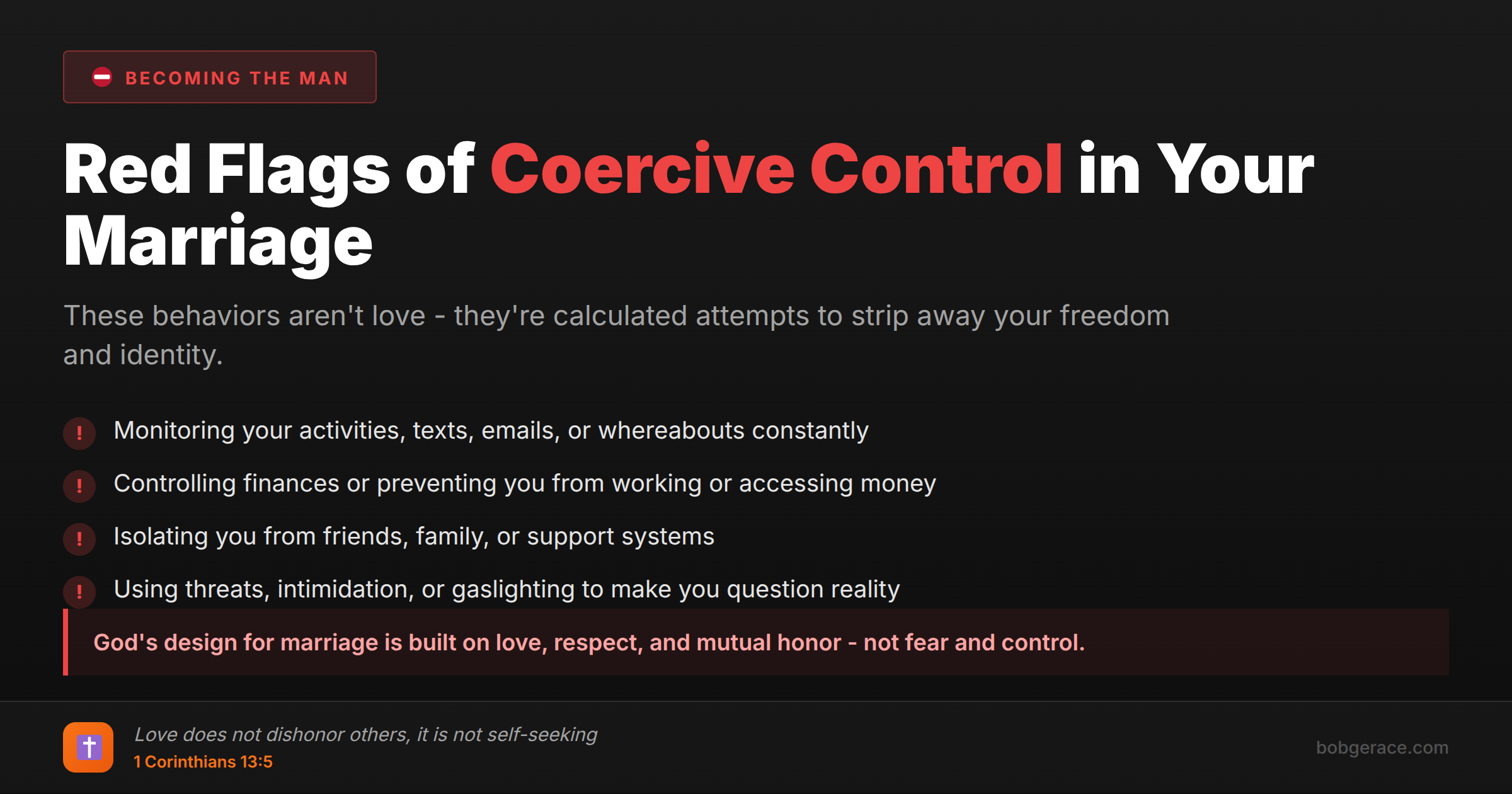
Coercive control is a pattern of behavior designed to dominate, isolate, and control you through fear, intimidation, and manipulation. It's often invisible to others because it doesn't leave physical marks, but it systematically strips away your autonomy, self-worth, and freedom. Unlike occasional arguments or disagreements, coercive control is persistent and calculated. Your partner may monitor your activities, control finances, isolate you from friends and family, use threats or intimidation, manipulate your emotions through guilt or gaslighting, and gradually erode your sense of reality. These behaviors create an environment where you feel constantly walking on eggshells, questioning your own perceptions, and losing your sense of self.
The Full Picture
Coercive control operates like a spider's web - it's constructed gradually, almost imperceptibly, until you realize you're completely entangled. Unlike physical abuse that happens in episodes, coercive control is a constant undercurrent that shapes every aspect of your daily life.
Financial Control is often the first red flag. He might take over all financial decisions, hide money, prevent you from working, or create financial dependency. You find yourself having to ask permission for basic purchases or having no access to accounts.
Social Isolation happens gradually. He criticizes your friends and family, creates conflict when you spend time with others, or makes it difficult for you to maintain relationships. Before you know it, your support network has shrunk to nearly nothing.
Emotional Manipulation includes gaslighting (making you question your memory or perceptions), constant criticism disguised as 'help,' emotional blackmail, and using your vulnerabilities against you. He might say things like 'You're too sensitive' or 'That never happened' when you try to address his behavior.
Monitoring and Surveillance can involve checking your phone, tracking your location, showing up unexpectedly, interrogating you about your activities, or using technology to monitor your communications.
Threats and Intimidation don't have to be physical. They can include threats to leave, threats involving children, threats to your reputation, or creating an atmosphere of fear through unpredictable mood swings and explosive anger.
The most insidious aspect is how it affects your thinking. You begin to modify your behavior to avoid his reactions, constantly calculating how to keep peace, and gradually losing your sense of what's normal or acceptable in a relationship.
What's Really Happening
From a psychological perspective, coercive control operates on the principle of learned helplessness combined with trauma bonding. The controlling partner systematically dismantles their victim's autonomy through a combination of intermittent reinforcement and psychological conditioning.
What makes coercive control particularly damaging is its impact on your nervous system. Living under constant surveillance and unpredictable threats keeps you in a state of hypervigilance, which exhausts your mental and emotional resources. This chronic stress impairs your ability to think clearly, make decisions, and recognize the severity of your situation.
The controller often alternates between punishment and reward, creating what we call trauma bonding. After periods of tension or abuse, he may become loving, apologetic, or generous, which releases bonding chemicals in your brain. This cycle creates an addictive pattern that makes leaving feel emotionally impossible, even when you intellectually know the relationship is harmful.
Coercive control also involves identity erosion. Through constant criticism, monitoring, and control, your sense of self becomes increasingly dependent on his approval. You may find yourself adopting his opinions, interests, and even his version of events, losing touch with your own thoughts and feelings.
Recovery requires rebuilding your sense of reality, reconnecting with your own thoughts and feelings, and gradually reclaiming your autonomy. This process takes time and often requires professional support, but healing is absolutely possible with the right resources and support system.
What Scripture Says
God's design for marriage is built on love, respect, and mutual honor - the complete opposite of coercive control. Scripture provides clear guidance on how we should treat one another and what healthy relationships look like.
Love is not controlling. 1 Corinthians 13:4-5 tells us that 'Love is patient, love is kind. It does not envy, it does not boast, it is not proud. It does not dishonor others, it is not self-seeking, it is not easily angered, it keeps no record of wrongs.' Coercive control violates every aspect of biblical love - it's impatient, unkind, dishonoring, self-seeking, and often angry.
You have inherent worth and dignity. Genesis 1:27 declares that we are created 'in the image of God' - both male and female. This means you have inherent worth that cannot be diminished by anyone's treatment of you. Psalm 139:14 reminds us we are 'fearfully and wonderfully made.'
Fear has no place in love. 1 John 4:18 states, 'There is no fear in love. But perfect love drives out fear, because fear has to do with punishment.' If you're constantly afraid of your partner's reactions, that's not love - it's control through fear.
God calls us to wisdom and discernment. Proverbs 27:14 warns about those who use sweet words to manipulate: 'Whoever loudly blesses their neighbor early in the morning will be taken as a curse.' God wants us to recognize manipulation, even when it comes disguised as care or concern.
Christ came to set us free. Galatians 5:1 says, 'It is for freedom that Christ has set us free. Stand firm, then, and do not let yourselves be burdened again by a yoke of slavery.' God doesn't want you living under the oppression of coercive control.
We're called to be peacemakers, not peacekeepers. Matthew 5:9 blesses peacemakers, but true peace cannot exist where there's ongoing oppression and control. Sometimes making peace requires confronting ungodly behavior, not enabling it.
What To Do Right Now
-
1
Document patterns - Start keeping a private record of controlling behaviors, including dates and specific incidents
-
2
Reconnect safely - Reach out to one trusted friend or family member, even if it's been a long time
-
3
Create a safety plan - Identify safe places to go and people to call if you need immediate help
-
4
Secure important documents - Quietly gather copies of ID, financial documents, and important papers in a safe location
-
5
Establish financial independence - Open a separate bank account if possible, even with small amounts
-
6
Seek professional support - Contact a therapist, counselor, or domestic violence advocate who understands coercive control
Related Questions
- What is 'love bombing'?
- What is the cycle of abuse/reconciliation?
- How do I distinguish hoovering from genuine pursuit?
- What are red flags that this is manipulation?
- What is 'performative remorse'?
- What is 'intermittent reinforcement'?
- She says she's 'fine' but she's not
- She shuts down when I try to connect
- She's scared of my anger
- I don't hit her but I still scare her
Also find Bob on
Subscribe for weekly videos on Christian marriage.
Your Situation Needs a Human
Coercive control is specific to your marriage, your partner's patterns, your safety. A coach who hears your story can help you see what's actually happening and build a plan that fits your reality.
Talk to Bob →