What does 'prayer of faith' mean for my situation?
6 min read
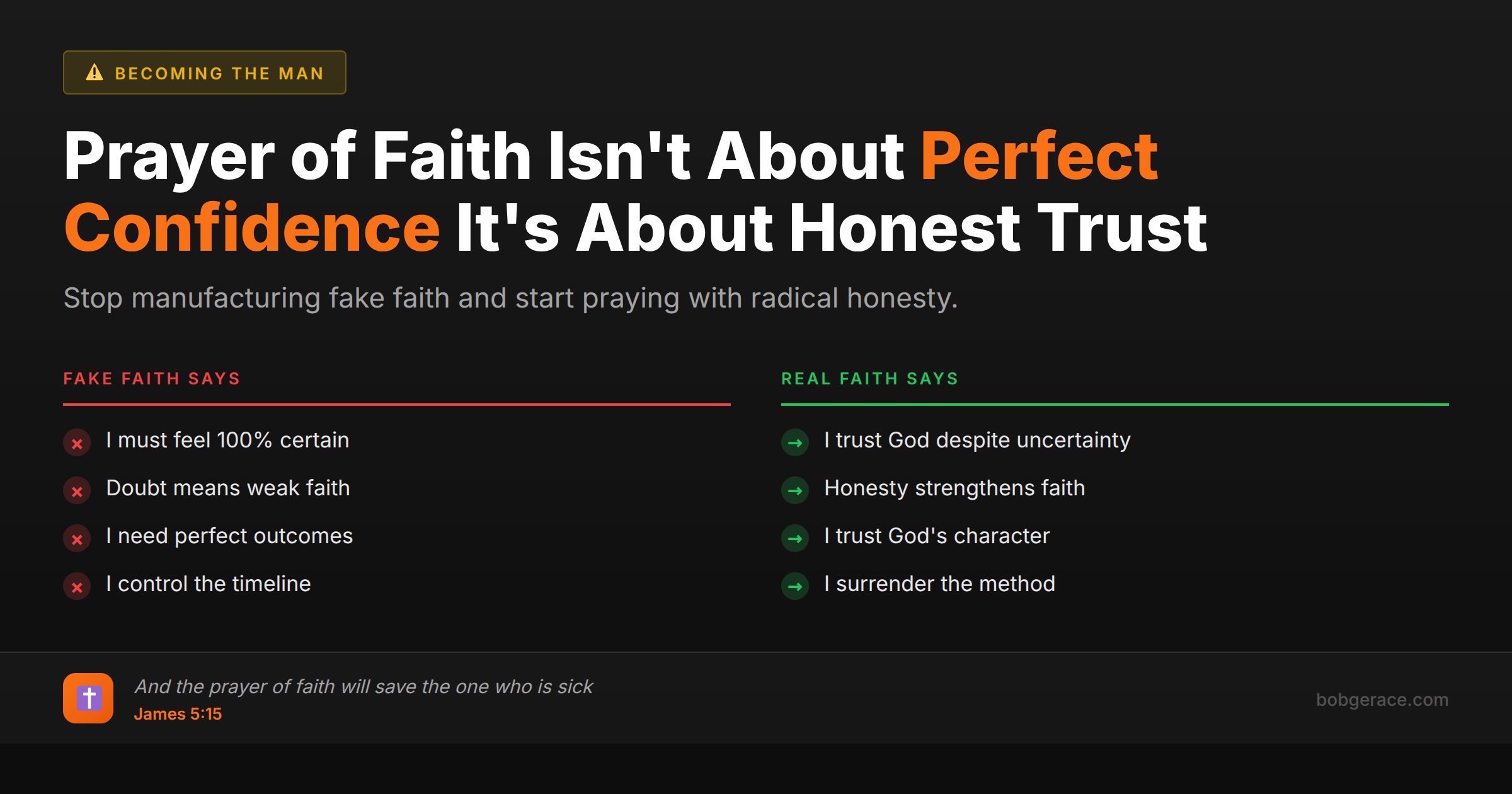
The 'prayer of faith' from James 5:15 isn't about manufacturing perfect confidence or pretending doubt doesn't exist. It's about coming to God with honest trust, believing He hears you and will act according to His character and promises, even when you can't see the outcome. In your marriage situation, this means praying with the deep conviction that God cares about your struggle and will work for your good, while surrendering the timeline and method to Him. It's faith in God's nature, not faith in getting exactly what you want when you want it.
The Full Picture
The prayer of faith has been misunderstood and weaponized against hurting people for too long. You've probably heard it used to suggest that if you just had 'enough faith,' your marriage problems would disappear. That's not biblical, and it's not helpful.
Real faith-filled prayer starts with honesty, not perfection. When James wrote about the prayer of faith in James 5:15, he was addressing a community dealing with real suffering, real sickness, and real problems. The context isn't about perfect people with perfect faith getting perfect results. It's about broken people bringing their brokenness to a faithful God.
Faith in prayer means trusting God's character, not controlling God's actions. You're not trying to manipulate divine outcomes through spiritual techniques. You're anchoring your prayers in what you know to be true about God - that He loves you, that He's working for your good, that He understands your pain, and that He has the power to transform hearts and circumstances.
Your marriage situation requires this kind of grounded faith. Whether you're dealing with betrayal, communication breakdown, emotional distance, or patterns that seem impossible to change, faith-filled prayer acknowledges both the severity of your situation and the sufficiency of your God. It doesn't minimize your pain or rush toward false positivity. Instead, it holds space for both your honest struggle and your confident hope in God's ability to work in ways you cannot see or predict.
What's Really Happening
From a therapeutic perspective, what people often call 'prayer of faith' can become a form of spiritual bypassing - avoiding difficult emotions by jumping straight to religious solutions. This creates additional shame when prayers don't seem 'faithful enough' or when circumstances don't change quickly.
Healthy faith-based prayer actually supports psychological healing by providing a secure attachment relationship with God that mirrors the secure attachment we need in human relationships. When you pray with genuine faith, you're practicing vulnerability, trust, and emotional regulation within a safe relationship.
The neurological benefits of this kind of prayer are measurable. Faith-based prayer activates the parasympathetic nervous system, reducing cortisol levels and creating space for clearer thinking about your marriage challenges. It's not magical thinking - it's accessing the calming presence of God that allows your brain to move out of survival mode and into connection mode.
I often see couples who have been taught that 'prayer of faith' means never expressing doubt or negative emotions to God. This creates internal fragmentation where parts of their experience feel unwelcome in their spiritual life. True faith-filled prayer integrates all of your experience - fear, anger, disappointment, hope - into honest communication with a God who can handle your full reality.
What Scripture Says
James 5:15 gives us the foundational understanding: 'And the prayer of faith will save the one who is sick, and the Lord will raise him up. And if he has committed sins, he will be forgiven.' Notice this isn't about perfect faith producing perfect outcomes, but about faithful prayer connecting us to God's healing power.
Hebrews 11:1 defines faith itself: 'Now faith is the assurance of things hoped for, the conviction of things not seen.' Your prayer of faith is anchored in confident hope in God's promises, even when you can't see how He's working in your marriage.
Mark 9:24 shows us what honest faith looks like: 'Immediately the father of the child cried out and said, "I believe; help my unbelief!"' This man's prayer was answered not because his faith was perfect, but because he brought his imperfect faith honestly to Jesus.
Romans 8:26-27 reminds us that the Spirit helps our weakness in prayer: 'Likewise the Spirit helps us in our weakness. For we do not know what to pray for as we ought, but the Spirit himself intercedes for us with groanings too deep for words.' Your faith-filled prayers are supported by the Spirit's intercession.
Matthew 17:20 puts the focus on authentic rather than enormous faith: 'Because of your little faith... if you have faith like a grain of mustard seed, you will say to this mountain, "Move from here to there," and it will move.' Small, genuine faith is more powerful than large, manufactured confidence.
Psalm 62:8 invites complete honesty: 'Trust in him at all times, O people; pour out your heart before him; God is a refuge for us.' Faith-filled prayer includes pouring out your real emotions, not hiding them behind spiritual language.
What To Do Right Now
-
1
Start with radical honesty - tell God exactly how you feel about your marriage situation, including fear, anger, and disappointment
-
2
Anchor your prayers in God's character - remind yourself of His love, faithfulness, and power as you pray
-
3
Pray for your spouse's heart, not just changed behavior - ask God to work in ways only He can see and reach
-
4
Include prayers of surrender - release your timeline and preferred outcomes while maintaining hope in God's goodness
-
5
Ask for daily grace and wisdom for your own responses and choices in your marriage
-
6
End each prayer session by thanking God for one thing He has already provided or one truth about His character
Related Questions
- How do I pray for my wife when she's hurting me?
- How do I pray for my marriage when it seems hopeless?
- How do I pray without demanding outcomes?
- What does surrendered prayer look like?
- How do I pray when I'm angry at God?
- What is biblical lament?
- Does God want me to stay in this marriage?
- How do I trust a God who let this happen?
- Is my suffering redemptive?
Also find Bob on
Subscribe for weekly videos on Christian marriage.
Praying alone isn't the same as having a coach
Bob works with men who are doing the spiritual work but need someone who knows their specific marriage—what to pray for, what to actually do next, how to stay steady when nothing changes.
Talk to Bob →