What does wisdom say?
6 min read
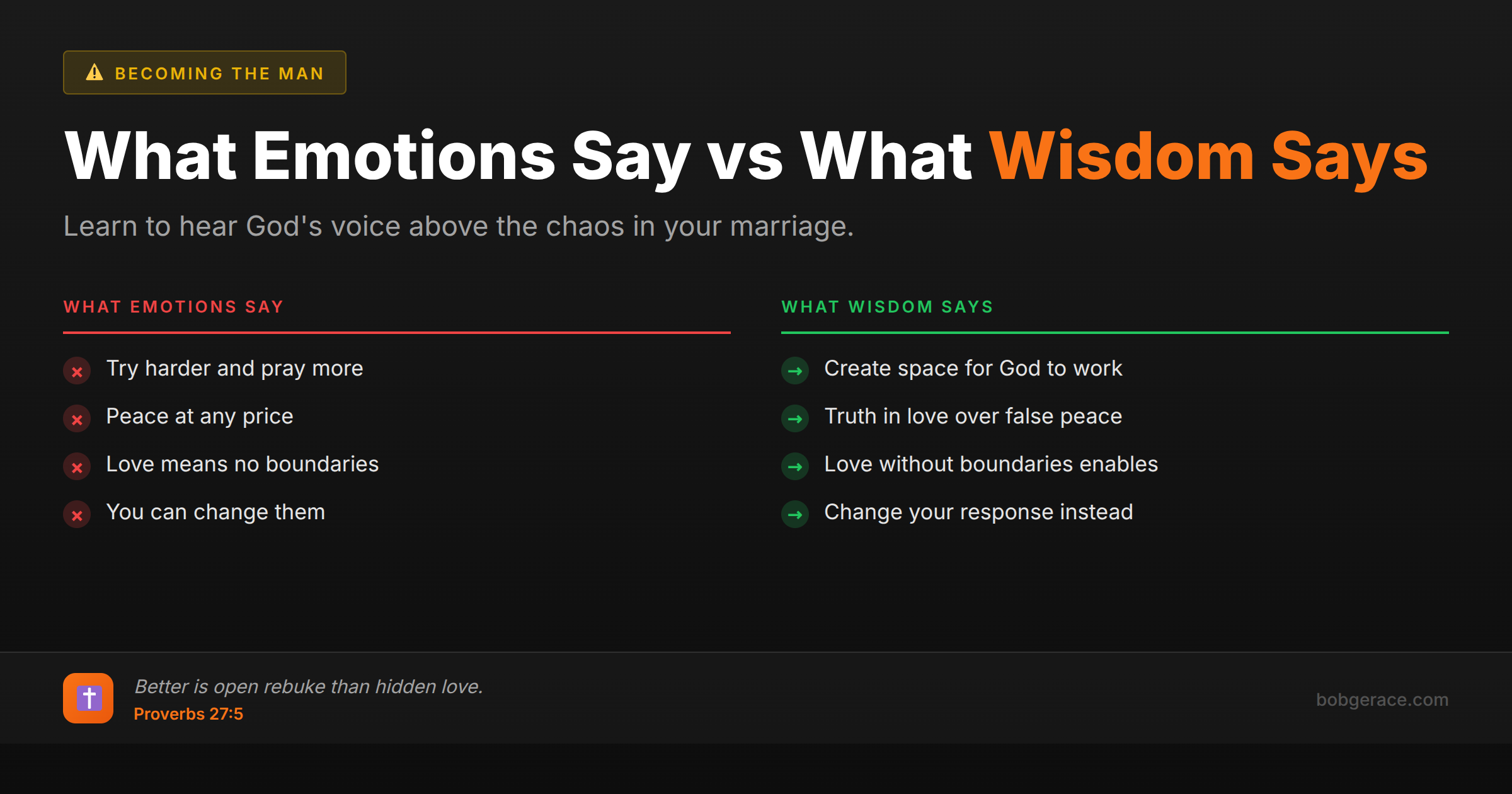
Wisdom calls us to step back from our emotions and circumstances to see our marriage through God's eyes. When you're caught in the chaos of conflict, manipulation, or dysfunction, wisdom provides the steady voice that cuts through confusion and points toward truth. Wisdom says that love without boundaries isn't love at all—it's enabling. It says that peace at any price often costs you your soul. Wisdom teaches that you cannot change another person, but you can change how you respond to them. Wisdom also reminds you that God's design for marriage includes mutual respect, sacrificial love, and healthy interdependence—not codependency or abuse. When your marriage lacks these elements, wisdom doesn't tell you to try harder or pray more; it tells you to establish boundaries, speak truth in love, and sometimes create space for God to work. Wisdom is both gentle and fierce, patient and decisive.
The Full Picture
Wisdom is the ability to see your marriage from God's perspective, not just your own. When you're in the thick of marital struggles, everything feels urgent, emotional, and overwhelming. But wisdom takes the long view. It asks different questions: What does God want for me? What does healthy love actually look like? How can I honor God while also protecting what He's entrusted to me?
Wisdom distinguishes between godly submission and ungodly enabling. Many Christian women have been taught that being a good wife means accepting whatever behavior their husband dishes out. But wisdom knows the difference between biblical submission and being a doormat. Submission to a godly man looks completely different from submission to a man who is not walking with God. Wisdom says you can honor God's design for marriage while still requiring your husband to honor it too.
Wisdom sees patterns, not just incidents. When your husband apologizes after an outburst, wisdom doesn't just focus on his sincere words—it looks at whether his behavior is actually changing over time. When he promises to get help, wisdom watches to see if he follows through. Wisdom isn't cynical, but it's not naive either. It hopes for the best while preparing for reality.
Wisdom understands that sometimes love looks like consequences. The most loving thing you can do for a husband who is destroying your marriage might be to let him experience the full weight of his choices. Wisdom doesn't rescue someone from consequences they've earned. Instead, it creates space for God to work in their heart through those consequences. This isn't punishment—it's love that refuses to enable destruction.
What's Really Happening
From a clinical perspective, wisdom functions as our internal navigation system that integrates emotional, rational, and spiritual information to guide decision-making. Many women in troubled marriages have learned to override their internal wisdom because they've been conditioned to prioritize their husband's comfort over their own well-being and discernment.
This conditioning often stems from trauma bonding, where intermittent reinforcement creates a powerful psychological attachment to the very person causing harm. When you're trauma-bonded, your emotional system can't distinguish between intensity and intimacy, between drama and love. Wisdom helps you step outside this reactive cycle and see the relationship patterns more clearly.
Neurologically, wisdom engages the prefrontal cortex—the brain's executive center—rather than operating from the limbic system where fear, guilt, and anxiety dominate. When you're constantly in fight-or-flight mode due to marital chaos, accessing wisdom becomes increasingly difficult. This is why creating physical and emotional space is often necessary before wisdom can be heard.
Wisdom also recognizes that chronic emotional dysregulation in a marriage isn't just a spiritual problem—it's often a mental health issue that requires professional intervention. While prayer and faith are essential, wisdom knows when additional resources are needed. It doesn't spiritualize away problems that have practical solutions.
What Scripture Says
Proverbs 27:5-6 - "Better is open rebuke than hidden love. Wounds from a friend can be trusted, but an enemy multiplies kisses." Wisdom knows that sometimes loving confrontation is more valuable than false peace. When your husband's behavior is destructive, wisdom says that honest communication about consequences is more loving than pretending everything is fine.
Proverbs 22:3 - "The prudent see danger and take refuge, but the simple keep going and pay the penalty." Wisdom doesn't ignore red flags or dismiss patterns of harmful behavior. It takes protective action when necessary, understanding that naive optimism can lead to unnecessary suffering.
Ephesians 5:11 - "Have nothing to do with the fruitless deeds of darkness, but rather expose them." This verse reminds us that wisdom doesn't participate in or enable destructive behavior, even when it comes from our spouse. Instead, it brings darkness into the light through honest communication and appropriate boundaries.
Proverbs 31:26 - "She speaks with wisdom, and faithful instruction is on her tongue." The Proverbs 31 woman is praised for her wisdom, not her silence. Wisdom gives you both the discernment to know when to speak and the courage to say what needs to be said.
Matthew 10:16 - "Be as shrewd as snakes and as innocent as doves." Jesus calls us to combine wisdom with purity of heart. This means being discerning about people's actions while maintaining love and hope for their redemption.
1 Corinthians 14:33 - "For God is not a God of disorder but of peace." Wisdom recognizes that chronic chaos, manipulation, and emotional volatility don't reflect God's character or His design for marriage.
What To Do Right Now
-
1
Create quiet space daily to listen for God's wisdom through prayer and Scripture reading, away from the emotional chaos of your circumstances.
-
2
Write down the patterns you see in your marriage, not just the isolated incidents—wisdom reveals itself through honest observation over time.
-
3
Identify one area where you've been enabling destructive behavior and commit to implementing a loving boundary with clear consequences.
-
4
Seek counsel from mature believers who will speak truth in love, not just tell you what you want to hear or what seems most "spiritual."
-
5
Stop making decisions based solely on fear, guilt, or your husband's emotional reactions—let wisdom guide your choices instead.
-
6
Ask yourself: 'What would I advise my daughter to do in this exact situation?' Often this reveals wisdom that's been clouded by your emotional investment.
Related Questions
Ready to Access God's Wisdom for Your Marriage?
You don't have to navigate these difficult decisions alone. Get the biblical guidance and practical support you need to move forward with confidence.
Get Support →