What role does group play vs. one-on-one?
6 min read
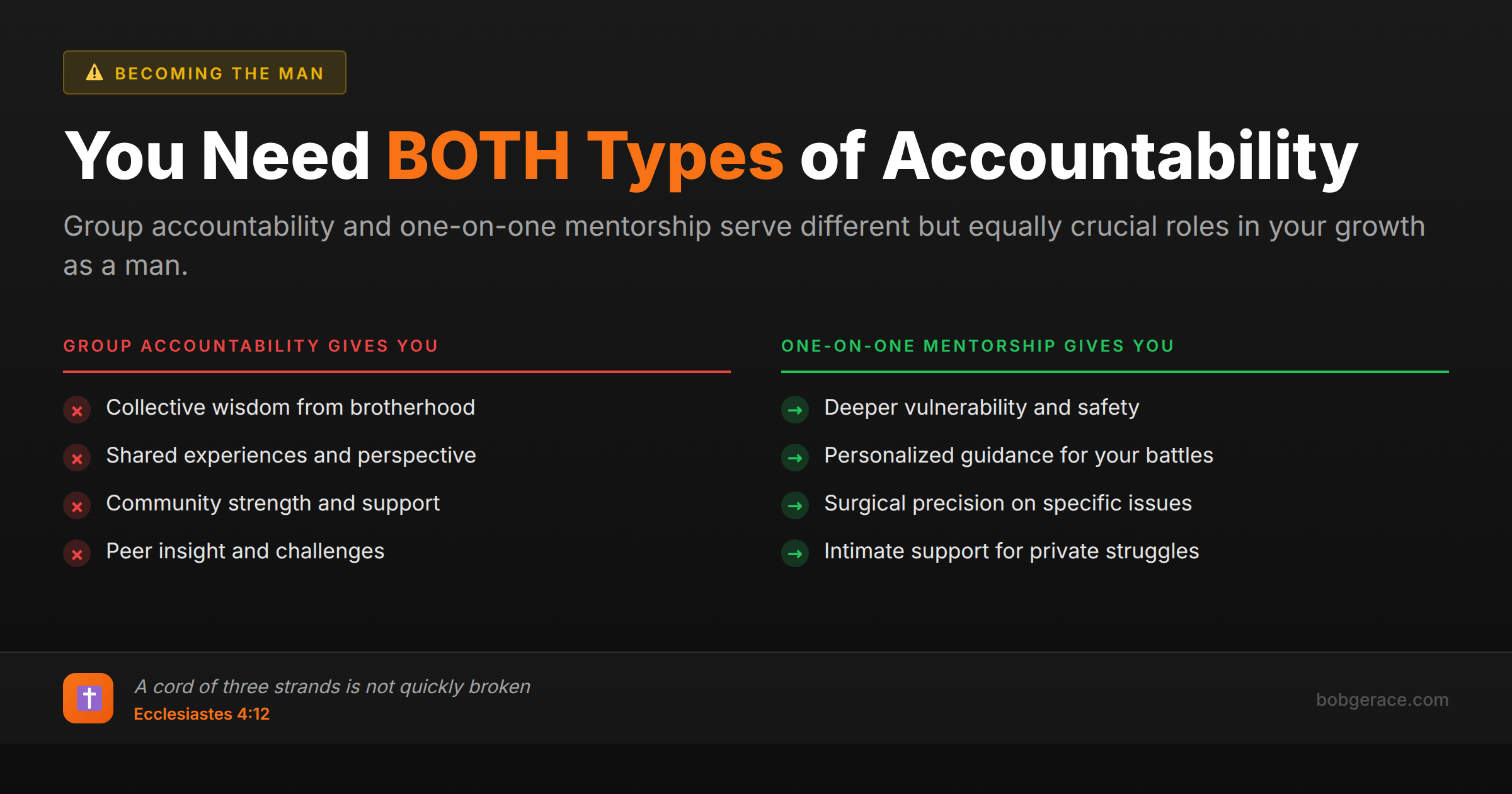
Group and one-on-one accountability serve different but equally crucial roles in your journey as a man. Group settings provide collective wisdom, shared experiences, and the power of brotherhood—you realize you're not alone in your struggles. One-on-one relationships offer deeper vulnerability, personalized guidance, and the safety to address your most private battles. The group gives you perspective and community strength. One-on-one gives you surgical precision and intimate support. You need both. Groups help normalize your experience and challenge you through peer insight. Individual relationships allow for the kind of deep work that's too sensitive or specific for group discussion. Most successful men utilize both formats strategically.
The Full Picture
Here's what most men get wrong: they think they have to choose between group accountability and one-on-one relationships. That's like asking whether you need your left leg or your right leg to walk effectively. You need both, and they serve distinctly different purposes in your development as a man.
Group accountability is your training ground. It's where you learn that your struggles aren't unique, where you gain collective wisdom from men who've walked similar paths, and where you develop the courage to be vulnerable in a safe environment. Groups provide perspective that no single person can offer. When five guys tell you the same thing about your behavior, it's harder to dismiss than when one person says it.
Groups also create healthy competition and motivation. There's something powerful about sitting in a circle with other men who are committed to growth. It pushes you to show up better, to be more honest, and to take action on the things you know you need to change.
One-on-one relationships are your surgical suite. This is where you go deep on the issues that are too sensitive, too specific, or too complex for group discussion. Some battles require the focused attention of a mentor, coach, or trusted friend who knows your full story and can speak directly into your specific situation.
The individual relationship allows for customized guidance. Your marriage struggles are unique to you and your wife. Your relationship with your kids has dynamics that only apply to your family. Your career challenges need personalized strategy. A group can provide general wisdom, but one-on-one gives you targeted solutions.
The most effective men I work with use both strategically—groups for community, perspective, and motivation; one-on-one for deep work, specific guidance, and intensive breakthrough moments.
What's Really Happening
From a psychological standpoint, group and individual accountability activate different therapeutic mechanisms that are both essential for lasting change. Group settings leverage social learning theory—we learn behaviors and attitudes by observing others and seeing the consequences of their actions. When men see peers successfully implementing new behaviors or honestly sharing their failures, it normalizes the change process and reduces shame.
Groups also provide what we call "universality"—the powerful realization that you're not alone in your struggles. This reduces isolation and the toxic belief that "I'm the only one who struggles with this." The collective wisdom of a group often provides solutions that no single individual could generate alone.
However, groups have limitations. Social desirability bias can cause men to present a more favorable version of themselves, and complex individual dynamics may get oversimplified in group discussions. Some men also struggle with vulnerability in group settings due to past experiences or personality factors.
One-on-one relationships allow for deeper psychological work. The safety of an individual relationship enables men to explore childhood wounds, attachment patterns, and deeply rooted beliefs that drive destructive behaviors. Individual work can be more precisely tailored to a person's specific psychological makeup, trauma history, and learning style.
The research is clear: men who utilize both group and individual support show significantly better outcomes in behavioral change, relationship satisfaction, and overall psychological well-being. The group provides the community and perspective; the individual provides the customization and depth. Neither alone is as effective as both together.
What Scripture Says
Scripture gives us a clear blueprint for both group and individual accountability, showing us that God designed both for our spiritual growth and development as men.
The Power of Community: Ecclesiastes 4:12 reminds us, "Though one may be overpowered, two can defend themselves. A cord of three strands is not quickly broken." This isn't just about marriage—it's about the strength that comes from community. Hebrews 10:24-25 instructs us to "consider how we may spur one another on toward love and good deeds, not giving up meeting together." Group accountability provides the spurring, encouragement, and collective strength that individual effort cannot.
Individual Mentorship: Proverbs 27:17 tells us "As iron sharpens iron, so one person sharpens another." This one-on-one sharpening process requires intimate knowledge of each other's character, struggles, and growth areas. Paul's relationship with Timothy exemplifies this—deeply personal, highly specific, and individually tailored guidance that could only happen in a one-on-one mentoring relationship.
Jesus' Model: Christ himself used both approaches. He had his group of twelve disciples for community learning and mutual support, but he also had individual relationships—his time alone with Peter after the resurrection (John 21), his personal conversation with the woman at the well (John 4), and countless one-on-one encounters that addressed specific individual needs.
Confession and Healing: James 5:16 says "Confess your sins to each other and pray for each other so that you may be healed." Sometimes this happens in group settings where collective prayer and support bring breakthrough. Other times it requires the safety of individual confession to a trusted brother who can provide specific guidance and prayer for your unique situation.
God designed both formats because he knows we need both community strength and individual attention to become the men he called us to be.
What To Do Right Now
-
1
Evaluate your current accountability structure—do you have group support, one-on-one mentorship, both, or neither?
-
2
Identify one group setting where you can connect with other growth-minded men (church small group, men's Bible study, or accountability group)
-
3
Find one man you respect who's further along in his journey and ask him to meet monthly for mentorship and guidance
-
4
Create clear boundaries for what you'll share in group versus individual settings—save your most sensitive issues for one-on-one
-
5
Commit to showing up consistently in both formats—consistency is more important than intensity in accountability relationships
-
6
Schedule both your group meetings and individual coffee dates as non-negotiable appointments in your calendar right now
Related Questions
- Why do I need other men?
- What should I look for in a brotherhood?
- How do I find other men?
- What is accountability and what isn't it?
- What makes accountability relationships work?
- How do I find men I can be real with?
- How do I not lose my mind right now?
- What support do I need?
- Should I get outside perspective?
- What does wise counsel look like?
Also find Bob on
Subscribe for weekly videos on Christian marriage.
Bring Your Situation to a Coach
Group and one-on-one both matter—but neither replaces a coach who knows your marriage, your patterns, and what's actually blocking you right now.
Talk to Bob →