What's the difference between therapy and coaching for me?
5 min read
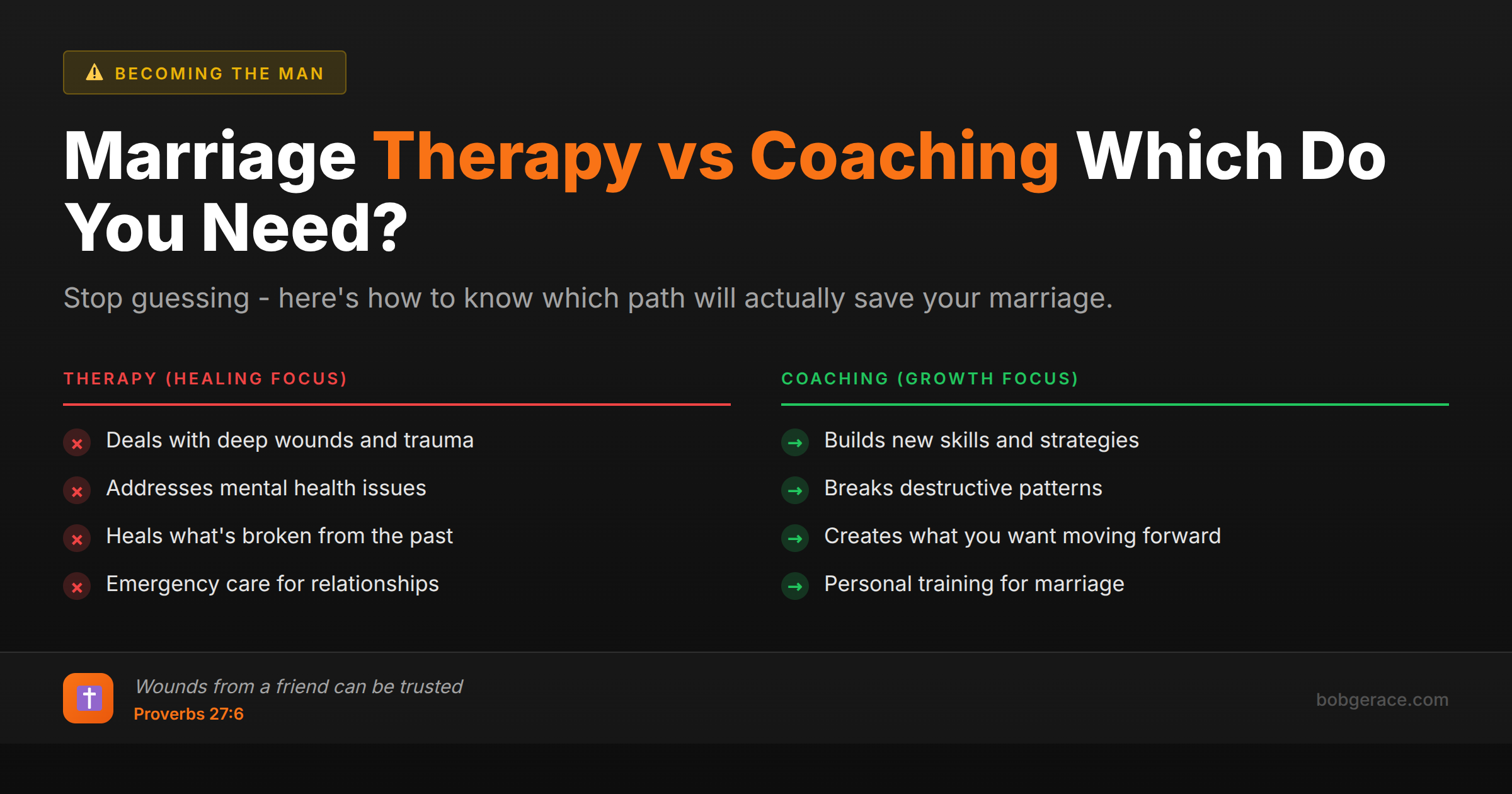
Here's the straight truth: therapy digs into wounds and trauma to heal what's broken, while coaching builds skills and strategies to create what you want moving forward. If you're dealing with deep hurt, addiction, mental health issues, or significant trauma affecting your marriage, you likely need therapy first. If you're ready to learn new tools, break destructive patterns, and build a stronger marriage but aren't dealing with clinical issues, coaching might be your answer. Think of therapy as emergency room care for your relationship, and coaching as personal training for your marriage. Both are valuable, but they serve different purposes at different times in your journey.
The Full Picture
Let me paint this picture clearly because too many couples waste time in the wrong approach. Therapy is about healing. It's clinical work focused on diagnosing and treating mental health conditions, processing trauma, and working through deep emotional wounds. Therapists are trained to handle depression, anxiety, PTSD, addiction, and other clinical issues that require professional intervention.
Coaching is about building. It's forward-focused work that assumes you're mentally healthy and ready to learn new skills. Coaches help you identify destructive patterns, develop better communication tools, and create actionable plans for the marriage you actually want.
Here's where it gets tricky: many couples think they need therapy when they actually need coaching, and vice versa. You might be sitting in therapy sessions for months talking about your feelings when what you really need is someone to teach you how to argue without destroying each other. Or you might be trying coaching approaches when unresolved trauma is sabotaging every attempt at progress.
The key difference is readiness. If you're emotionally bleeding out, you need therapy to stop the bleeding first. If you're stable but stuck in bad patterns, coaching can teach you new moves. Sometimes you need both, but rarely at the same time. Most couples I work with have already done some therapy work or don't need it – they need practical tools and accountability to build the marriage they want.
What's Really Happening
From a clinical perspective, the distinction comes down to scope of practice and treatment goals. As a licensed therapist, I'm trained to diagnose and treat mental health disorders, work with trauma responses, and provide clinical interventions for conditions like depression, anxiety, or personality disorders that significantly impact relationship functioning.
Therapy operates from a medical model – we identify pathology, create treatment plans, and work toward symptom reduction or resolution. The process is often exploratory, helping clients understand the 'why' behind their patterns through insight and emotional processing. We dig into family of origin issues, attachment wounds, and past traumas that create present-day relationship problems.
Coaching, by contrast, operates from a wellness model. It assumes clients are psychologically healthy and focuses on skill-building, goal achievement, and behavioral change. Coaches don't diagnose or treat mental health conditions – they help functional people become more functional.
Here's the clinical reality: if you're experiencing symptoms of depression, anxiety, PTSD, addiction, or other mental health conditions, these issues will sabotage coaching efforts until they're clinically addressed. However, if you're mentally healthy but relationally stuck, coaching's practical, solution-focused approach often produces faster, more sustainable results than traditional therapy. The key is honest assessment of where you are and what you actually need.
What Scripture Says
Scripture gives us wisdom about both healing and growth in our relationships. Proverbs 27:6 tells us, *"Wounds from a friend can be trusted, but an enemy multiplies kisses."* Sometimes we need the deep, potentially painful work of therapy to address wounds that are infected and won't heal on their own.
But Scripture also emphasizes the importance of building and growing. Ephesians 4:15-16 says, *"Instead, speaking the truth in love, we will grow to become in every respect the mature body of him who is the head, that is, Christ. From him the whole body, joined and held together by every supporting ligament, grows and builds itself up in love, as each part does its work."* This speaks to the coaching model – building up what's already healthy.
Proverbs 19:20 instructs us, *"Listen to advice and accept discipline, and at the end you will be counted among the wise."* This applies to both approaches – being willing to receive help whether it's healing-focused therapy or skill-building coaching.
The key is found in Ecclesiastes 3:1: *"There is a time for everything, and a season for every activity under the heavens."* There's a time for healing (therapy) and a time for building (coaching). Nehemiah 4:17 shows us both: *"From that day on, half of my men did the work, while the other half were equipped with spears, shields, bows and armor."* Sometimes we need to heal and protect, sometimes we need to build and advance. Wisdom knows which season you're in and chooses the right tool for the job.
What To Do Right Now
-
1
Honestly assess your mental health - are you dealing with depression, anxiety, trauma, addiction, or other clinical issues that need professional treatment?
-
2
Identify your primary goal - do you need healing from past wounds or do you need to build new skills and patterns moving forward?
-
3
Ask yourself: 'Am I emotionally stable enough to learn and implement new tools right now, or do I need clinical support first?'
-
4
Consider your timeline - therapy typically takes longer for deep work, coaching can produce results more quickly for skill-building
-
5
Evaluate your relationship's foundation - if there's active addiction, abuse, or severe mental health issues, address these clinically before focusing on relationship building
-
6
Choose one approach to start - trying both simultaneously often creates confusion and dilutes progress in both areas
Related Questions
- Do I need therapy, coaching, or both?
- What are markers that I need more than coaching?
- What does a comprehensive mental health assessment look like?
- What therapies actually work for anger?
- What is 'complex trauma' and do I have it?
- What role might ADHD/depression/anxiety play?
- What does affair recovery therapy look like?
- What is EMDR and could it help?
- What therapies help with this kind of trauma?
- Is his program legitimate?
Also find Bob on
Subscribe for weekly videos on Christian marriage.
Not Sure What Your Marriage Needs?
Bring your specific situation to Bob. He'll tell you straight whether coaching fits where you are, or if you need something else first.
Talk to Bob →