Why does my anger make her less safe not more attached?
6 min read
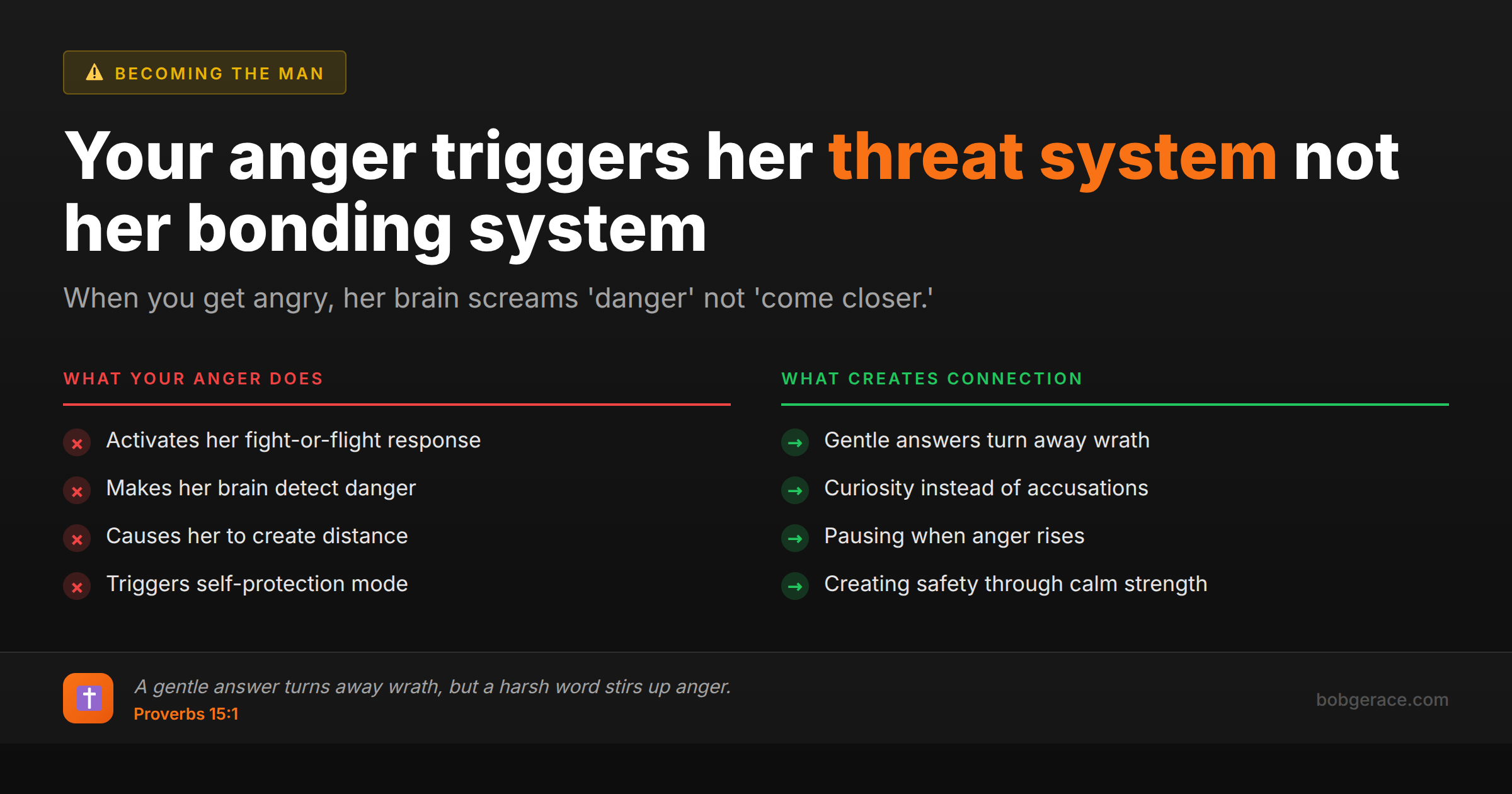
Your anger triggers her threat detection system, not her bonding system. When you get angry, your wife's brain interprets this as danger, activating her fight-or-flight response instead of her attachment system. She doesn't think "I need to get closer to work this out" - she thinks "I need to protect myself from this threat." This happens because anger signals unpredictability and potential harm to the nervous system. Even if you're not physically threatening, raised voices, harsh tones, or aggressive body language register as danger. Her withdrawal isn't defiance - it's biology. She's literally wired to create distance from perceived threats, not move toward them for connection.
The Full Picture
Here's what's really happening when your anger shows up in your marriage: you're accidentally activating your wife's threat detection system instead of her attachment system.
Think about it from a biological standpoint. When humans sense danger, we don't move toward the threat - we move away from it. Your wife's nervous system can't distinguish between "angry because he's frustrated" and "angry because he might hurt me." Anger triggers the same neurological pathways regardless of intent.
Your anger creates what attachment researchers call "fear without solution." She wants to connect with you (that's her attachment drive), but she also needs to stay safe (that's her survival drive). When these two drives conflict, survival always wins. So she withdraws, shuts down, or becomes defensive.
This creates a vicious cycle. You get frustrated that she's pulling away, so you get angrier, thinking more intensity will get through to her. But more anger just confirms to her nervous system that you're unsafe, so she withdraws further. You're essentially putting your foot on the gas while wondering why the car won't start.
The cruel irony is that you probably get angry because you care so much. You want things to work, you want her to understand, you want connection. But anger is the wrong tool for the job you're trying to do. It's like using a hammer when you need a screwdriver - you'll just make a mess.
Understanding this isn't about never feeling angry. It's about recognizing that if your goal is connection and intimacy, anger will take you in the opposite direction every single time.
What's Really Happening
From an attachment perspective, what you're experiencing is a classic case of competing biological systems. When you express anger, you're activating your wife's sympathetic nervous system - her threat detection and survival response.
Here's the key insight: attachment behaviors only emerge when we feel safe. Your wife can't simultaneously be in survival mode and attachment mode. These are neurologically incompatible states. When her amygdala (fear center) is activated by your anger, it literally hijacks the prefrontal cortex where reasoning and bonding occur.
This explains why she might seem "irrational" during or after your angry episodes. She's not choosing to be difficult - she's operating from a different part of her brain entirely. Her responses (withdrawal, silence, defensiveness) aren't about the topic you're arguing about. They're about her nervous system trying to restore safety.
Securely attached couples understand this instinctively. They've learned that emotional regulation comes before problem-solving. They prioritize safety over being right, connection over winning the argument.
The good news is that this pattern is completely changeable. When you learn to approach conflict from a place of emotional regulation rather than activation, you'll see a dramatic shift in her responses. She'll move toward you instead of away from you, engage instead of withdraw, collaborate instead of defend.
The goal isn't to eliminate all anger from your marriage - it's to learn how to process and express it in ways that preserve safety and promote connection rather than creating distance and fear.
What Scripture Says
Scripture consistently warns about the destructive power of unchecked anger and calls us to pursue peace and gentleness in our relationships.
Proverbs 15:1 reminds us: "A gentle answer turns away wrath, but a harsh word stirs up anger." God's design for communication prioritizes gentleness precisely because it creates safety rather than fear.
Ephesians 4:26-27 gives us crucial guidance: "In your anger do not sin: Do not let the sun go down while you are still angry, and do not give the devil a foothold." Notice it doesn't say "don't get angry" - it says don't let anger lead you into sin or give Satan an opportunity to destroy your relationship.
James 1:19-20 provides the perfect framework: "Everyone should be quick to listen, slow to speak and slow to become angry, because human anger does not produce the righteousness that God desires." Your anger, no matter how justified it feels, won't create the marriage God wants for you.
Colossians 3:19 specifically addresses husbands: "Husbands, love your wives and do not be harsh with them." The word "harsh" here includes anger, irritability, and emotional roughness. God commands gentleness because He knows it's what creates the safety necessary for love to flourish.
1 Peter 3:7 calls husbands to "be considerate as you live with your wives, and treat them with respect." Anger is the opposite of consideration and respect.
God's design for marriage requires the safety that only comes through self-control, gentleness, and emotional regulation. When we follow His pattern, we create the environment where love and connection can thrive.
What To Do Right Now
-
1
Acknowledge the pattern - Tell your wife: "I'm realizing my anger makes you feel unsafe instead of helping us connect. I want to change this."
-
2
Learn your anger triggers - Notice what situations, topics, or feelings tend to activate your anger before it explodes.
-
3
Practice the pause - When you feel anger rising, say "I need a few minutes to collect myself" and step away until you're regulated.
-
4
Replace anger with curiosity - Instead of "Why won't you..." try "Help me understand what's happening for you right now."
-
5
Apologize for past harm - Own how your anger has made her feel unsafe: "I'm sorry my anger has scared you. You deserve to feel safe with me."
-
6
Get help with regulation - Work with a counselor, coach, or mentor to develop better emotional management tools before the next conflict.
Related Questions
- What does my rage communicate to her attachment system?
- Why do I hurt the person I'm trying to keep?
- Is my anger an attachment cry gone wrong?
- What does anxious attachment anger look like?
- How do I express need without rage?
- What is 'anger as control' vs. 'anger as pain'?
- Why does my pursuing make her pull away more?
- What does 'protest behavior' look like and am I doing it?
- What is 'anxious protest behavior' and am I doing it?
Also find Bob on
Subscribe for weekly videos on Christian marriage.
Get a Coach on This Today
Your anger pattern is specific to your marriage, your triggers, your history with her. A coach who knows your situation can help you regulate before you flood—not after the damage is done.
Talk to Bob →