Her resentment runs deeper than I knew
6 min read
When you realize her resentment runs deeper than you knew, you're facing years or even decades of accumulated hurt, disappointment, and unmet needs. This isn't just about recent conflicts - it's about patterns of feeling unheard, unseen, or unvalued that have compounded over time. The good news is that recognition is the first step toward healing. Deep resentment didn't develop overnight, and it won't disappear overnight either. But marriages can absolutely recover from this. What matters now is how you respond to this revelation - with defensiveness and minimization, or with genuine curiosity about her experience and commitment to real change.
The Full Picture
When a husband discovers his wife's resentment runs deeper than he realized, it's often a shocking wake-up call. You might be thinking, "How did I miss this?" or "Why didn't she tell me sooner?" But here's the reality: she probably did tell you, just not in ways you recognized or heard.
Resentment builds gradually through a thousand small moments. Every time she felt dismissed when sharing her feelings. Every time her needs were pushed aside for other priorities. Every time she had to ask multiple times for help with something important to her. Every time she felt like she was managing the household and relationship alone.
Women often communicate dissatisfaction indirectly first. She might have started with hints, suggestions, or gentle complaints. When those didn't create change, she may have become more direct. If that still didn't work, many women eventually stop trying and begin building walls of protection around their hearts.
The depth of her resentment reflects the depth of her investment. People don't develop deep resentment toward relationships they don't care about. The intensity of her negative feelings often mirrors how much she once hoped and cared about the marriage working.
This revelation is actually an opportunity. While painful, understanding the true extent of her hurt gives you clarity about what needs to be addressed. You're no longer operating in the dark, wondering why she seems distant or disconnected. Now you know there's real work to be done - and that means there's a path forward.
What's Really Happening
From a psychological perspective, deep resentment in marriage typically develops through a process called 'negative sentiment override.' When this occurs, a spouse begins interpreting even neutral or positive actions through a lens of accumulated hurt and disappointment.
Research by Dr. John Gottman shows that when resentment reaches this level, the wife's nervous system is often in a chronic state of emotional flooding. Her brain has learned to expect disappointment or conflict from the relationship, creating a defensive stance that protects her from further hurt but also blocks //blog.bobgerace.com/sexual-pressure-christian-marriage-destroying-desire/:intimacy.
The depth of resentment usually correlates with three factors: the duration of unaddressed issues, the significance of unmet needs, and the number of repair attempts that failed. Women often have a higher emotional investment in relationship harmony, so when that harmony is repeatedly disrupted without resolution, the psychological impact compounds.
However, deep resentment can be transformed when certain conditions are met: genuine acknowledgment of her experience, consistent behavioral changes over time, and the rebuilding of emotional safety in the relationship. The key is understanding that her resentment serves as protection - and she'll only release that protection when she experiences sustained evidence that change is real and lasting.
What Scripture Says
Scripture addresses the reality of deep relational wounds and the path toward healing with remarkable clarity and hope.
Proverbs 18:14 reminds us: *"The human spirit can endure in sickness, but a crushed spirit—who can bear?"* Deep resentment often reflects a crushed spirit that has endured repeated disappointment. This isn't weakness; it's the natural response of a heart that has been repeatedly wounded.
Ephesians 4:26-27 instructs: *"In your anger do not sin: Do not let the sun go down while you are still angry, and do not give the devil a foothold."* When anger and hurt aren't addressed quickly, they create opportunities for resentment to take root and grow.
Colossians 3:19 specifically commands: *"Husbands, love your wives and do not be harsh with them."* Harshness isn't just about raised voices - it includes dismissiveness, emotional unavailability, and treating her concerns as unimportant.
1 Peter 3:7 calls husbands to *"be considerate as you live with your wives, and treat them with respect... so that nothing will hinder your prayers."* God takes seriously how we treat our wives, and our spiritual lives are impacted when we fail in this area.
Isaiah 61:3 promises that God can give *"beauty for ashes, the oil of joy for mourning, the garment of praise for the spirit of heaviness."* This transformation is possible in marriage when we align our actions with God's heart for healing and restoration.
God's design for marriage includes the reality that deep wounds can be healed through genuine repentance, consistent change, and His supernatural grace working in both hearts.
What To Do Right Now
-
1
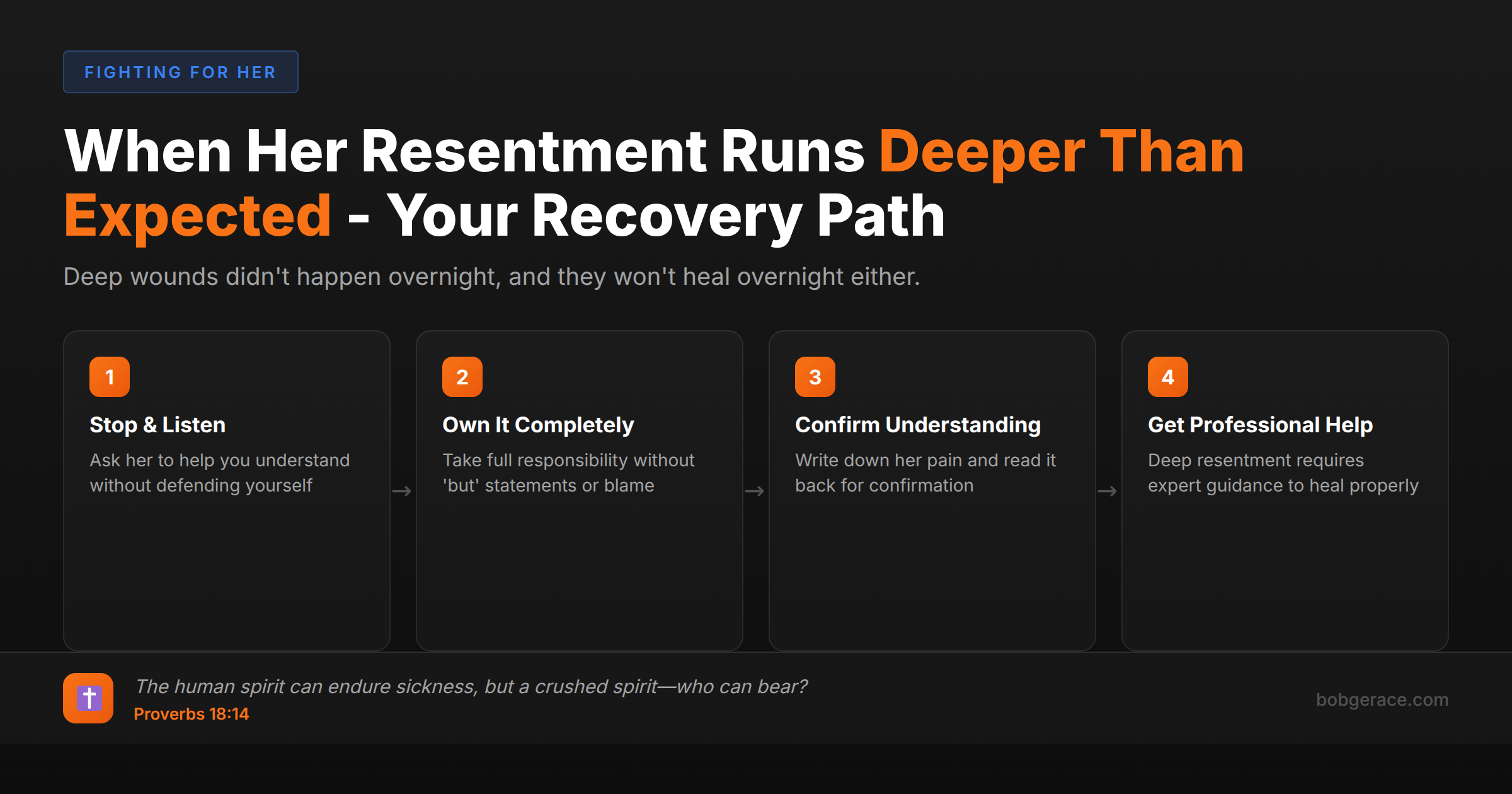
Stop defending and start listening - ask her to help you understand the full scope of her hurt without trying to explain your intentions
-
2
Take complete ownership for your part without adding 'but' statements or shifting any blame to her
-
3
Write down everything she's shared about her pain and read it back to her to confirm you understand
-
4
Commit to specific behavioral changes with timeline accountability - don't just promise to 'try harder'
-
5
Get professional help immediately - deep resentment requires skilled guidance to navigate healing properly
-
6
Demonstrate consistency in small daily actions rather than grand gestures - trust is rebuilt through reliability, not intensity
Related Questions
- She brings up things from years ago
- She has a list of everything I did wrong
- How do I address years of built-up hurt?
- What is 'accumulated resentment'?
- What are 'attachment injuries' and how many did I cause?
- What does genuine repair look like for old wounds?
- Why does she remember everything differently than I do?
- What is 'negative sentiment override' and does she have it?
- What role did our relationship problems play?
- I keep making the same mistakes
Also find Bob on
Subscribe for weekly videos on Christian marriage.
This Needs a Coach in Your Corner
Years of accumulated hurt means your marriage has patterns a tool can't see. Bob works with men whose wives carry deep resentment—he'll help you read what's actually happening in your specific situation.
Talk to Bob →