What about perpetual unfaithfulness?
6 min read
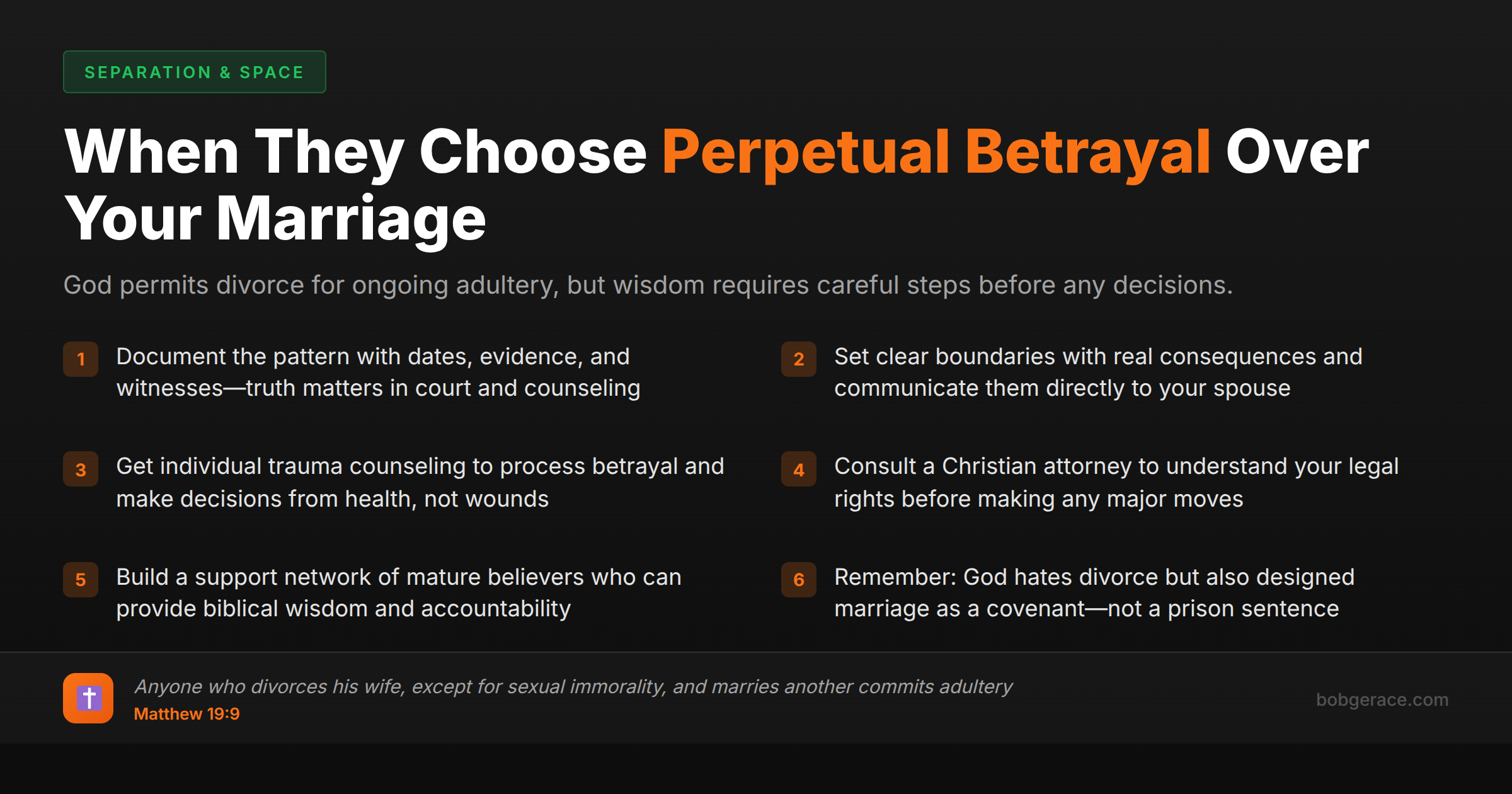
Perpetual unfaithfulness—ongoing, unrepentant adultery—represents a fundamental rejection of the marriage covenant. While Jesus permits divorce for adultery (Matthew 19:9), perpetual unfaithfulness goes beyond a single act of betrayal to become a lifestyle of covenant-breaking. Scripture makes clear that marriage reflects Christ's relationship with the church, and persistent adultery destroys that reflection. This doesn't mean you rush to divorce. God hates divorce because He loves restoration. However, when a spouse repeatedly chooses adultery despite confrontation, consequences, and opportunities for repentance, you're dealing with someone who has already broken the covenant in their heart. The exception clause exists precisely for situations where one spouse abandons the marriage covenant through persistent sexual immorality.
The Full Picture
Perpetual unfaithfulness isn't just multiple affairs—it's a heart posture that rejects the marriage covenant. When Jesus spoke about the exception clause in Matthew 19:9, He wasn't just addressing single acts of adultery but the broader concept of *porneia*—ongoing sexual immorality that violates the marriage bond.
Understand what you're really facing. A spouse caught in perpetual unfaithfulness has made a series of choices that prioritize their desires over their covenant with you and God. This isn't about weakness or temptation—it's about a fundamental rejection of what marriage represents.
The pattern matters more than the individual acts. One affair followed by genuine repentance, accountability, and changed behavior is different from ongoing infidelity, lies, and manipulation. Perpetual unfaithfulness often includes:
- Repeated affairs despite consequences - Ongoing deception and manipulation - Refusal to accept responsibility - Lack of genuine repentance - Absence of real behavior change
God's heart is always for restoration, but restoration requires repentance. The faithful spouse isn't required to enable destructive behavior indefinitely. Sometimes the most loving thing you can do is allow natural consequences—including the end of the marriage—to occur.
Remember that you cannot save someone who doesn't want to be saved. Your faithfulness, prayers, and forgiveness are powerful, but they cannot override another person's free will to choose destruction over restoration.
What's Really Happening
From a clinical perspective, perpetual unfaithfulness often indicates deeper psychological and spiritual issues that go far beyond typical marital problems. We're usually dealing with patterns of narcissistic behavior, sexual addiction, or personality disorders that require intensive professional intervention.
The faithful spouse in these situations often experiences what we call 'betrayal trauma'—a form of PTSD that results from ongoing deception and emotional abuse. The constant cycle of discovery, false promises, and repeated betrayals creates profound psychological damage that compounds over time.
What's particularly destructive is the gaslighting that typically accompanies perpetual infidelity. The unfaithful spouse often manipulates reality, making the faithful partner question their perceptions, memories, and even their sanity. This psychological abuse is often more damaging than the sexual betrayal itself.
It's crucial to understand that staying in this dynamic without real change isn't noble—it's often enabling. The unfaithful spouse learns that their behavior has no lasting consequences, which actually reinforces the pattern. Sometimes the most therapeutic intervention is allowing the natural consequence of covenant-breaking: the end of the marriage.
Recovery from perpetual infidelity requires the unfaithful spouse to acknowledge the full extent of their betrayal, commit to intensive therapy, submit to complete transparency, and demonstrate sustained behavioral change over years, not months. Without these elements, 'reconciliation' becomes simply managed dysfunction.
What Scripture Says
Scripture provides clear guidance on perpetual unfaithfulness, though it requires careful study to understand God's heart on this painful issue.
Jesus acknowledges the exception: *"I tell you that anyone who divorces his wife, except for sexual immorality, and marries another woman commits adultery"* (Matthew 19:9). The Greek word *porneia* encompasses ongoing sexual immorality, not just single acts of adultery.
Marriage reflects a sacred covenant: *"For this reason a man will leave his father and mother and be united to his wife, and the two will become one flesh. This is a profound mystery—but I am talking about Christ and the church"* (Ephesians 5:31-32). Perpetual unfaithfulness destroys this reflection of Christ's faithful love.
God expects faithfulness in covenant: *"'Has not the one God made you? You belong to him in body and spirit. And what does the one God seek? Godly offspring. So be on your guard, and do not be unfaithful to the wife of your youth'"* (Malachi 2:15). Ongoing infidelity violates God's design for marriage.
Truth and consequences matter: *"Above all, my brothers and sisters, do not swear—not by heaven or by earth or by anything else. All you need to say is a simple 'Yes' or 'No.' Otherwise you will be condemned"* (James 5:12). Perpetual unfaithfulness demonstrates that vows meant nothing.
Protection from evil is biblical: *"Above all else, guard your heart, for everything you do flows from it"* (Proverbs 4:23). Sometimes guarding your heart means removing yourself from ongoing destruction.
Wisdom recognizes patterns: *"By their fruit you will recognize them. Do people pick grapes from thornbushes, or figs from thistles?"* (Matthew 7:16). Perpetual unfaithfulness reveals the true condition of the heart.
What To Do Right Now
-
1
Document the pattern of infidelity with dates, evidence, and witnesses—truth matters in these situations
-
2
Establish clear boundaries with consequences and communicate them directly to your spouse
-
3
Seek individual counseling to process betrayal trauma and make decisions from health, not woundedness
-
4
Consult with a Christian attorney to understand your legal rights and options before making any decisions
-
5
Build a support network of mature believers who can provide wisdom and accountability through this process
-
6
Pray for discernment between enabling destructive behavior and showing genuine love and forgiveness
Related Questions
- What does Scripture say about divorce?
- Does adultery justify divorce?
- What is 'porneia' and what does it include?
- Does the exception clause allow divorce or require it?
- If I divorce, can I remarry?
- What if I was the innocent party?
- She says she'll end it but hasn't
- She ended it but they're still talking
- How long do I wait before giving up?
- What does biblical forgiveness require of me?
Also find Bob on
Subscribe for weekly videos on Christian marriage.
Your Marriage. Your Timeline. Real Guidance.
Perpetual unfaithfulness doesn't follow a script. A coach who knows your specific situation helps you see what's actually happening and what your next right move is.
Talk to Bob →