What does safety look like to her nervous system?
6 min read
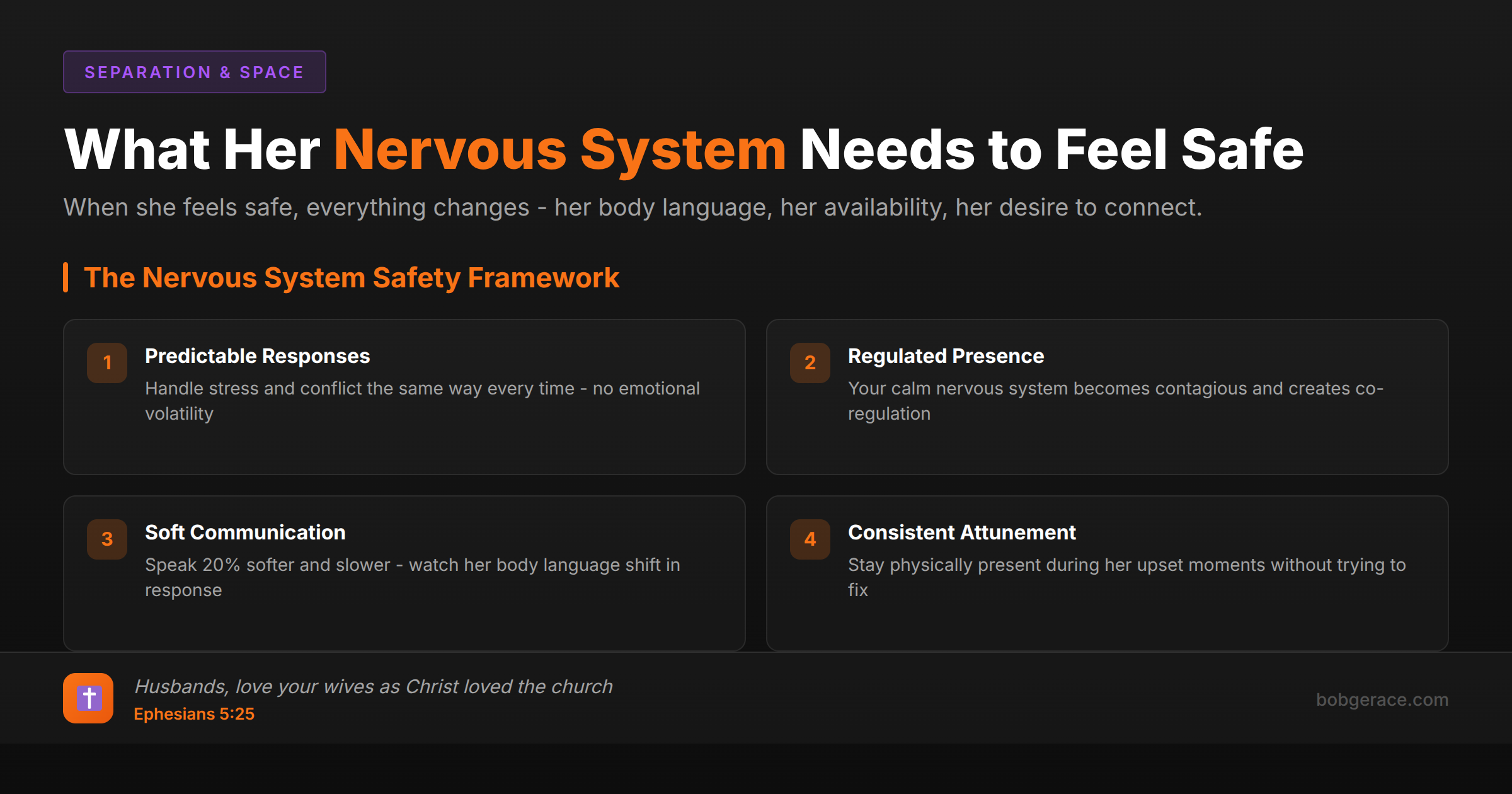
When your wife's nervous system feels safe, she exists in what polyvagal theory calls the 'ventral vagal state' - her social engagement system is online, she can connect, communicate, and be present with you. Safety isn't just about physical protection; it's about predictability, emotional attunement, and the absence of threat detection. Her nervous system feels safe when it can predict your responses, when conflict doesn't escalate into chaos, and when she experiences consistent emotional co-regulation with you. This shows up as relaxed body language, engaged eye contact, playful banter, physical affection, and her willingness to be vulnerable. When safety is present, she can access her prefrontal cortex for higher-order thinking rather than operating from survival mode.
The Full Picture
Your wife's nervous system is constantly scanning for safety or threat - it's called neuroception, and it happens below conscious awareness. When she feels safe, her ventral vagal complex is activated, allowing for social engagement, connection, and intimacy. When she doesn't, her system moves into protective states.
Physical signs of nervous system safety include: - Relaxed facial muscles and soft eyes - Open body posture, uncrossed arms - Natural breathing patterns - Playful or affectionate touch - Spontaneous laughter or smiling
Emotional and behavioral indicators: - Willingness to share thoughts and feelings - Engaging in conflict without shutting down - Initiating physical or emotional intimacy - Making future plans together - Expressing needs without defensiveness
Here's what most men miss: safety isn't created by grand gestures or perfect behavior. It's built through thousands of micro-interactions where she experiences you as predictable, attuned, and non-threatening. It's your tone of voice when she's stressed, how you handle her emotions when they're inconvenient, and whether she can trust that conflict won't turn into character assassination.
When her nervous system is dysregulated, she might be in sympathetic activation (fight/flight) or dorsal vagal shutdown (withdrawal/numbness). Understanding these states helps you respond appropriately rather than taking her behavior personally.
What's Really Happening
From a polyvagal perspective, safety is neurobiological before it's psychological. Her nervous system is making split-second assessments about threat and safety based on your facial expressions, vocal tone, body language, and behavioral patterns.
When wives 'check out,' their nervous systems have often moved into protective states after repeated experiences of feeling unsafe. This isn't necessarily about physical danger - it's about emotional overwhelm, unpredictability, or chronic activation of her stress response system.
The three key elements her nervous system needs for safety are:
1. Co-regulation: Your calm nervous system helps regulate hers. When you remain grounded during her emotional storms, you're offering your ventral vagal state as a resource.
2. Predictability: Her system relaxes when it can predict your responses. Consistency in how you handle stress, conflict, and daily interactions builds neurobiological trust.
3. Attunement: She needs to feel seen and understood, not fixed or managed. Attunement means your nervous system is genuinely curious about and responsive to hers.
Many husbands try to create safety through problem-solving or reassurance, but these cognitive approaches often miss the mark. Her brainstem and limbic system need experiential proof of safety through your regulated presence and consistent, non-threatening responses over time.
What Scripture Says
Scripture reveals God's heart for creating safety within covenant relationships. As husbands, we're called to be sources of security and peace, not anxiety and chaos.
"Husbands, love your wives as Christ loved the church and gave himself up for her" (Ephesians 5:25). Christ's love created ultimate safety - predictable, sacrificial, and unconditional. Her nervous system needs to experience this same quality of love from you.
"There is no fear in love. But perfect love drives out fear, because fear has to do with punishment" (1 John 4:18). When your wife's system is scanning for threat, perfect love - consistent, patient, kind - gradually rewires her capacity for trust and connection.
"A gentle answer turns away wrath, but a harsh word stirs up anger" (Proverbs 15:1). Your tone, timing, and approach directly impact her nervous system's threat detection. Gentleness isn't weakness; it's strength under control, creating space for her to feel safe.
"Be completely humble and gentle; be patient, bearing with one another in love" (Ephesians 4:2). These aren't just nice suggestions - they're neurobiological necessities for her system to move out of protection and into connection.
"The fruit of righteousness will be peace; its effect will be quietness and confidence forever" (Isaiah 32:17). When you walk in righteousness - doing marriage God's way - the natural result is her nervous system experiencing peace, quietness, and confidence in your relationship.
God designed marriage to be a place of refuge, not a source of chronic stress activation.
What To Do Right Now
-
1
Regulate yourself first - Practice deep breathing, prayer, or grounding techniques before interactions. Your calm nervous system is contagious.
-
2
Lower your voice and slow down - Speak 20% softer and slower than feels natural. Watch her body language shift in response.
-
3
Make your responses predictable - Handle stress, conflict, and daily challenges the same way consistently. Eliminate emotional volatility.
-
4
Practice co-regulation during her upset - Stay physically present and breathe deeply while she processes emotions. Don't try to fix or stop her feelings.
-
5
Create daily micro-moments of safety - Gentle touch, eye contact, asking about her day with genuine curiosity, predictable routines.
-
6
Eliminate threat cues - No raised voices, aggressive body language, interrupting, dismissing, or emotional punishment when she expresses needs or concerns.
Related Questions
- What is 'dorsal vagal' state?
- What signals threat to her nervous system?
- What do I do that activates her defense?
- What would help her ventral vagal (social engagement)?
- How do I co-regulate with someone who won't engage?
- How do I become a safe person again?
- What does nervous system regulation look like?
- How do I become a safe emotional presence?
- What does 'holding space' actually mean?
- What does emotional co-regulation look like?
Also find Bob on
Subscribe for weekly videos on Christian marriage.
Your Marriage Isn't a Textbook Case
Understanding nervous system theory is one thing. Knowing what safety looks like in your specific marriage—with your history, your patterns, your wife—requires a human who can see what you can't.
Talk to Bob →