Is there peace available before resolution?
6 min read
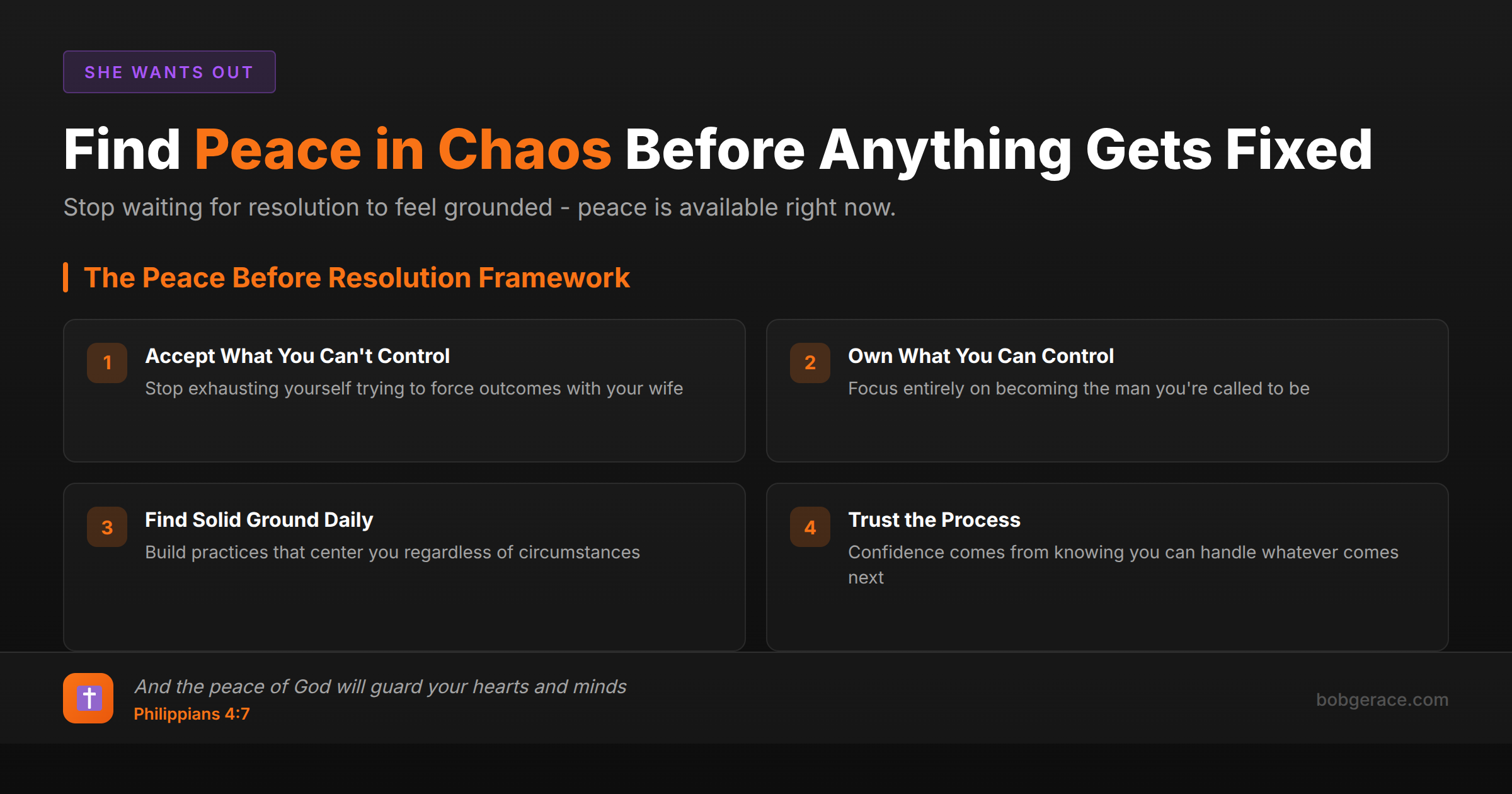
Yes, peace is absolutely available before resolution - and it's not the fake kind that comes from denial or wishful thinking. I've seen countless men discover genuine peace in the middle of marriage chaos, even when their wives are pulling away or considering divorce. This peace isn't about having answers or guarantees. It's about finding solid ground beneath your feet when everything feels uncertain. It comes from accepting what you can't control while taking full ownership of what you can. When you stop exhausting yourself trying to force outcomes and start focusing on becoming the man you're called to be, something shifts. The desperate anxiety begins to settle, replaced by a deeper confidence that you can handle whatever comes next.
The Full Picture
Most men think peace only comes after their marriage is "fixed" - when their wife is happy again, when the fighting stops, when the future feels secure. This thinking keeps you trapped in a constant state of anxiety because you're tying your emotional well-being to outcomes you can't control.
Real peace works differently. It's available right now, in the middle of uncertainty, because it's based on truth rather than circumstances.
Here's what I see happening with guys who find this peace:
• They stop living in reaction mode - Instead of their emotions being jerked around by every conversation or her latest mood, they develop internal stability • They quit the exhausting control game - They realize they can't manage their wife's feelings, decisions, or timeline, and this actually brings relief • They focus on their own growth - When you pour energy into becoming a better man rather than trying to fix everything, you regain a sense of purpose and direction • They develop genuine faith practices - Not just crisis prayers, but real spiritual disciplines that ground them
The mistake most men make is thinking peace means everything is okay. That's not peace - that's comfort. Peace is being okay when everything isn't okay. It's having confidence that you can navigate whatever comes, whether that's reconciliation, separation, or anything in between.
This doesn't mean you don't care about the outcome. It means you're not held hostage by uncertainty. You're building your life on something more solid than your wife's current feelings about the marriage.
What's Really Happening
From a psychological perspective, what we're talking about is the difference between conditional and unconditional emotional regulation. Most men in marriage crisis experience what we call "external locus of control" - their emotional state depends entirely on external factors they can't influence.
Research in attachment theory shows that adults with secure attachment can maintain emotional equilibrium even during relationship uncertainty. This isn't about being detached or uncaring - it's about having developed what psychologists call "emotional self-regulation" and "distress tolerance."
The anxiety you feel when your marriage is in crisis triggers your nervous system's threat detection. Your brain interprets relationship uncertainty as danger, flooding you with stress hormones that make clear thinking nearly impossible. This is why so many men make desperate, counterproductive moves during marriage crisis.
Peace before resolution requires developing what we call "window of tolerance" - your capacity to remain calm and thoughtful even under stress. This happens through:
Mindfulness practices that help you observe your thoughts and feelings without being overwhelmed by them. Cognitive restructuring that challenges catastrophic thinking patterns. Somatic awareness that helps you recognize and regulate physical stress responses.
Neuroplasticity research shows that regular practices like meditation, prayer, and journaling actually reshape your brain's response to uncertainty. Men who develop these capacities report feeling more grounded and less reactive, even when their marriage situation hasn't changed.
This isn't positive thinking or denial. It's developing genuine emotional resilience based on accepting reality while building your capacity to respond rather than react.
What Scripture Says
Scripture makes it clear that peace isn't dependent on our circumstances being resolved. Philippians 4:6-7 tells us, "Do not be anxious about anything, but in every situation, by prayer and petition, with thanksgiving, present your requests to God. And the peace of God, which transcends all understanding, will guard your hearts and your minds in Christ Jesus."
Notice this peace "transcends understanding" - meaning it doesn't make logical sense based on your situation. It's supernatural, available even when nothing is figured out.
Isaiah 26:3 promises, "You will keep in perfect peace those whose minds are steadfast, because they trust in you." The Hebrew word for "steadfast" means firmly fixed or supported. When your mind is anchored in God's character rather than your circumstances, peace follows.
John 14:27 records Jesus saying, "Peace I leave with you; my peace I give you. I do not give to you as the world gives. Do not let your hearts be troubled and do not be afraid." The world offers conditional peace - everything has to be okay for you to feel okay. Christ offers something different.
Psalm 46:10 instructs, "Be still, and know that I am God." This isn't passive waiting - it's active trust. The Hebrew word for "still" means to cease striving, to let go of your frantic efforts to control outcomes.
Romans 8:28 reminds us that "in all things God works for the good of those who love him." This doesn't mean everything that happens is good, but that God can work through anything - even marriage crisis - for your ultimate good.
1 Peter 5:7 encourages us to cast "all your anxiety on him because he cares for you." This is practical instruction: when anxiety comes, you have somewhere to put it rather than carrying it yourself.
What To Do Right Now
-
1
Start each morning with 10 minutes of prayer or meditation before checking your phone or thinking about marriage problems
-
2
Practice deep breathing exercises when anxiety hits - breathe in for 4 counts, hold for 4, exhale for 6
-
3
Write down three things you're grateful for each day, focusing on what's actually going well in your life
-
4
Identify one area of personal growth you can work on today that's completely within your control
-
5
Set boundaries with yourself about how much time you'll spend analyzing your marriage situation each day
-
6
Connect with one person who can offer you encouragement or accountability without trying to fix your marriage
Related Questions
- How long do I wait before giving up?
- How do I know if I'm in denial or in faith?
- What does healthy hope look like vs. fantasy?
- How do I grieve a marriage that isn't dead yet?
- What does the 'ambiguous loss' of marital limbo do to a person?
- Is there research on how long to stand?
- How do I pray through this?
- How do I surrender without giving up?
- What does surrendered prayer look like?
- How do I live with uncertainty?
Also find Bob on
Subscribe for weekly videos on Christian marriage.
You Don't Have to Figure This Out Alone
Coaching means someone who knows your marriage, not just the concept. Someone who can see what you can't see when you're in it.
Talk to Bob →