Is this still a negotiation or is this execution?
6 min read
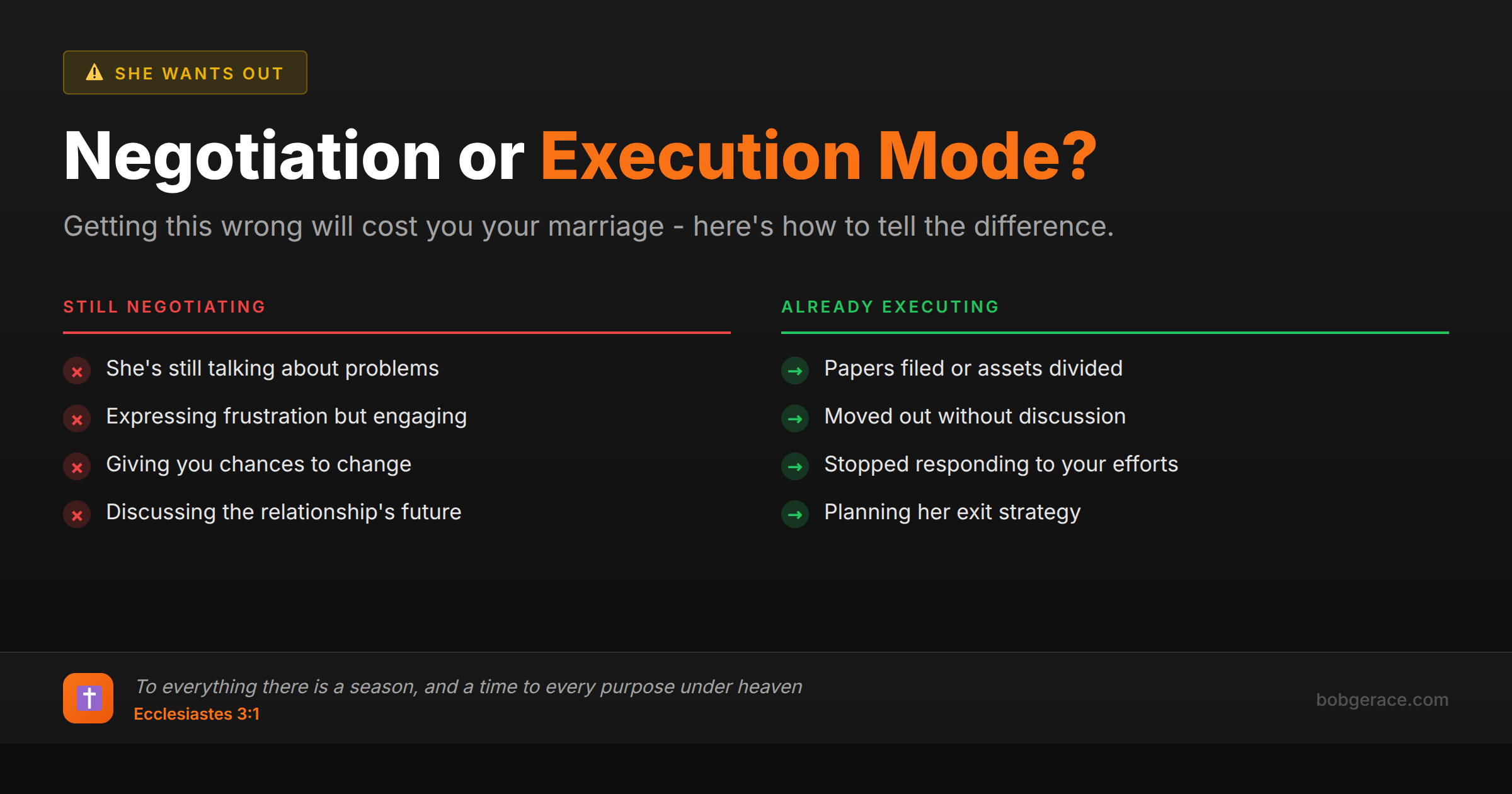
Here's the brutal truth: if your wife has already filed papers, moved out, or started dividing assets without discussion, you're in execution mode. But if she's still talking about problems, expressing frustration, or giving you opportunities to change, you're likely still in negotiation territory. The difference matters enormously because your response strategy changes completely. In negotiation, you have time to demonstrate real change and address core issues. In execution, you're operating under a completely different timeline and set of dynamics. Many men waste precious weeks treating execution like negotiation, or panic during negotiation thinking it's already over. The key indicators aren't always obvious, and misreading this moment can cost you your marriage. You need to know exactly where you stand so you can respond appropriately.
The Full Picture
Understanding whether you're in negotiation or execution mode requires looking at behavior patterns, not just words. Women often communicate their emotional state through actions before they verbalize their final decision.
Negotiation indicators include: • She's still expressing frustration or disappointment (emotion means investment) • She gives you specific examples of what needs to change • She's willing to discuss the relationship, even if conversations are heated • She hasn't taken concrete legal or financial steps • She's still participating in household decisions and family planning • Physical intimacy may be reduced but hasn't completely stopped
Execution indicators include: • Conversations become purely logistical (kids, finances, schedules) • She's emotionally detached - calm in a way that feels final • She's researching lawyers, apartments, or financial independence • She's building support networks that don't include you • She talks about the marriage in past tense • She's making unilateral decisions about major life aspects
The gray zone is where most men get confused. This is when she's emotionally checked out but hasn't taken concrete steps yet. She may be gathering courage, resources, or waiting for the right timing. During this phase, she might seem like she's negotiating but is actually preparing for execution.
Many men miss the transition moment. They think because she hasn't filed papers or moved out, they have unlimited time. Wrong. The emotional decision often happens months before the physical action. By the time you see obvious execution signs, you may have already lost the real battle.
The most dangerous mistake is treating execution like negotiation - making promises, explaining yourself, or trying to process emotions when she's already moved to logistics. Equally dangerous is panicking during negotiation and creating the very crisis you're trying to avoid.
What's Really Happening
From a psychological perspective, the transition from negotiation to execution represents a fundamental shift in cognitive processing. During negotiation, your wife is still engaging in what we call 'relationship-focused thinking' - she's considering possibilities, weighing outcomes, and emotionally invested in potential solutions.
Execution mode reflects what Gottman's research identifies as emotional flooding followed by detachment. The woman has typically experienced what psychologists call 'decision crystallization' - a point where continued deliberation becomes psychologically untenable. She shifts from emotional processing to protective, practical planning.
This transition often follows a pattern of escalating emotional labor without reciprocal change. Women frequently report feeling like they've been negotiating for years through complaints, requests, and emotional expressions that went unheard. By the time they reach execution, they've often experienced what I call 'hope exhaustion' - a depletion of emotional resources invested in relationship repair.
Neurologically, the brain shifts from the emotional processing centers to the executive function areas during this transition. This explains why women often appear 'suddenly' different - calm, logical, and seemingly cold. They're not being cruel; they're protecting themselves by engaging different neural pathways.
The challenge for men is that this transition can appear sudden from the outside, but it's usually the culmination of an internal process that's been building for months or years. Understanding this helps explain why traditional relationship strategies often fail during execution mode - you're trying to appeal to emotional investment that has already been withdrawn.
Recognizing this shift early allows for appropriate intervention strategies that match her psychological state rather than working against it.
What Scripture Says
Scripture provides wisdom for discerning seasons and responding appropriately to each. Ecclesiastes 3:1 reminds us, "To everything there is a season, and a time to every purpose under heaven." Understanding whether you're in a season of building or a season of emergency response matters enormously.
Proverbs 27:14 warns, "Whoever blesses his neighbor with a loud voice, rising early in the morning, will be counted as cursing." This speaks to the importance of appropriate timing and response. Treating execution like negotiation - continuing to make promises and explanations when she's moved to protective mode - can actually push her further away.
Luke 14:28-30 teaches us to count the cost before building: "For which of you, desiring to build a tower, does not first sit down and count the cost, whether he has enough to complete it? Otherwise, when he has laid a foundation and is not able to finish, all who see it begin to mock him." You need accurate assessment before determining your strategy.
The concept of discernment appears throughout Scripture. 1 Kings 3:9 shows Solomon asking for "an understanding heart to judge your people, that I may discern between good and bad." In marriage crisis, discernment means accurately reading the situation rather than seeing what you hope to see.
Matthew 10:16 instructs us to be "wise as serpents and harmless as doves." This applies directly - you need wisdom to read the situation accurately and respond strategically, while maintaining integrity and love. False hope based on misreading leads to poor decisions that can damage rather than restore.
Galatians 6:9 encourages persistence: "Let us not grow weary of doing good, for in due season we will reap, if we do not give up." But this doesn't mean ignoring reality. Biblical hope is grounded in truth, not wishful thinking.
What To Do Right Now
-
1
Document her specific behaviors over the past 2 weeks - what she says, how she responds, what actions she's taking
-
2
Ask one direct question: 'Are we still working on this marriage, or have you decided it's over?' Listen to both words and tone
-
3
Stop making promises or explanations until you understand which mode you're in - wrong strategy makes everything worse
-
4
Look at her phone behavior, social media, and conversations with friends for clues about her planning and mindset
-
5
Assess whether she's still invested emotionally (gets angry, disappointed) or has become logistical and detached
-
6
Adjust your entire approach based on what you discover - negotiation requires change demonstration, execution requires crisis management
Related Questions
- She's already talked to a lawyer — what now?
- She filed for divorce — can I stop it?
- What stage of decision is she in?
- What is 'the point of no return' and is she past it?
- How do I read her actions vs. her words?
- What leverage do I have and should I use it?
- What boundaries should I set?
- How do I make this decision?
- What factors should I weigh?
- How do I separate fear from wisdom?
Also find Bob on
Subscribe for weekly videos on Christian marriage.
Get a Coach on This Today
You need someone who knows your specific situation—what she's actually said, what's already happened, where the line is. Bob works with men in active crisis every week.
Talk to Bob →