How do I be strong and gentle?
6 min read
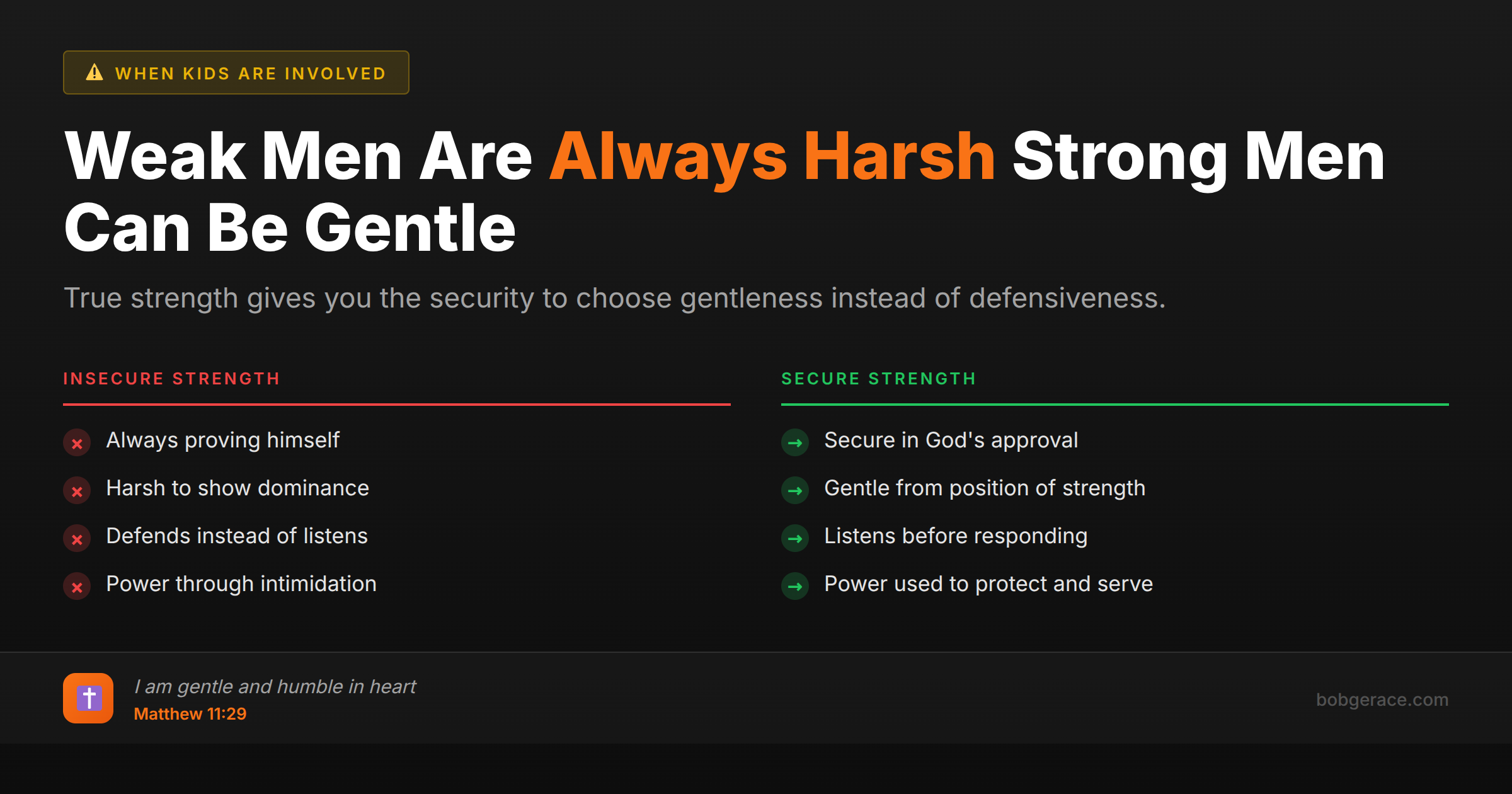
Being strong and gentle isn't contradictory - it's the mark of mature masculinity. True strength isn't about domination or harshness; it's about having the power to protect and serve while choosing tenderness in how you use that power. Think of Jesus overturning tables in the temple, then gently welcoming children. That's strength with gentleness. This balance starts with understanding that gentleness flows FROM strength, not despite it. A weak man can't afford to be gentle because he's always defending himself. A truly strong man can be gentle because his security comes from God, not from proving himself to others. Your wife needs both - your strength to feel secure and protected, and your gentleness to feel loved and cherished.
The Full Picture
The struggle to balance strength and gentleness plagues most Christian men because we've been fed lies about what masculinity looks like. Society either pushes toxic masculinity (dominate or be dominated) or tries to feminize men entirely. Neither reflects God's design.
Real strength looks different than the world teaches. It's not about being the loudest voice in the room or never showing emotion. True strength is having convictions worth standing for, the courage to lead when leadership is costly, and the discipline to do what's right even when it's hard. It's being strong enough to admit when you're wrong and humble enough to ask for forgiveness.
Gentleness isn't weakness - it's strength under control. Picture a skilled horseman with a powerful stallion. The horse has tremendous strength, but the rider directs that power with gentle pressure from his legs and light touches of the reins. That's what biblical gentleness looks like - all that strength channeled through love, wisdom, and self-control.
Your wife doesn't want to be married to a pushover, but she also doesn't want to live with a tyrant. She wants a man who can handle whatever life throws at your family (strength) while treating her heart with tenderness (gentleness). She wants to feel both protected and cherished.
This balance requires intentionality. You have to actively choose gentleness in your tone, your touch, and your approach to conflict. You have to actively choose strength in your decisions, your leadership, and your commitment to do what's right for your family even when it's uncomfortable.
What's Really Happening
From a therapeutic perspective, the inability to balance strength and gentleness often stems from attachment wounds and learned behaviors. Many men grew up with fathers who were either absent, harsh, or passive - leaving them without a model of healthy masculine strength combined with emotional attunement.
Neurologically, this balance requires integration between different brain systems. The strength aspect engages our executive functioning - decision-making, goal-setting, and protective instincts. The gentleness aspect requires our limbic system to be regulated and our prefrontal cortex to modulate our responses based on emotional intelligence.
I see three common patterns in my practice: First, men who default to harshness because they equate gentleness with weakness - often due to childhood experiences where showing softness led to being hurt or shamed. Second, men who avoid strength because they fear being seen as controlling or aggressive - usually due to witnessing destructive masculine behavior. Third, men who compartmentalize, being strong at work but checking out emotionally at home.
The integration of strength and gentleness requires emotional regulation skills, secure attachment, and a clear sense of identity not dependent on others' approval. When a man knows who he is in Christ, he can access both his protective strength and his nurturing capacity without feeling threatened by either.
What Scripture Says
Scripture gives us the perfect model of strength and gentleness in Jesus Christ. Colossians 2:3 tells us that *'in him are hidden all the treasures of wisdom and knowledge,'* yet Matthew 11:29 records Jesus saying, *'Take my yoke upon you and learn from me, for I am gentle and humble in heart.'*
Ephesians 5:25-28 commands husbands to *'love your wives, just as Christ loved the church and gave himself up for her... husbands ought to love their wives as their own bodies.'* This requires both strength (sacrificial giving) and gentleness (tender care).
1 Peter 3:7 instructs men to *'live with your wives in an understanding way, showing honor to the woman as the weaker vessel, since they are heirs with you of the grace of life.'* The word 'understanding' implies gentle attentiveness, while 'showing honor' requires strong conviction about her worth.
Galatians 6:1 shows this balance in relationships: *'Brothers, if anyone is caught in any transgression, you who are spiritual should restore him in a spirit of gentleness.'* Notice it takes spiritual strength to confront sin, but it must be done with gentleness.
Proverbs 27:5-6 reminds us that *'Better is open rebuke than hidden love. Wounds from a friend can be trusted, but an enemy multiplies kisses.'* Sometimes love requires the strength to have difficult conversations, delivered with gentle hearts.
The fruit of the Spirit includes both gentleness and self-control (Galatians 5:22-23) - showing that God's character in us produces this beautiful balance of strength under control.
What To Do Right Now
-
1
Identify your default pattern - Do you tend toward harshness (too much strength) or passivity (avoiding necessary strength)? Ask your wife for honest feedback.
-
2
Practice the pause - Before responding in conflict, take three deep breaths and ask yourself: 'How can I be both truthful and gentle here?'
-
3
Study Jesus' interactions - Read through a Gospel this month, specifically noting how Jesus balanced truth-telling with compassion in different situations.
-
4
Work on your tone - Record yourself having a difficult conversation and listen to your tone. Practice saying hard things with a gentle voice.
-
5
Build your emotional vocabulary - Strength includes being able to identify and communicate your emotions clearly rather than just reacting.
-
6
Schedule regular one-on-ones with your wife - Create safe space for honest communication where you practice listening with strength and responding with gentleness.
Related Questions
Also find Bob on
Subscribe for weekly videos on Christian marriage.
You Don't Have to Figure This Out Alone
Calibrating strength and gentleness in your actual marriage—with your wife's specific wounds and your specific patterns—takes a coach who knows your story.
Talk to Bob →