How do I lead when she doesn't follow?
6 min read
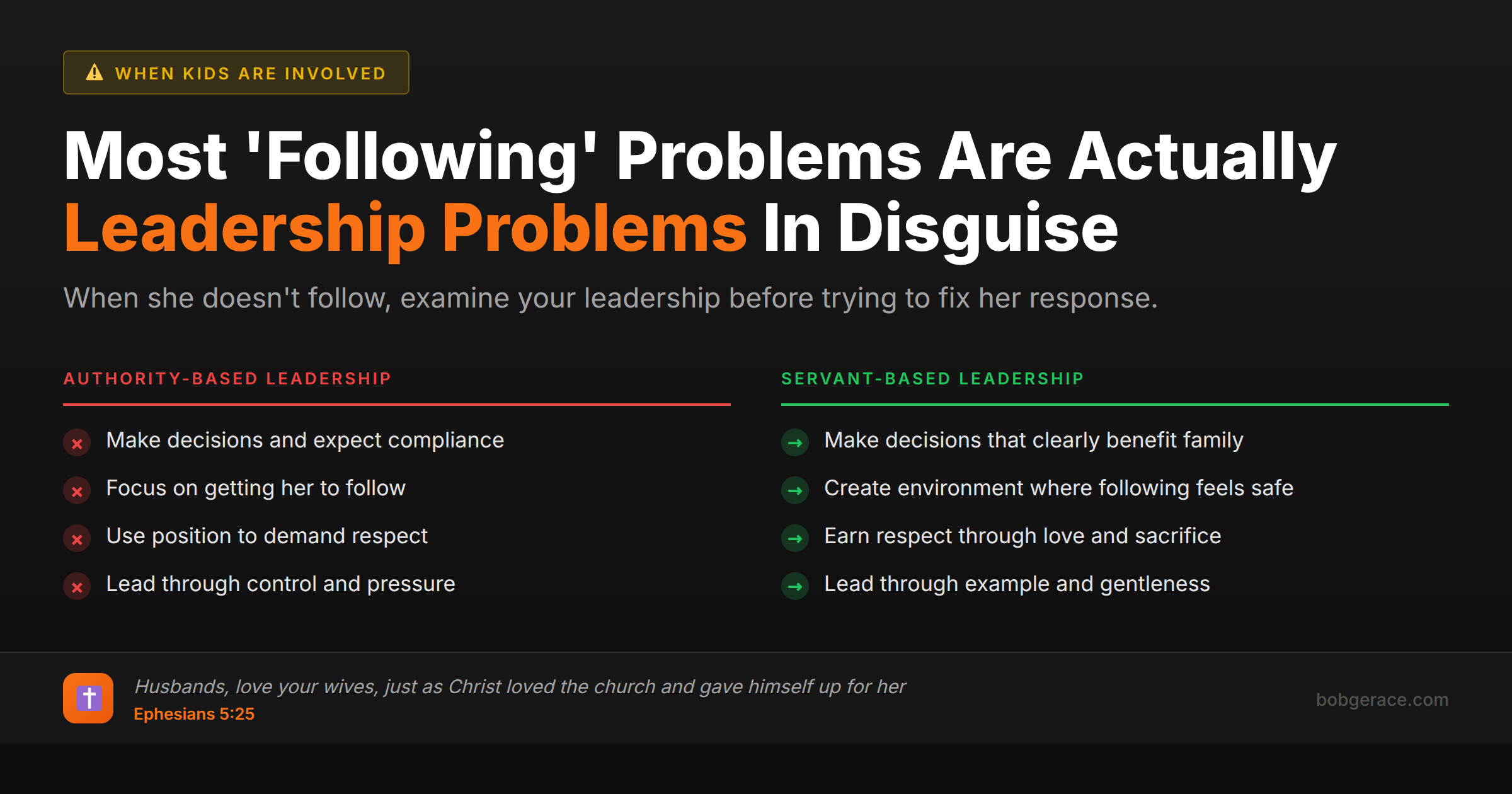
When your wife doesn't follow your lead, the first question isn't 'How do I make her follow?' but 'Am I leading in a way worth following?' Biblical leadership in marriage is about servant leadership - leading through love, sacrifice, and example, not authority or control. Most 'following' problems are actually leadership problems in disguise. Start by examining your own leadership style. Are you leading with gentleness and respect? Are you making decisions that clearly benefit your family? Are you listening to her input and concerns? True biblical leadership creates an environment where following feels safe and wise, not forced or fearful.
The Full Picture
Let's get real about this situation. You're frustrated because you feel like you're trying to lead your family biblically, but your wife isn't getting on board. Maybe she questions your decisions, resists changes you want to make, or just seems to ignore your attempts at leadership altogether.
Here's what's usually happening: Most men approach biblical leadership like they're the CEO of Marriage Inc. They make decisions, announce them, and expect compliance. When their wife doesn't fall in line, they assume she's being rebellious or unsubmissive. But that's not how biblical leadership works in marriage.
Biblical leadership is influence, not authority. You can't force someone to follow - you can only create conditions where following makes sense. Think about leaders you've respected in your life. Did you follow them because they had a title, or because they earned your trust and respect?
Your wife is your partner, not your employee. She has her own relationship with God, her own wisdom, and her own concerns about your family's direction. If she's not following, there's usually a good reason. Maybe your leadership style feels harsh or dismissive. Maybe you're not including her in the decision-making process. Maybe she doesn't trust that your decisions have her best interests at heart.
The goal isn't blind obedience - it's unity. God designed marriage to be a partnership where two people become one. That requires both leadership and followership to be rooted in love, respect, and mutual consideration. When your wife struggles to follow, it's often because something in that dynamic is broken.
What's Really Happening
From a clinical perspective, resistance to leadership in marriage often stems from attachment and trust issues rather than defiance. When a wife doesn't follow her husband's lead, we typically see one of several underlying dynamics.
First, there may be a breakdown in emotional safety. If previous leadership attempts felt controlling, dismissive, or harmful, the wife's nervous system learns to resist as a protective mechanism. This isn't conscious rebellion - it's neurobiological self-preservation.
Second, we often discover communication patterns that create disconnection rather than unity. Husbands may present decisions as ultimatums rather than invitations to partnership. This triggers fight-or-flight responses rather than cooperation. The brain interprets authoritarian leadership as a threat to autonomy and dignity.
Third, many couples struggle with unclear expectations around biblical roles. Without explicit conversations about what leadership and submission look like in their specific marriage, both partners operate from assumptions that may be completely different.
Finally, past trauma or family-of-origin patterns significantly impact how both partners approach authority and submission. A wife who grew up with an abusive or absent father may have deep-seated reactions to male leadership that have nothing to do with her current husband's character.
The solution involves rebuilding emotional safety, improving communication patterns, and addressing underlying attachment wounds. True biblical leadership in marriage requires emotional intelligence, not just biblical knowledge.
What Scripture Says
Scripture gives us a clear model for leadership in marriage, but it's radically different from worldly authority structures.
Ephesians 5:25-28 sets the standard: *"Husbands, love your wives, just as Christ loved the church and gave himself up for her... In this same way, husbands ought to love their wives as their own bodies."* Christ's leadership of the church is characterized by sacrifice, not domination. He leads by serving, protecting, and giving His life for those He leads.
1 Peter 3:7 commands husbands to *"live with your wives in an understanding way, showing honor to the woman as the weaker vessel, since they are heirs with you of the grace of life."* Leadership requires understanding - you can't lead someone you don't understand. It also requires honor - treating your wife with dignity and respect.
Philippians 2:3-4 applies to marriage leadership: *"Do nothing out of selfish ambition or vain conceit. Rather, in humility value others above yourselves, not looking to your own interests but each of you to the interests of the others."* Biblical leadership is others-focused, not self-serving.
Proverbs 27:5-6 reminds us that *"Better is open rebuke than hidden love. Wounds from a friend can be trusted."* Sometimes your wife's resistance is actually a gift - she may see blind spots or dangers you've missed. A wise leader listens to feedback.
Matthew 20:25-26 shows how Jesus redefined leadership: *"You know that the rulers of the Gentiles lord it over them... Not so with you. Instead, whoever wants to become great among you must be your servant."*
What To Do Right Now
-
1
Stop trying to lead and start building relationship - spend intentional time listening to your wife's concerns and perspectives without trying to fix or change anything
-
2
Ask your wife directly: 'What would make it easier for you to trust my leadership?' and listen without getting defensive
-
3
Examine your recent leadership decisions - were they made with her input, or were they announcements you expected her to accept?
-
4
Start leading in small, servant-hearted ways that clearly benefit her and your family without requiring her response or acknowledgment
-
5
Have an honest conversation about what biblical roles look like in your specific marriage - don't assume you're on the same page
-
6
If resistance continues, consider couples counseling to address deeper trust or communication issues that may be blocking unity
Related Questions
Also find Bob on
Subscribe for weekly videos on Christian marriage.
Leading Your Actual Marriage
You know the principle. Applying it to your specific dynamic—her history, your patterns, what's actually blocking trust—requires someone who sees your marriage, not just the concept.
Talk to Bob →