How do I earn the right to lead?
6 min read
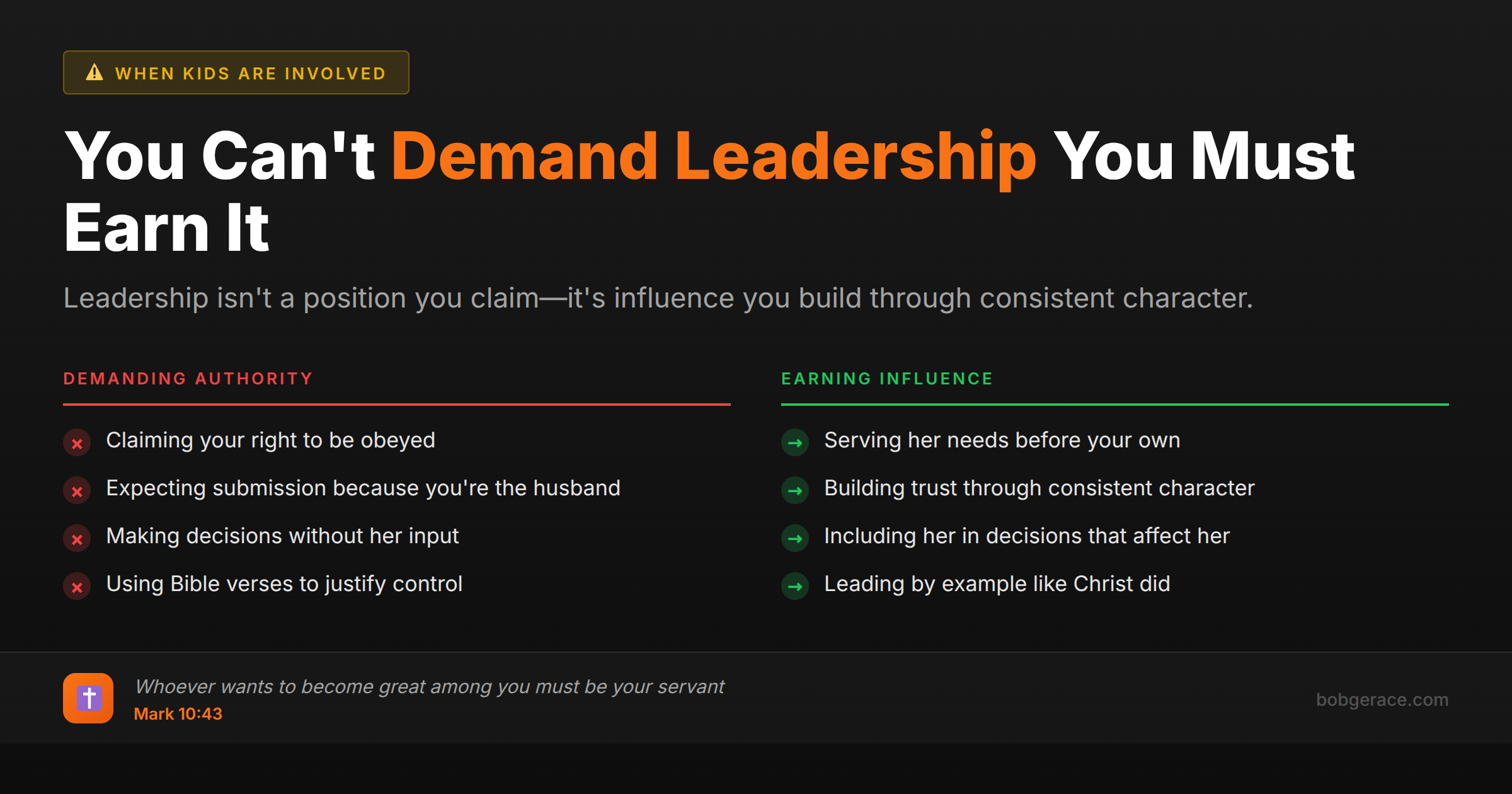
You earn the right to lead by serving first, not by demanding authority. Biblical leadership in marriage is modeled after Christ—who led by laying down His life for the church. Your wife needs to see consistent character, sacrificial love, and genuine care for her wellbeing before she'll trust your leadership. Leadership isn't a position you claim; it's influence you build through reliability, integrity, and putting her needs above your own. When you consistently demonstrate wisdom, emotional stability, and Christ-like love, you create an environment where she feels safe following your lead. This isn't about becoming perfect—it's about becoming trustworthy.
The Full Picture
Here's what most men get wrong about leadership in marriage: they think it's about being the boss. That's not biblical leadership—that's dictatorship, and it destroys marriages.
Real biblical leadership starts with this truth: you earn the right to lead by proving you can be trusted with that responsibility.
Think about it practically. Would you follow someone who's unreliable? Someone who makes decisions without considering how they affect you? Someone who demands respect but doesn't show it? Of course not. Neither will your wife.
The pathway to earning leadership looks like this:
First, you become a student of your wife. You learn what makes her feel loved, valued, and secure. You understand her fears, dreams, and daily challenges. Leadership without understanding is just control.
Second, you demonstrate consistency in the small things. You follow through on commitments. You manage your emotions well. You show up when life gets hard. Trust is built in drops and lost in buckets—so you protect what you're building.
Third, you put her wellbeing before your ego. When there's a decision to be made, you consider how it affects her first. When there's conflict, you're quick to take responsibility and slow to blame. When she needs support, you provide it without keeping score.
Here's the paradox: the more you serve, the more influence you gain. The more you put her needs first, the more she trusts your judgment. The more you lead like Christ—through love and sacrifice—the more she's willing to follow.
This isn't about becoming a doormat. It's about becoming the kind of man worth following. There's a huge difference between being weak and being humble, between being passive and being patient.
What's Really Happening
From a psychological perspective, leadership in intimate relationships is fundamentally about attachment security and trust-building. When a husband demands leadership without demonstrating trustworthiness, he triggers his wife's threat-detection system—the same neurological response that protects us from danger.
The neuroscience is clear: people follow those they perceive as safe and competent. Your wife's brain is constantly evaluating whether you're a source of security or threat. Every interaction either builds or erodes that perception.
Men often struggle with this because they confuse authority with influence. Authority is positional—it's given by title or role. Influence is relational—it's earned through consistent behavior that demonstrates care, competence, and character.
The most effective leaders in any context—including marriage—understand that leadership is a form of service. Research in organizational psychology shows that servant leaders create more trust, better outcomes, and higher satisfaction among those they lead.
In marriage therapy, I see this pattern repeatedly: husbands who focus on earning leadership through service create secure attachment bonds. Their wives feel emotionally safe, which paradoxically makes them more willing to trust their husband's judgment and direction.
The key is understanding that your wife's respect isn't something you can demand—it's something you earn through consistent demonstration of wisdom, emotional regulation, and genuine care for her wellbeing. When she feels truly cared for and valued, following your leadership becomes a natural response rather than a forced submission.
What Scripture Says
Scripture is crystal clear about how leadership works in marriage, but it's not what most men think.
Ephesians 5:25-26 sets the standard: "Husbands, love your wives, just as Christ loved the church and gave himself up for her to make her holy, cleansing her by the washing with water through the word." Notice what comes first—sacrificial love, not demanded submission.
Mark 10:43-44 shows Christ's leadership model: "Not so with you. Instead, whoever wants to become great among you must be your servant, and whoever wants to be first must be slave of all." Jesus earned the right to lead by serving first.
1 Peter 3:7 gives husbands specific instruction: "Husbands, in the same way be considerate as you live with your wives, and treat them with respect as the weaker partner and as heirs with you of the gracious gift of life, so that nothing will hinder your prayers." Leadership starts with consideration and respect.
Philippians 2:3-4 defines the heart attitude: "Do nothing out of selfish ambition or vain conceit. Rather, in humility value others above yourselves, not looking to your own interests but each of you to the interests of the others."
1 Timothy 3:4-5 connects family leadership with spiritual maturity: "He must manage his own family well and see that his children obey him, and he must do so in a manner worthy of full respect." The key phrase is "worthy of full respect"—respect that's earned, not demanded.
Luke 22:26 reinforces servant leadership: "But you are not to be like that. Instead, the greatest among you should be like the youngest, and the one who rules like the one who serves."
The pattern is unmistakable: biblical leadership is earned through service, demonstrated through love, and maintained through humility.
What To Do Right Now
-
1
Start serving in small, consistent ways—take over a chore she handles, bring her coffee, ask about her day and actually listen
-
2
Study your wife like you'd study for an important exam—learn her love language, her stress signals, what makes her feel valued and secure
-
3
Take full ownership of your mistakes without deflecting blame—apologize specifically and change your behavior, not just your words
-
4
Make decisions with her wellbeing as your primary consideration—ask 'How will this affect my wife?' before choosing your course of action
-
5
Demonstrate emotional stability by managing your reactions—stay calm under pressure, respond thoughtfully instead of reacting defensively
-
6
Create regular opportunities to discuss decisions together—show her that her input matters and that you value her wisdom and perspective
Related Questions
- What is 'servant leadership'?
- What does Christ's leadership model for husbands?
- What does initiating look like vs. dominating?
- How do I lead without demanding submission?
- What is 'sacrificial headship'?
- What's the difference between authority and authoritarianism?
- How do I become a man worth choosing without competing?
- What does rebuilding trust as a leader require?
- What does humble leadership look like?
- How do I reclaim authority I gave away?
Also find Bob on
Subscribe for weekly videos on Christian marriage.
You Don't Have to Figure This Out Alone
Leading well in your marriage means knowing what to do in your specific situation—not just the theory. A coach who knows your story can help you see what you're missing and calibrate your next move.
Talk to Bob →